If you lead revenue, marketing or growth at a B2B company and need to pick the right attribution model, the short answer is this: use single-touch attribution when your sales cycle is short and one interaction really does the work, and use multi-touch attribution when several people and multiple touchpoints sit between first contact and a closed deal. For the full picture, read our complete guide to revenue intelligence.
Most B2B teams with long sales cycles end up with a multi-touch attribution model as the main view and a single-touch attribution model as a cross-check. The attribution model matters less than agreeing on one, writing down why, and knowing where it misleads.
This article is for CEOs, CROs and marketing leaders who are tired of reports that disagree. You will get a plain definition of each approach for digital marketing and sales teams, a comparison on the same criteria, a worked example, and rules for choosing a marketing attribution model.
|
Single-Touch Attribution Single-touch attribution is a model that gives 100% of the credit for a conversion or closed deal to one interaction, usually the first or the last one in the buyer's journey. |
|
Multi-Touch Attribution Multi-touch attribution is a model that splits the credit for a conversion or closed deal across several interactions in the buyer's journey, using a rule such as equal shares, position or recency. |
Marketing attribution decides who gets credit for a closed deal
Marketing attribution is the practice of deciding how to assign credit for a conversion to the marketing touchpoints that came before it. Those touchpoints include marketing campaigns, emails, events and visits from different marketing channels such as organic search.
An attribution model is the rule that divides the credit. Different attribution models give different answers about marketing performance and marketing effectiveness, even when they describe the same customer interactions. That is why the choice matters before any report is built. Marketing attribution matters most to B2B teams because the sales cycle is long and the credit is contested.
Single-touch attribution models give one interaction all the credit
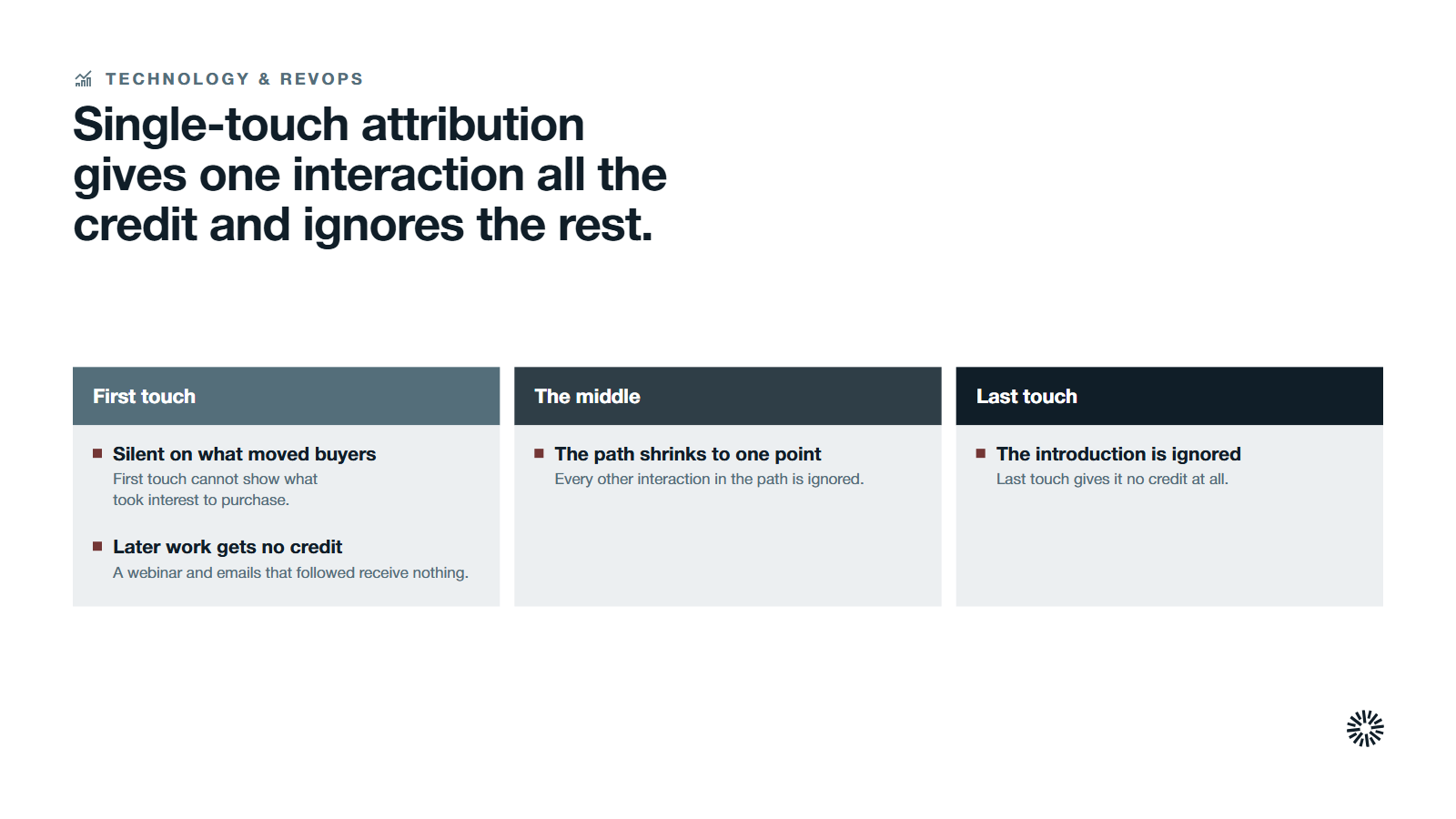
A single-touch attribution model picks one interaction to assign credit to and ignores the rest. Two versions are common. The first touch attribution model, also called a first click attribution model, credits the interaction that introduced the buyer. The last touch attribution model, also called a last click attribution model, credits the interaction that came just before the conversion.
HubSpot's own report builder calls these First Interaction and Last Interaction. Its attribution report definitions say each one "attributes 100% of the contact credits" to that single interaction in the conversion path.
The first touch attribution model rewards the start of the customer journey
First touch attribution answers one question: which marketing channels bring new buyers into your customer journey? If a buyer first arrived through organic search, that visit receives all the credit, even if a webinar and three emails followed.
It suits demand creation questions. It says nothing about what moved the buyer from interest to purchase.
The last touch attribution model rewards the final step before the sale
Last touch attribution gives all the credit to the last interaction before the conversion. It is simple, and many tools start with it. It is useful for driving conversions in short, direct response programs.
Google Analytics describes a close relative. Its attribution help page says the paid and organic last click model ignores direct traffic and gives all the credit to the last channel the customer clicked through.
Why teams still choose a single-touch attribution model
A single-touch attribution model is easy to explain and easy to audit. You can check any credited interaction in a minute. It needs little data collection effort, so it suits a young CRM or a small marketing strategy.
It also answers narrow questions well, such as which marketing channels bring in new demand. The first touch attribution model shows which channels introduce new buyers. The last touch attribution model shows which channels sit closest to the decision.
Multi-touch attribution models share credit across the customer journey
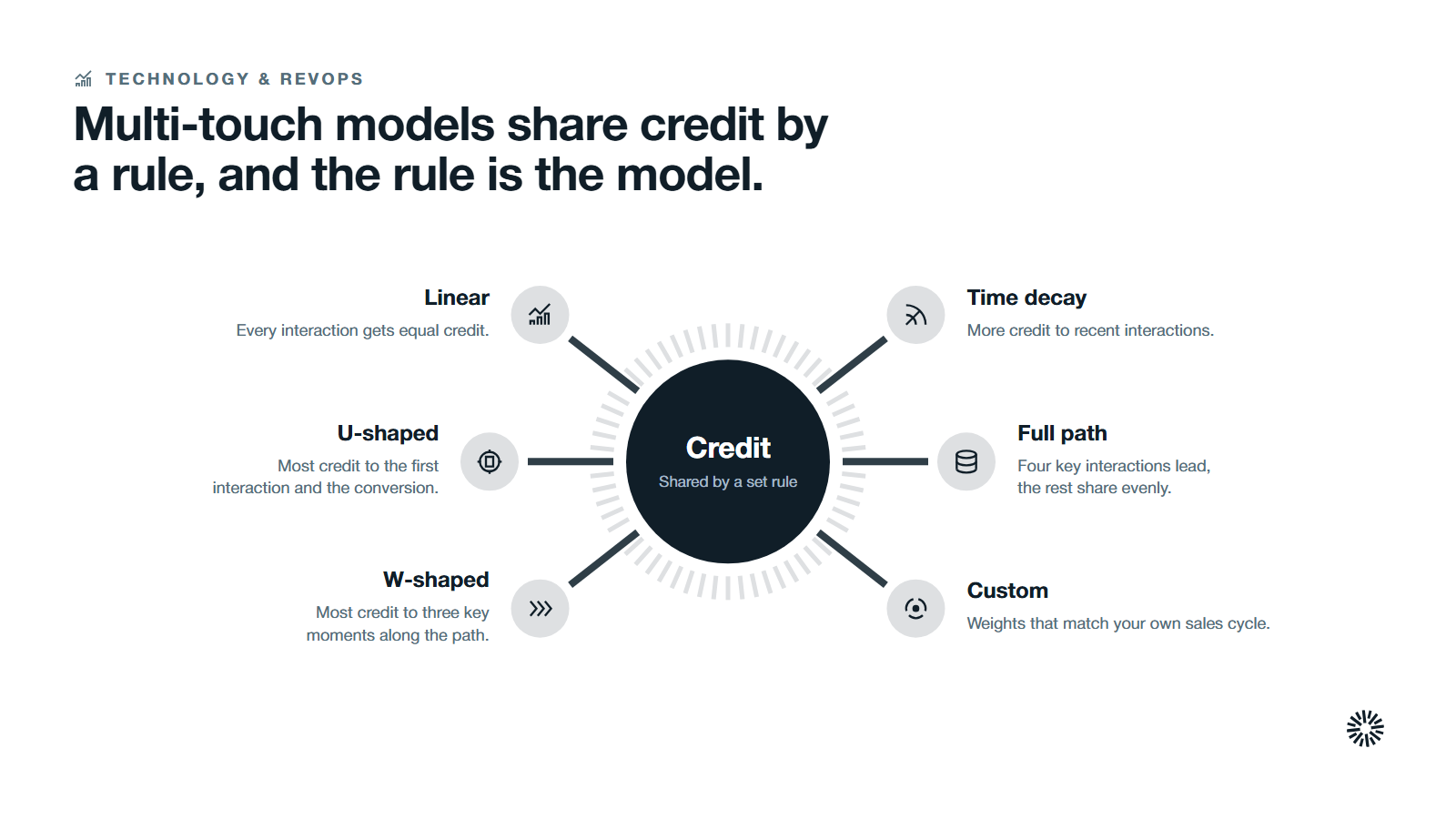
A multi-touch attribution model gives each interaction in the conversion path a defined share of the credit. The rule for sharing is the model. Change the rule and the same revenue is divided differently.
Multi-touch attribution captures non-linear customer journeys, where one buyer has multiple interactions across email, events, content and sales calls. It can reveal common paths to conversion, which touchpoints are driving conversions, the influential touchpoints along them, and how different marketing channels work together. It measures campaign performance beyond last-click models and gives insights into the effectiveness of various marketing channels, which can help you decide where budget optimization is worth the effort.
These are the multi-touch attribution models most B2B teams meet. HubSpot's report definitions describe them this way:
- Linear gives every interaction equal credit.
- U-shaped gives 40% each to the first interaction and the lead conversion, and spreads the remaining 20% evenly across the others.
- W-shaped gives 30% each to the first interaction, the interaction that created the contact and the last interaction that created the deal, and spreads 10% across the rest.
- Time decay gives more credit to recent interactions, using a 7-day half-life.
- Full path gives 22.5% each to four key interactions and spreads the remaining 10% evenly across the others.
The linear attribution model is the easiest multi-touch place to start
The linear attribution model assigns equal credit to every interaction. It avoids arguments about weights because there are none. Its weakness is the same: a quick email open counts as much as a demo.
Position-based and time decay attribution models encode a belief
Position based attribution, such as U-shaped attribution, gives the most credit to two moments. The time decay attribution model gives the most credit to the newest interactions. Any marketing attribution model that weights positions expresses a belief about what matters. That belief may be right for your business, but it is a rule, not a measurement.
A custom attribution model sets weights that match your own sales cycle
A custom attribution model lets a team define its own shares for its own stages of the customer journey. It can fit a long sales cycle better than a generic rule. It also needs more care, because every weight is a decision you must be able to defend.
A worked example with illustrative numbers
Take a deal worth 100,000 in revenue. The buyer reads a blog post, attends a webinar, submits a demo request and returns to the pricing page before signing. These figures are arithmetic for illustration, not results from any company.
Under first-touch, the blog post gets 100,000. Under last-touch, the pricing page does. Under linear, each of the four gets 25,000.
Under U-shaped attribution, the blog post and the demo request get 40,000 each, and the webinar and pricing page get 10,000 each. Four models, four stories, one deal.
Single-touch and multi-touch attribution compared on the same criteria
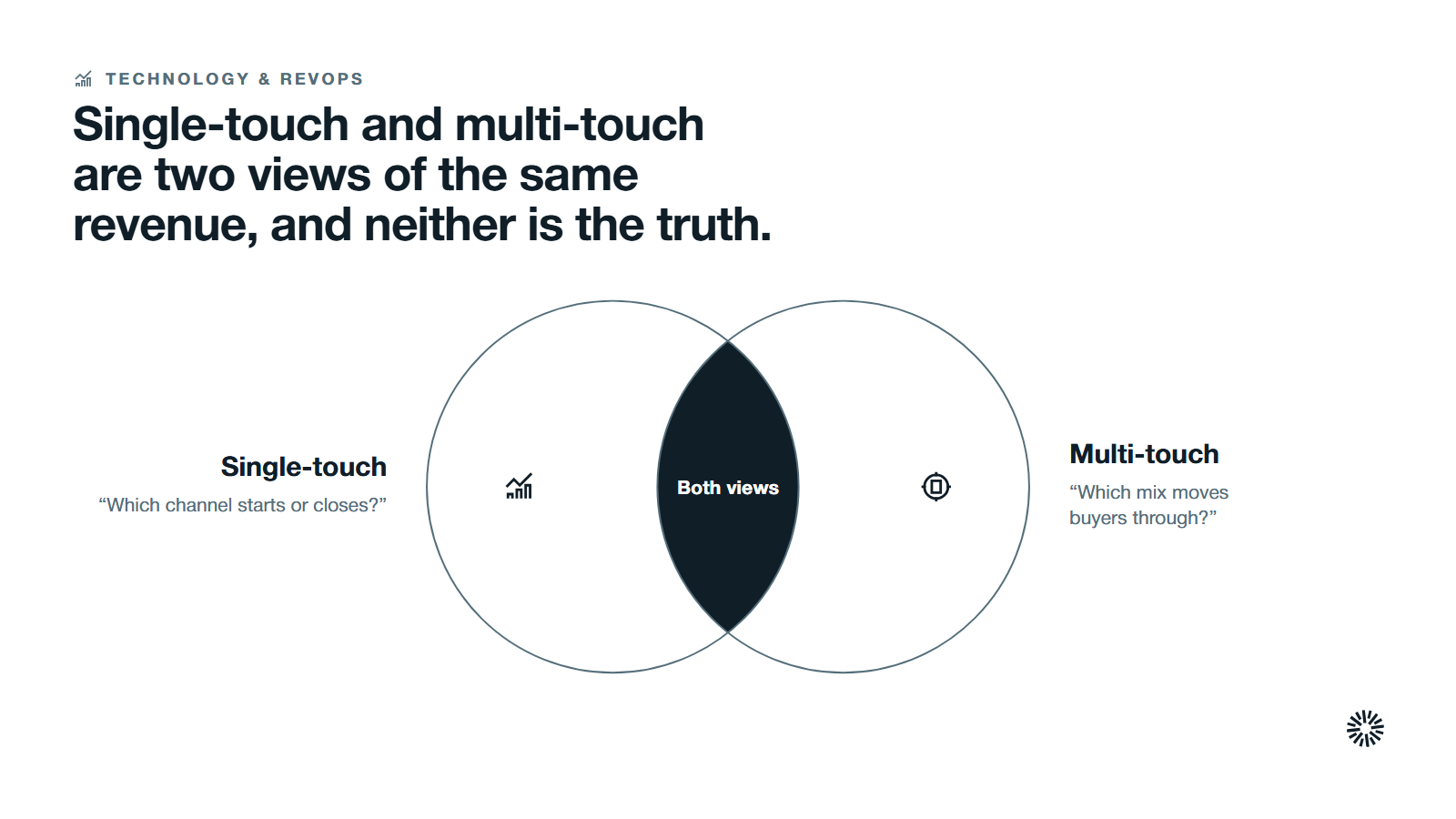
Both approaches describe the same revenue. They differ in how they assign credit, what they need and where they mislead. The last three rows are our reading, not a rule from any vendor.
| Criterion | Single-touch attribution | Multi-touch attribution |
|---|---|---|
| What it credits | One interaction, first or last | Several interactions, by a sharing rule |
| Data needed | A source for the chosen interaction | Tracked interactions linked to contacts and deals |
| Effort to audit | Low: check one record | Higher: check the whole path and the rule |
| Where it misleads | Ignores everything outside the one interaction | Looks precise, but the weights are a rule, not a measurement |
| Strongest fit | Short cycles and narrow questions | Long cycles with many interactions and several buyers |
| Best question to ask | Which channel starts or closes deals? | Which mix of work moves buyers through? |
Neither column is the truth. Both are views on the same data, and the honest use of either is to ask what the view cannot see.
Which attribution models can you use in Google Analytics and HubSpot?
Your analytics tools limit your marketing attribution choices, so check them before you debate theory. Google Analytics describes three models in its attribution reports: data-driven, paid and organic last click, and Google paid channels last click, which credits the last Google Ads channel the customer clicked through before converting. Its help page says data-driven attribution distributes credit based on data for each key event.
The same page adds that the first click, linear, time decay and position-based models are no longer available in Google Analytics reports as of November 2023.
HubSpot's report builder offers the first interaction, last interaction, linear, U-shaped, W-shaped, time decay and full path models. It notes that W-shaped and full path give no value when a deal was created before its associated contacts, so check your create dates.
Where each model misleads a B2B team with a long sales cycle
Long B2B cycles break single-touch attribution models first. Forrester's State of Business Buying 2024 reports that on average 13 people within an organization are involved in the buying decision, with 89% of purchases involving two or more departments.
With that many people and multiple touchpoints, no single interaction explains a deal. A first-touch view credits the article one person read. A last-touch view credits the form another person filled in. Neither sees the other people or gives a complete picture.
Multi-touch attribution models mislead in a different way. They can only weight what was recorded, so customer behavior outside your tracking never appears in the path. A podcast, a peer recommendation or a private chat is missing, and the model quietly gives its credit to something else. Our guide to the dark funnel covers what attribution cannot see.
Use attribution to guide resource allocation, not to settle blame
When marketing and sales argue over credit, the argument is usually about resource allocation, and about which marketing efforts deserve more of it. Treat the attribution model as one input to marketing spend decisions, and compare multiple attribution models over several quarters before you move money on the strength of one.
How to choose a marketing attribution model for a long sales cycle
Choosing a marketing attribution model has no single best answer for every company. Choose by the shape of your sales cycle, your business goals and the quality of your data, not by which model sounds more advanced. These rules are our reading and are meant to be argued with.
If your sales cycle is short and one person decides, start with single-touch
When a buyer moves from first contact to signature in a few interactions, a single-touch attribution model captures most of the story. Pick last touch for direct response programs and first touch for demand creation.
If several people and many interactions precede a deal, use multi-touch
Long cycles with buying groups need the credit shared. Start with an equal-share attribution model to avoid arguing about weights, then test a position-based model once the path data is trustworthy. Cross-channel attribution of this kind is where multi-touch earns its extra effort.
If your data is thin, do not buy precision you cannot feed
A multi-touch attribution model on patchy tracking gives confident answers built on gaps. Fix the tracking and the contact-to-deal links first. Our guide to CRM data quality shows what to clean.
If leaders argue about credit, show two models side by side
Report one single-touch and one multi-touch view of the same quarter. Where they agree, act. Where they disagree, you have found the question to investigate. Comparing different attribution models in this way supports data-driven decisions without pretending one view is final.
What you need in place before multi-touch attribution gives a fair answer
Marketing attribution needs a recorded path. Without these foundations, the attribution model has nothing honest to divide. Data accuracy matters more than the choice of rule, because accurate data is what every model divides. Data accuracy issues lead to misattribution, and data availability limits which models are even worth running.
- Every meaningful interaction in the customer journey is tracked against a contact, including email, events and sales activity.
- Contacts are associated with the deals they influenced, which depends on data integration, meaning integrating data across your CRM, website and email tools.
- Source and campaign fields are filled in the same way by every team.
- Historical data is kept in your analytics tools, so you can compare models on past quarters.
- Deal create dates and contact create dates are in a sensible order.
- One owner is accountable for the attribution model and its definitions.
For the wider reporting picture, see our guide to marketing data analytics, and our explanation of revenue attribution for how credit connects to closed revenue.
What you gain when this is done properly
When the marketing attribution model matches the sales cycle and the data behind it, attribution stops being an argument and becomes a shared reference for digital marketing and sales alike.
Sales gets credit that reflects the work it did
Sales sees which earlier customer interactions prepared a buyer along the customer journey, and can ask marketing for more of the content that helped, instead of hearing that last touch explains everything.
Marketing gets a clearer view of its marketing mix and marketing efforts
Marketing can show how its marketing efforts and marketing campaigns across the funnel contributed alongside the final interaction, and can compare channels on the same basis each quarter to shape its marketing strategy.
Customer success gets a clearer picture of what buyers expected
Interactions earlier in the customer journey show what customers were promised and which content they trusted. Customer success can carry that context into onboarding and use it to understand customer behavior.
Pick one attribution model, write down why, and revisit it each quarter
The real choice is not single-touch against multi-touch. It is whether you can explain what your marketing attribution model credits, what it ignores and what you will do differently because of it.
Propello designs and builds connected go-to-market systems on HubSpot for CEOs and revenue leaders at growing B2B companies, including the tracking and reporting that attribution depends on.
If you want a second opinion on which attribution model fits your sales cycle and whether your data can support it, an audit is the place to start.