If you lead marketing or revenue at a B2B company that already runs inbound marketing, your inbound marketing funnel is the path from a website visitor to a paying customer. You improve it by naming five stages, giving each one a metric and a question, and reviewing them every week, month and quarter.
This article is for CEOs, founders, CROs and marketing leaders whose marketing and sales teams argue about lead quality, and for the marketing teams who feel the blame. You will get a definition, what good looks like at each stage, the formulas behind the metrics, a review routine, and the mistakes that quietly distort a funnel report.
|
Inbound Marketing Funnel An inbound marketing funnel is the sequence of stages a person moves through, from visitor to lead to qualified lead to customer, as helpful content and follow-up earn their attention instead of interrupting it. |
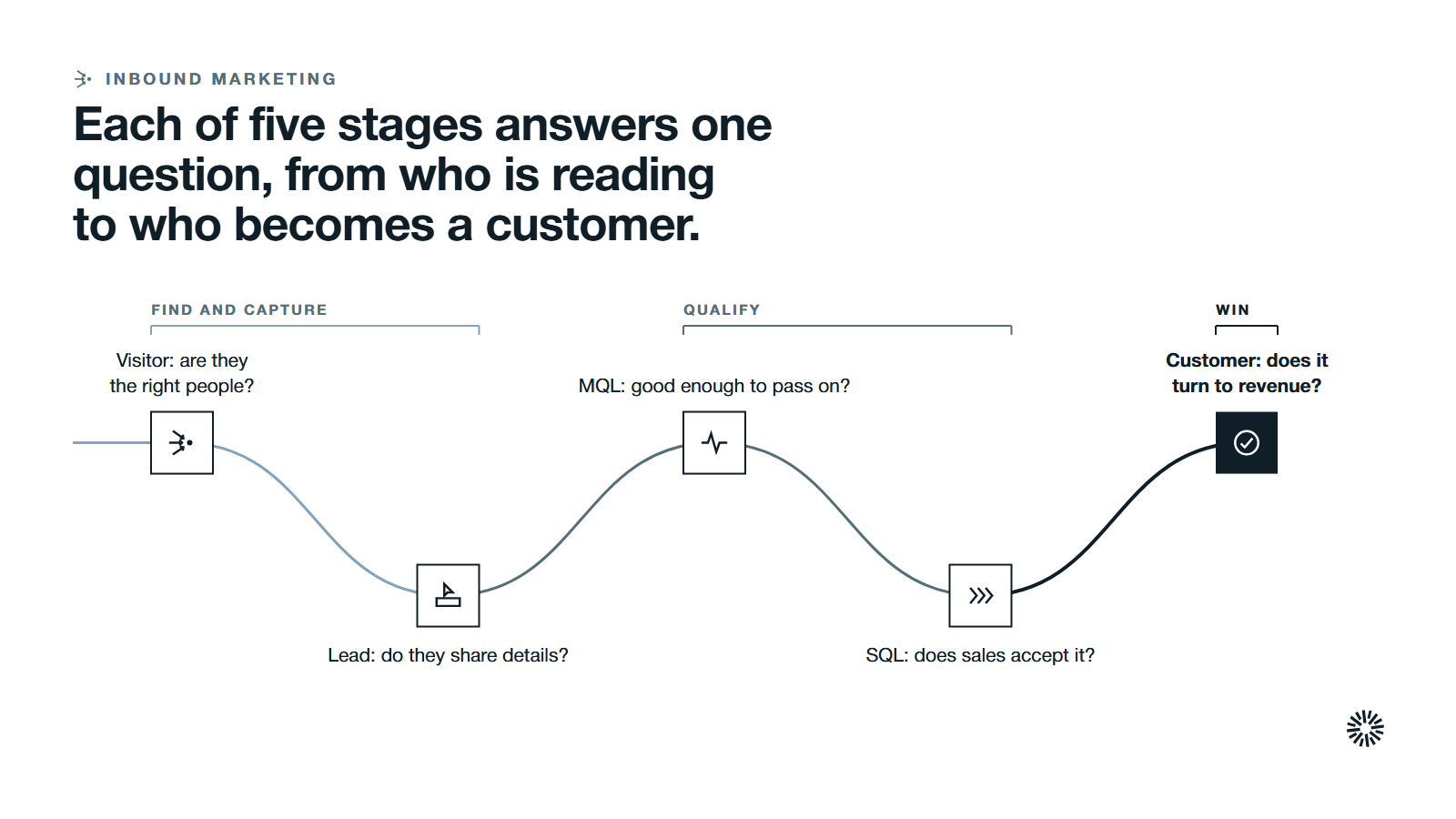
A healthy inbound marketing funnel has five stages that each answer one question
The inbound methodology draws people in with valuable content, then guides them toward a purchase. Inbound and outbound marketing differ in who starts the conversation.
Traditional outbound methods, such as cold calls and direct mail, reach out to people who never asked to hear from you. Our guide to what inbound marketing is covers the method. This article covers how to review the funnel it produces.
The funnel is a simplified view of the buyer's journey. Real buyers loop back, skip stages and arrive in groups. The inbound funnel still earns its place, because it lets you ask one clear question per funnel stage.
A classic sales funnel starts when a lead reaches sales. An inbound funnel starts earlier, with the website visitor, and it is a core part of digital marketing for B2B teams.
| Stage | The question it answers | The metric to watch |
|---|---|---|
| Visitor | Are the right people finding and reading us? | Engagement rate on key pages |
| Lead | Do visitors hand over their details? | Visitor-to-lead rate |
| Marketing qualified lead | Are leads good enough to pass on? | Lead-to-MQL rate |
| Sales qualified lead | Does sales accept what marketing sends? | MQL-to-SQL rate |
| Customer | Do qualified leads turn into revenue? | SQL-to-customer rate and acquisition cost |
A second meaning of the word deserves a note. "Marketing funnel" also covers paid and outbound programs. This article stays with the inbound kind, where the visitor arrives through search engines, social media and content.
What good looks like at each stage of the funnel
Good does not mean a number copied from another company. It means each stage has a clear definition, an owner, a trend you can read and a handoff that both teams accept.
Visitor: the right people arrive and stay
At the top of the funnel, you want visitors who match your buyer personas, not just more visitors. Look at which pages draw them, what they search for, and whether they stay.
Google Analytics defines an engaged session as one that lasts longer than 10 seconds, has a key event, or has two or more page or screen views. Its engagement rate help page says engagement rate is the percentage of engaged sessions. Google Search Console adds impressions and clicks from search, defined on its performance help page.
Lead: a visitor becomes a known contact
A lead is a person who gave you contact details by filling in a form on a landing page. The signs of health are steady form completion on pages with a clear offer and a record that keeps its source.
HubSpot's lifecycle stage guide defines a lead as a contact that has converted on your website or through some other interaction beyond a subscription sign-up. A subscriber is a separate, earlier stage.
Marketing qualified lead: marketing says this person is ready
A marketing qualified lead, or MQL, is a lead your marketing team has judged ready for sales. The test of a good definition is that it rests on fit and behavior you can write down, not on a gut feel. Quality leads, not only converting leads, are the goal.
Lead scoring is the usual tool. HubSpot's guide to building lead scores describes fit scores based on property values and engagement scores based on events. Our guide to building a lead scoring model shows how to make one that sales will use.
Sales qualified lead: sales accepts the handoff
A sales qualified lead, or SQL, is a contact your sales team has qualified as a potential customer. In HubSpot, the Lead Status property holds the sub-stages inside that lifecycle stage, so sales can record what happens next.
This stage is where the inbound sales process and marketing most often disagree. Our guide to MQL vs SQL explains how to set the handover so both sides can defend it.
Customer: the bottom of the funnel is revenue, then retention
HubSpot defines a customer as a contact or company with at least one closed deal. This is the stage the others exist for.
Keep going past the first sale. Existing customers who renew, expand or refer others, including brand advocates, are the cheapest growth you have, and they are the reason the funnel is worth fixing.
How inbound marketing efforts feed each funnel stage
Content and channels do different jobs at different stages. Content mapping aligns each piece with the awareness, consideration or decision stage of the buyer's journey, and it exposes gaps in your marketing strategy. Match the job to the stage before you judge the result.
At the top of the funnel, content should create awareness. Blog posts, educational videos, search engine optimization and social media posts reach people who are actively searching or actively seeking solutions. Relevant content that names their pain points earns the visit.
Paid ads can add reach through other marketing channels, but they sit beside the inbound marketing process, not inside it.
In the middle, whitepapers, case studies, targeted content and landing pages turn interest into lead generation. The middle of the funnel focuses on converting visitors into leads. Marketing automation can nurture leads with follow-up that matches what each person read, so prospects engage when they are ready. For the full picture, read our complete guide to inbound lead generation.
The bottom of the funnel aims to close deals with qualified leads. Buyers weigh options in their purchasing process, and product demos, customer testimonials, clear comparisons and a fast reply from sales reps help.
After the sale, onboarding, support and feedback loops turn customers into advocates. The funnel narrows as people move down it, so the audience shrinks while lead quality rises.
The inbound marketing funnel metrics, with the formula behind each one
These key metrics need only simple data analysis and give your optimization process something to act on.
Calculate each one from the same date range and the same stage definitions. The arithmetic below uses one invented month and is illustrative, not a benchmark: 10,000 sessions, 6,000 engaged sessions, 300 leads, 90 MQLs, 45 SQLs, 9 customers and $18,000 of marketing and sales cost.
Engagement rate
Engagement rate tells you whether top-of-the-funnel traffic is the kind that reads and acts.
Formula: engagement rate = engaged sessions / sessions x 100
Illustrative arithmetic: 6,000 / 10,000 x 100 = 60%.
Visitor-to-lead rate
This is the conversion rate of the awareness stage into the consideration stage.
Formula: visitor-to-lead rate = new leads / sessions x 100
Illustrative arithmetic: 300 / 10,000 x 100 = 3%.
Lead-to-MQL rate
This rate shows whether the leads you generate are the leads you want.
Formula: lead-to-MQL rate = MQLs / leads x 100
Illustrative arithmetic: 90 / 300 x 100 = 30%.
MQL-to-SQL rate
A low rate means marketing and sales disagree on what qualified means. A very high rate can mean the MQL bar is too strict.
Formula: MQL-to-SQL rate = SQLs / MQLs x 100
Illustrative arithmetic: 45 / 90 x 100 = 50%.
SQL-to-customer rate
This rate shows whether sales converts the leads it accepted.
Formula: SQL-to-customer rate = new customers / SQLs x 100
Illustrative arithmetic: 9 / 45 x 100 = 20%.
Customer acquisition cost
Customer acquisition cost is what it takes, in marketing and sales spend, to win one customer.
Formula: customer acquisition cost = total marketing and sales cost / new customers
Illustrative arithmetic: $18,000 / 9 = $2,000.
Time in stage
Speed matters as much as rates. HubSpot records a Date entered and a Date exited for each lifecycle stage, plus the time spent in it, according to its lifecycle stage guide. Use them to find where leads wait.
For a wider list of measures, see our guide to inbound marketing metrics. To tie these numbers to revenue, see how to measure inbound marketing ROI.
Read every funnel stage as one chain, not five separate numbers
Two ratios from the same illustrative month show why. Leads to customers is 9 / 300 x 100 = 3%. Sessions to customers is 9 / 10,000 x 100 = 0.09%.
Now improve one stage. If lead-to-MQL rises from 30% to 40% with everything else unchanged, MQLs become 120, SQLs 60 and customers 12. That is arithmetic, not a forecast. Better stages compound, which is why you should fix the weakest handoff first.
HubSpot can draw this for you. Its custom funnel report shows conversion rates between lifecycle stages. It uses the built-in Lifecycle stage property, so custom properties cannot serve as funnel steps.
A weekly, monthly and quarterly routine keeps the inbound marketing process honest
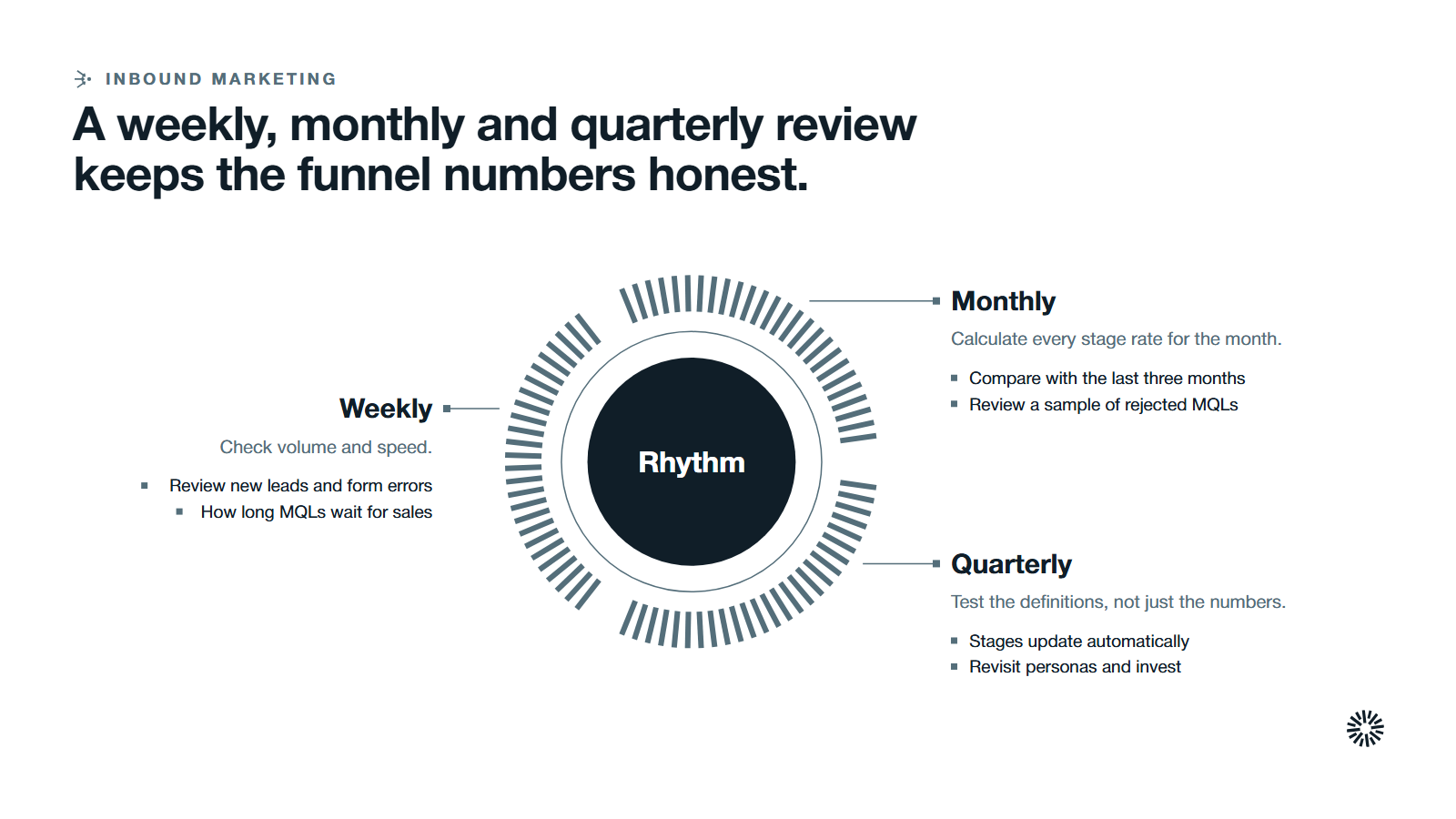
Small reviews on a fixed schedule beat a big rebuild after a bad quarter.
Weekly
Check volume and speed. Review new leads, form errors, and how long MQLs wait before sales acts. Open the sources of the week's best and worst leads, and confirm tracking still works on key landing pages.
Monthly
Calculate every stage rate for the month and compare it with the last three months. Read the rates next to time in stage and look for the stage where the trend changed.
Sit down with the sales team and review a sample of rejected MQLs. Ask why each was rejected, then adjust lead scoring or the offer behind it.
Quarterly
Test the definitions, not just the numbers. Check that each stage still means what you wrote, that lifecycle stages update automatically, and that closed deals trace back to a first source.
Revisit your buyer personas, calculate customer acquisition cost and decide where to invest. Our guide to revenue attribution helps with the credit question. If your funnel logic feels outdated, our comparison of growth loops vs funnels and the marketing flywheel vs funnel debate help you choose a model.
Common funnel mistakes distort the numbers before anyone sees them
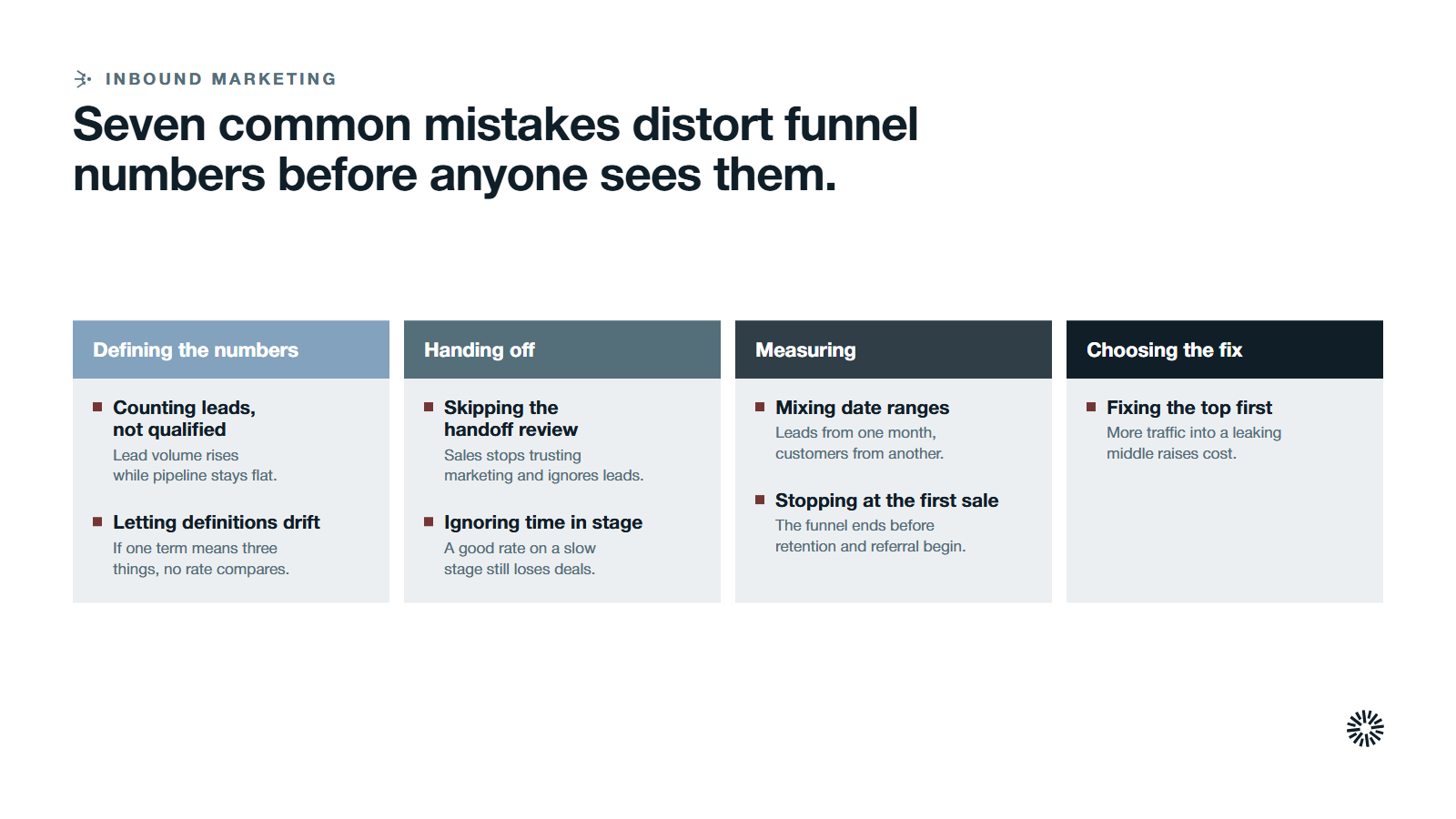
Most failures come from a few repeated mistakes.
- Counting leads, not qualified leads. Lead volume rises while pipeline stays flat.
- Letting definitions drift. If MQL means three things, no rate is comparable.
- Skipping the handoff review. Sales stops trusting marketing and ignores new MQLs.
- Ignoring time in stage. A good rate on a slow stage still loses deals.
- Mixing date ranges. Leads from March and customers from June make a rate meaningless.
- Stopping at the first sale. The funnel ends before retention and referral begin.
- Fixing the top first. More traffic into a leaking middle raises cost, not revenue.
What you gain when this is done properly
When every stage has a definition, a metric and a review date, the debate about lead quality becomes a conversation about numbers. Sales and marketing teams, and customer success, each gain something specific.
Sales gets leads worth calling
Sales reps receive contacts who match an agreed definition, with the source and history on the record. Follow-up time goes to people who are ready, and the sales process starts from context, not a cold call.
Marketing proves which work moves revenue
Marketing can show which content and channels produce qualified leads and customers, not only form fills. Budget moves toward what works, and leadership sees marketing efforts reported in revenue terms.
Customer success inherits better-informed customers
Customer success sees what each customer was promised and which content they read before buying. Onboarding starts where the buyer left off, which helps retention and gives you loyal customers who refer others.
Make the funnel part of your go-to-market system
An inbound marketing funnel is a set of agreements between marketing, sales and customer success, measured on a routine. Once the agreements hold, you have an effective inbound strategy: every stage answers one question, and you know where to act next.
Propello designs and builds connected go-to-market systems on HubSpot for CEOs and revenue leaders at growing B2B companies. If you want help defining lifecycle stages and reviewing your funnel, an audit is the place to start. Propello is a HubSpot partner, as our about page explains.