

If you run revenue, customer success or sales at a B2B company, the short answer is this: customer success owns whether customers reach the outcomes they bought for, and account management owns the commercial relationship, meaning the renewal and the expansion deal. Many companies need both jobs, and the real question is who holds each one at your size.
Customer success vs account management is mostly a question of ownership, not job titles. The two roles share accounts, customers and often a tool, and when nobody decides who owns the renewal, both teams assume the other one does.
This article is for CEOs, founders, heads of sales and customer success leaders who are deciding how to split post-sale work. You will get a plain definition of each role, a side-by-side comparison on the same criteria, how the split changes as a company grows, what breaks when it is unclear and decision rules by company stage.
|
Customer Success Customer success is a proactive discipline that helps customers reach their desired outcomes with your product or service, which protects renewals and creates the conditions for expansion and referrals. |
|
Account Management Account management is the practice of owning the commercial relationship with an existing customer, including renewals, contract changes and the sale of additional products or seats. |
Customer success owns the outcome the customer bought for
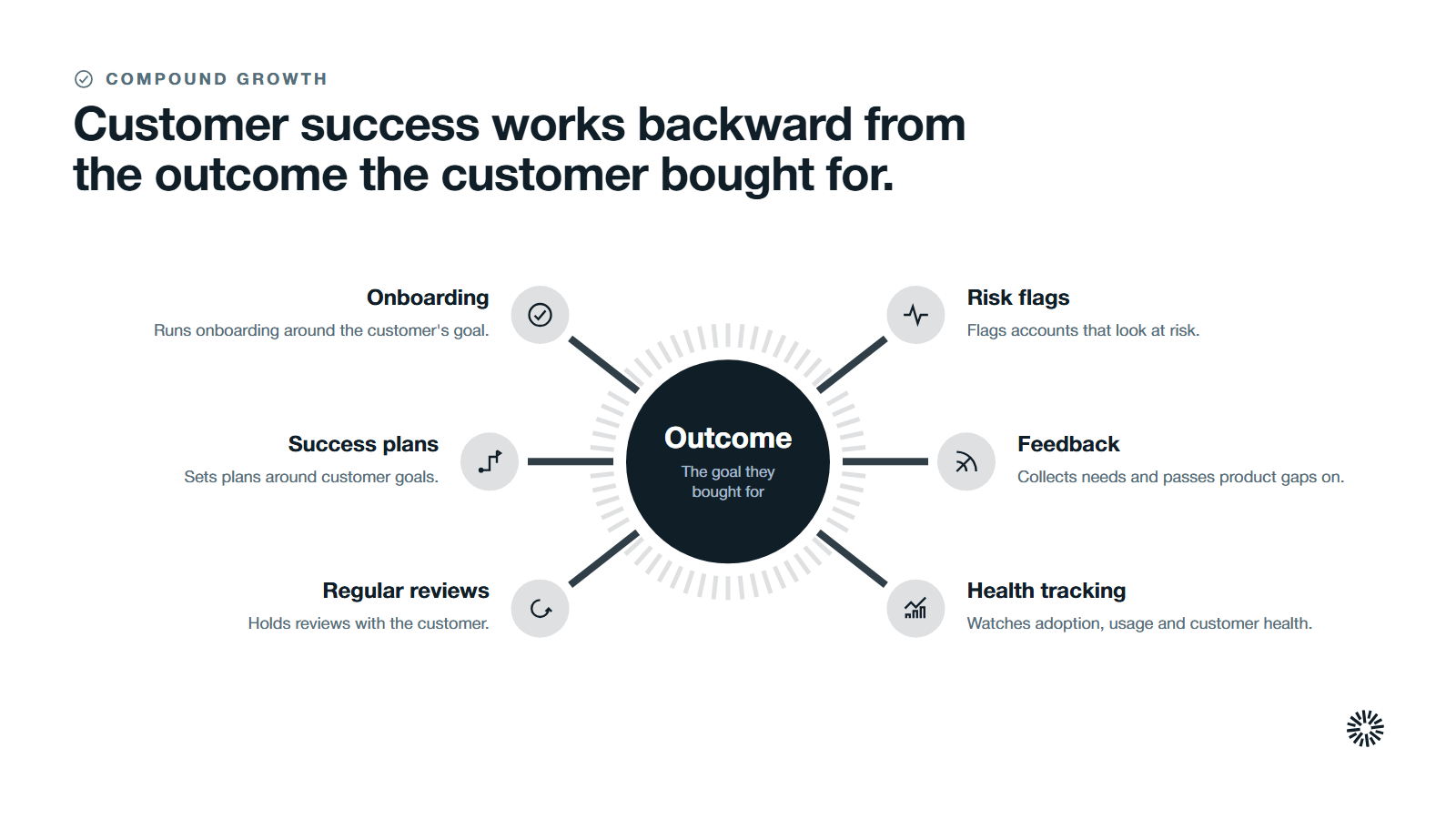
Customer success starts from the customer's goal and works backward. Proactive engagement tied to measurable outcomes is how the team keeps ensuring customers get the most value from the product, and it builds their long term success.
The team learns what the customer set out to achieve, checks whether the product is getting them there and steps in early when it is not. Our guide to what customer success is covers the discipline in full.
The work is proactive. A customer success manager watches product adoption, usage and customer behavior and acts on the signals before a customer raises a problem. Customer success focuses on value realization across the entire lifecycle, from onboarding to the renewal conversation and beyond.
Teams also need the machinery behind the role: health definitions, handoffs, playbooks and reporting. Our guide to customer success operations explains how that machinery is built and run.
What a customer success manager does day to day
A customer success manager runs onboarding, sets success plans around customer goals, holds regular reviews and flags accounts that look at risk. They also collect feedback on customer needs and pass product gaps to the people who can fix them.
Their output is a customer who uses the product well and keeps seeing ongoing value. Customer health is how they track it. Renewal is a result of that work, not the work itself. Other success managers, such as onboarding specialists, support the same customer journey.
Account management owns the commercial relationship
Account management treats each existing customer as a relationship to grow commercially. Account managers know the buying group, the contract, the budget cycle and the next decision. The account management role is to keep key customers buying and to find the next sale inside existing accounts.
In larger companies this is called key account management, and key account managers handle enterprise accounts.
That work is closer to sales than to service. It involves contract management, pricing, negotiation, procurement and timing, and it ends in a signed renewal or a signed expansion. Closing deals inside the account is part of the job, and so is spotting growth opportunities early. Strong relationship building with decision makers is part of the craft.
Account management is also where expansion revenue is earned. Our guide to expansion revenue explains the forms it takes and why it depends on healthy accounts.
What an account manager does day to day
Account managers map the people in the customer's organization, run account planning, track renewal dates and prepare the commercial case for each renewal. They spot new teams that could use more of the product, find cross sell opportunities and run the conversation to a close.
Their output is account growth: revenue retained and revenue added. Customer satisfaction matters to account managers because unhappy customers do not sign.
Customer success vs account management compared on the same criteria
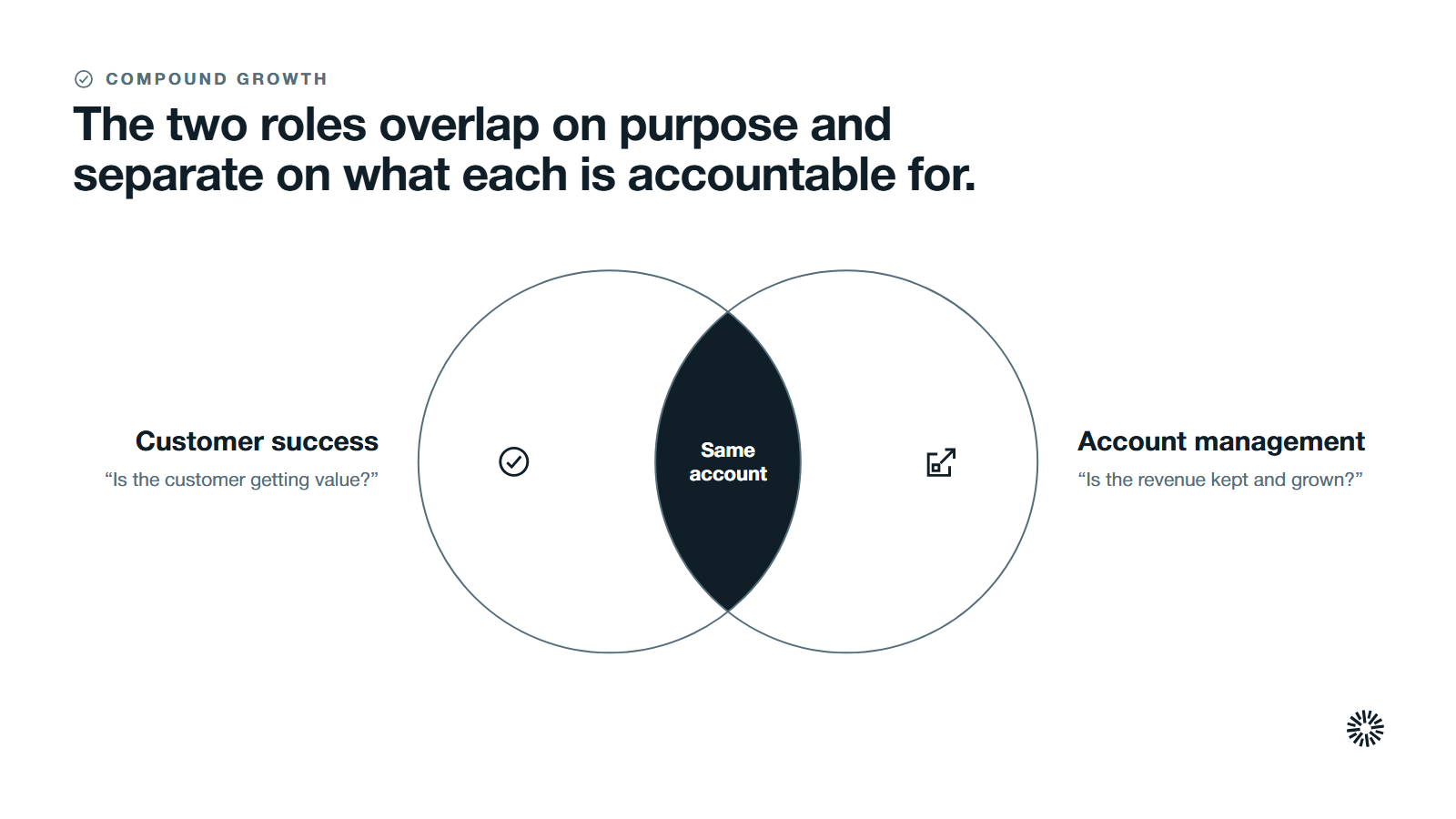
The two roles overlap on purpose. They separate on what each is accountable for. The table below compares them on the same seven criteria. It is our reading of how the roles are usually divided, and your company may draw the lines differently.
| Criterion | Customer success | Account management |
|---|---|---|
| Main goal | Customers reach the outcomes they bought for | Revenue from existing customers is kept and grown |
| Owner of renewal | Influences it through adoption and health | Often owns the commercial close |
| Owner of expansion | Spots the need and signals readiness | Often owns the deal |
| Typical metrics | Adoption, health, time to value, retention | Renewal rate, expansion revenue, net revenue retention |
| Core activities | Onboarding, success plans, reviews, risk work | Stakeholder mapping, pricing, negotiation, renewal and upsell |
| Needed most when | Product value takes effort to realize | Contracts are large, multi-year or negotiated |
| Main risk | Happy users with no budget holder to renew | Closing renewals on accounts that are not getting value |
Read the owner rows with care. In many companies one person holds both. In others a customer success manager closes renewals under a set size and an account manager takes the larger deals.
Who owns renewal and expansion is the question that splits the roles
Renewal and expansion are where the two jobs meet, and where most confusion starts. Customer success creates the conditions for both and watches for expansion signals. Account management turns those conditions into signed revenue and revenue growth.
Placement varies by company. The Bridge Group's 2026 research of 158 B2B companies, published on 22 June 2026, reports that 38% of account executives hold sole or blended ownership of renewal and expansion, a share it describes as nearly doubled since 2024. It adds that role consolidation is most pronounced below $25K average selling price.
That finding concerns sellers, not customer success managers. It still shows the trend: at smaller deal sizes, one person often carries the sale and the renewal.
In practice, customer success managers raise the signal and account managers act on it. A customer success manager sees the usage drop or the new team asking questions, and account managers decide whether to open a cross sell conversation or a risk call.
Success managers and account managers who meet weekly on the same account list avoid duplicate outreach and give the customer one primary point of contact in the post sale relationship.
Where you sit on that range should shape who you name as the owner. Subscription businesses and any SaaS business with a self-serve entry price feel this most.
Pick one owner for each commercial event
For every renewal and every expansion deal, one named person is accountable for the result. Others contribute, but the account record shows a single owner. This is a design choice, not a rule from any study, and it prevents the most common failure in post-sale teams.
Metrics show which role is doing which job
The two roles are judged on different numbers, even when they share a dashboard. Using the wrong measure for a role pushes people toward the wrong behavior.
Customer success measures adoption and health
Customer success is measured on whether customers use the product and reach their goals. Those success metrics include product adoption, account health, time to first value and the rate at which customers stay. Retention is the shared result, but the leading performance metrics are adoption and health.
Account management measures revenue kept and added
Account management is measured on commercial results: renewal rate, expanding revenue and net revenue retention for the accounts in its book. These are lagging numbers that arrive after the contract moves, and they cover both cross sell and growing revenue within existing customers.
Shared goals keep the two honest
Give both roles one shared number, such as net revenue retention for the segment, plus their own leading measures. The shared number stops each side from winning on its own metric while the account suffers. Our guide to customer retention strategy explains how retention is planned across teams.
How the split changes as the company grows
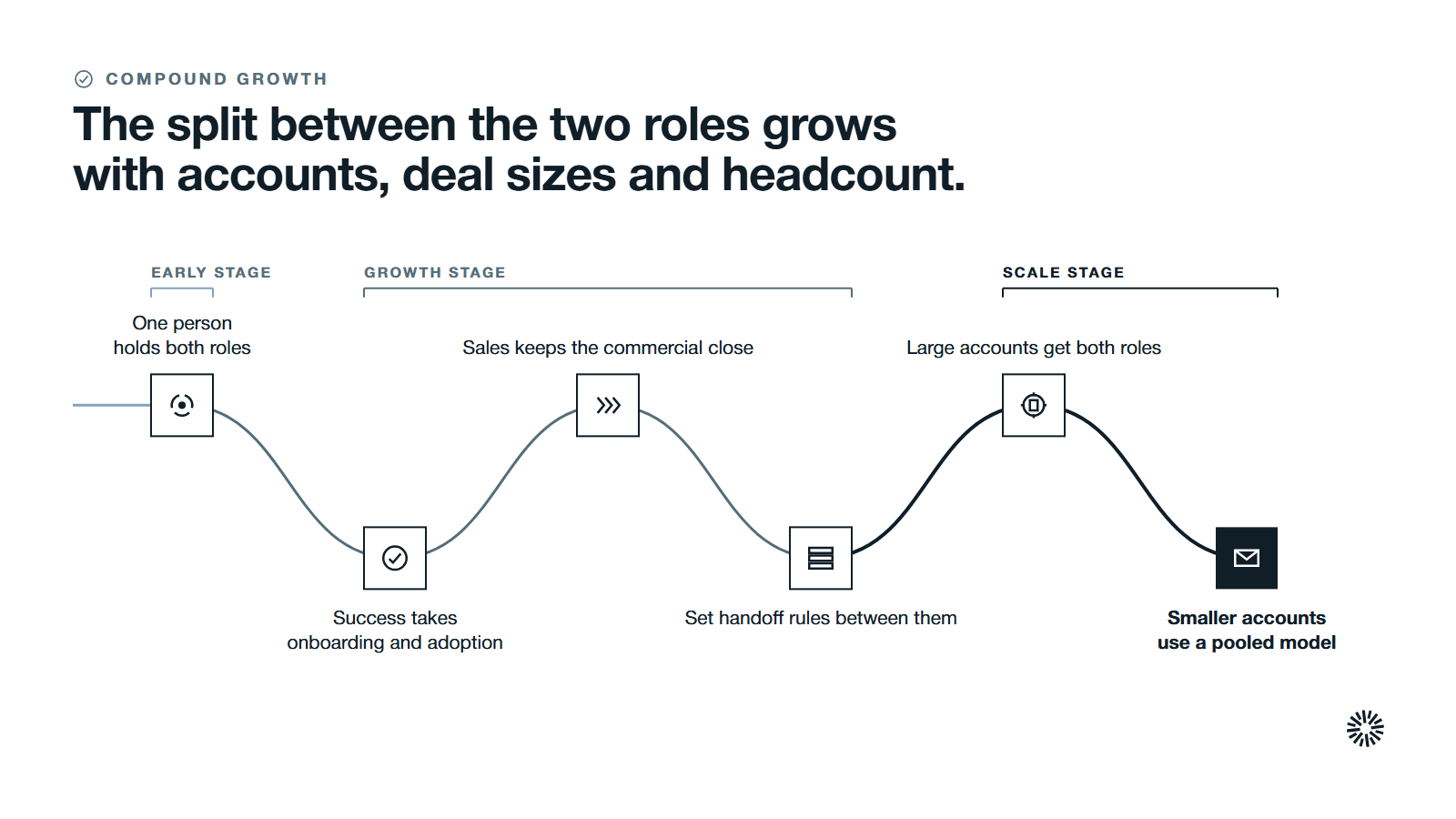
Few companies start with both roles. They begin with one person and separate the work as accounts, deal sizes and headcount grow.
Early stage: one person holds both
In a small company, a founder, a seller or a single customer success hire covers onboarding, renewals and upsell. There are too few new clients to justify specialists, and the primary focus is landing the next customer. The risk is that renewal and outcome work slips behind new customers.
Growth stage: customer success and sales share the renewal
As accounts multiply, customer success takes onboarding and adoption, and the sales team keeps the commercial close through an account executive or one of its account managers.
One reasonable order is to hire the first customer success manager before the first account manager, because adoption problems show up before contract complexity does.
Handoffs between them need rules: who contacts the customer when, and who records the renewal forecast.
Scale stage: separate customer success and account management
At scale, larger accounts get a pair of account managers and customer success managers working as cross functional teams. Smaller accounts are served through a pooled or digital model. Each role has its own targets, a clear boundary and a defined job description.
None of these stages is better than another. Each fits a size of company and a size of deal, and moving too early adds cost while moving too late loses accounts.
What breaks when the split is unclear
An unclear split rarely fails loudly. It fails through small gaps that add up across accounts.
- Nobody owns the renewal date. Each team assumes the other has it, and the customer is contacted late or twice.
- Customers hear two commercial messages. A success manager promises a feature while an account manager quotes a price, and the customer experience suffers.
- Risk is seen and not acted on. Customer success flags a weak account, but nobody with commercial authority picks it up.
- Expansion gets pitched to unhealthy accounts. Account management pushes an upsell on a customer still struggling with onboarding.
- Metrics reward the wrong behavior. One team is paid on renewals and the other on satisfaction, and they pull in different directions.
The fix is the same each time: name one owner per event, define the handoff and share one account record.
Customer success vs account management by stage: five decision rules
Choose by evidence about your accounts, not by which title sounds more established. These rules are our reading and are meant to be argued with.
If you have a few customers, give one person both jobs
With a handful of accounts, one owner is faster than two. A single customer success manager or seller can hold both jobs while closing deals and tracking customer health. Write down the renewal date and the outcome the customer wants for every account, and review them monthly.
If deals are small and sales cycles are short, let sales keep the renewal
At low contract values, separate account managers add cost without adding much. Let the seller who closed the deal own the renewal, and use customer success to drive adoption.
If deals are large or multi-year, add account management
Large contracts bring procurement, several stakeholders and negotiated terms. Dedicated account managers handle that commercial work while customer success managers stay on outcomes.
If renewals slip despite healthy usage, fix ownership before hiring
When customers use the product and still renew late, the gap is commercial ownership. Name the owner of each renewal before you add anyone.
If customers are healthy but expansion is flat, strengthen account management
Strong adoption with no growth in contract value suggests nobody is selling inside the account. Give a named person an expansion goal and the authority to pursue it.
Skills and career paths differ even when the work overlaps
The two roles draw on different strengths. Customer success managers need product depth, coaching skill and the ability to read data driven insights about usage. Account managers need commercial acumen, negotiation skill and comfort with procurement.
Career paths often cross. Many people move from customer success to account management as they take on commercial goals, and some account managers move into customer success leadership. Hiring for each job description with this in mind keeps the roles honest.
What you gain when this is done properly
When the split matches your size and each event has one owner, customers get a clear point of contact, and each team knows what it is accountable for.
Sales gets cleaner handoffs and warmer expansion leads
Sales receives accounts that are healthy and well understood, and expansion leads arrive with context. Renewal timing is visible early enough to plan the quarter.
Marketing gets customers it can speak to and learn from
Marketing can build customer stories, references and campaigns for the right segment, because it knows which accounts are healthy and which are being worked. Our guide to customer marketing shows how to speak to the base.
Customer success gets a defined remit and a partner
Customer success can focus on outcomes and the customer lifecycle without carrying quota for every deal, and has a commercial partner for the conversations it should not lead. Risk gets flagged to someone able to act, and success and account management stay aligned on long term customer relationships.
Match the roles to your stage, then connect them
The choice is not between two job titles. It is about which events in the customer relationship need an owner today, and who is best placed to hold each.
Propello designs and builds connected go-to-market systems on HubSpot, so that customer success and account management work from one record of the customer. Propello is a HubSpot partner.
If you want a second opinion on how to split post-sale work at your stage, an audit is the place to start.
