If you are a founder, business owner, CEO or revenue leader at a growing B2B company, should you hire a HubSpot agency or build with your own team? A small team can run HubSpot alone for a while, but the case for outside help grows with every team, tool and handoff you add.
This article sets out when that happens, what breaks if you wait, what to build and in what order, and what each part of your revenue team gains when the work is done properly. You will finish with a clear way to decide, whichever route you take.
The decision in one paragraph: if one team uses HubSpot and someone inside owns how it is set up, your own team is enough for now. Once two or more teams work in the same portal, records and rules start to drift between them, and no one has the time or the skills to own the design, bring in a HubSpot agency to build the foundations. Then keep the day-to-day running in house.
|
HubSpot Agency A HubSpot agency is a services firm that implements, configures and runs the HubSpot platform for other companies, and many are listed as Solutions Partners in HubSpot's partner directory. |
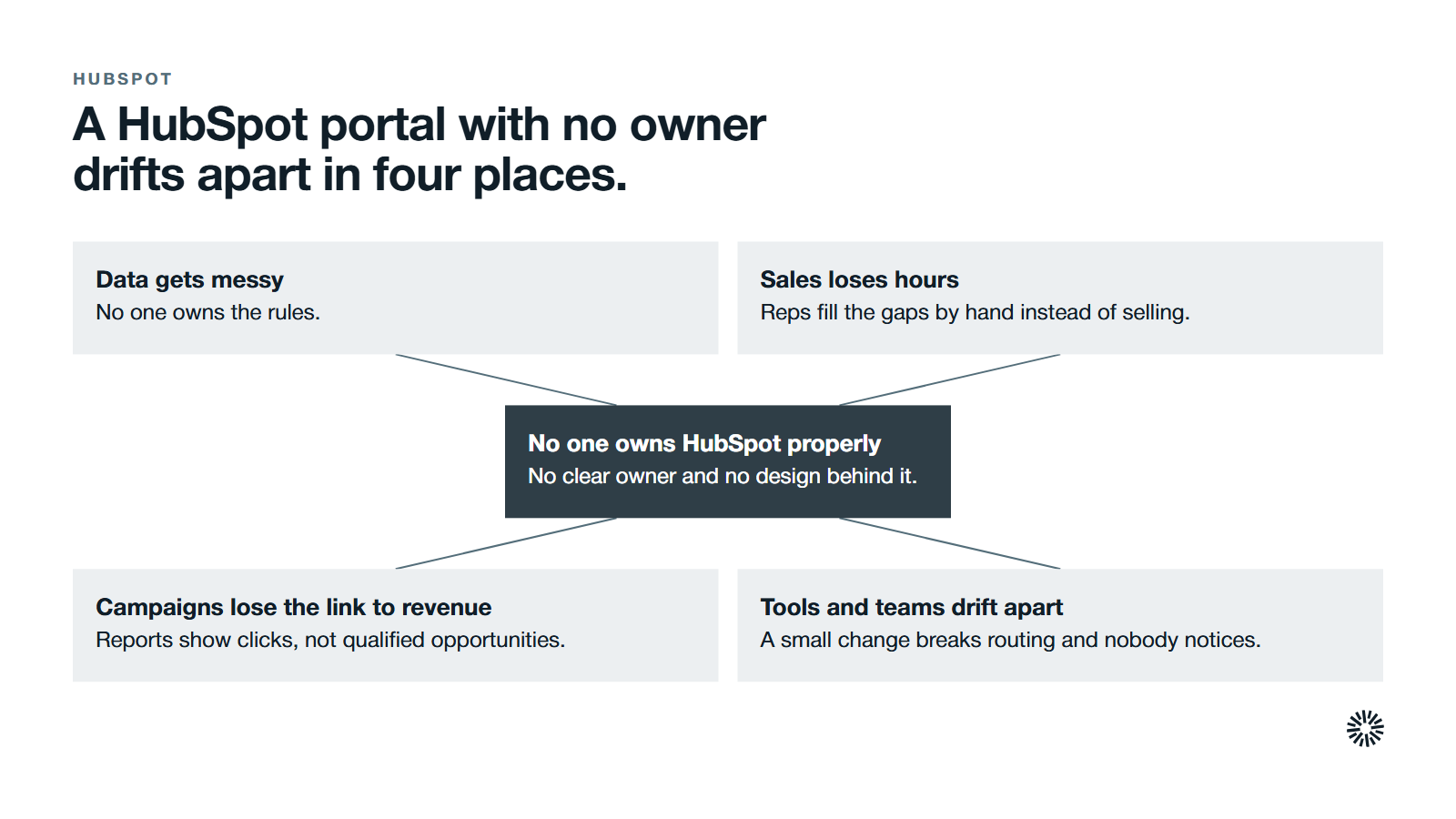
What breaks when no one owns HubSpot properly
Most HubSpot customers start simply. One person sets up the CRM, imports contacts and builds a few forms. Then the business grows, and the portal grows with it, usually without a design behind it.
Data gets messy because no one owns the rules
Properties are added for one campaign and never retired. Lifecycle stages mean one thing to marketing and another to sales. Duplicate records pile up. Within a year, the customer relationship management data that everyone is meant to trust becomes something people double-check in spreadsheets.
Sales loses hours to work that is not selling
When the sales pipeline is not set up around how your buyers actually move, reps fill the gap by hand. They update records, chase missing details and copy information between tools. Salesforce's 2024 State of Sales research found that sales reps report spending 70% of their time on non-selling tasks.
Marketing campaigns run without a link to revenue
Marketing can report opens, clicks and form fills, but cannot show which marketing campaigns led to qualified opportunities. Without that link, budget decisions rest on opinion, and the argument between marketing and sales about lead quality never ends.
Tools and teams drift apart
Every new tool, form or workflow, including third-party marketing tools, is added by someone with a local problem. Few people check how it affects the others. A small change to lead scoring can break routing, and nobody finds out until a hot lead sits untouched.
None of this is a skills failure. It is what happens when a platform that touches every customer interaction has no clear owner and no design. A good agency partner exists to supply both, which is the job HubSpot partners are hired to do.
What a HubSpot partner agency actually does
A HubSpot partner agency does the technical and strategic work that turns the platform into a working system, from CRM setup to the marketing and sales strategies that sit on top of it.
HubSpot describes its Solutions Partner Program as designed for service firms, consultancies and agencies, and says partners can work with you to achieve your goals using HubSpot across marketing, sales, customer success, web design and CRM.
HubSpot calls its members Solutions Partners, so a HubSpot solutions partner and a HubSpot agency partner are usually the same kind of firm. Service offerings differ. A full-service agency covers many areas, while a specialized one may focus on CRM work, web design or inbound marketing services. Ask which HubSpot experts will work on your account, and whether they will act as a dedicated team or share your account with other clients. Ask other agencies the same questions, so you can compare answers. Many HubSpot partners are built around one core service, and a HubSpot partner agency with a narrow focus often goes deeper in that area than a generalist does.
In practice, the work falls into a few groups:
- CRM implementation and data migration: planning the data model, moving records across and cleaning them on the way.
- Platform setup and onboarding: configuring Marketing Hub, Sales Hub and Service Hub around your process rather than the defaults.
- Custom integration: helping you connect HubSpot to the finance, product and support tools your team already relies on.
- Process automation and reporting: building workflows, lead scoring and dashboards that show what is working.
- Training and ongoing support: teaching your team to run the system and fixing it as the business changes. Continuous support matters because a portal that nobody adjusts slowly stops matching how you sell.
- Strategic alignment: agreeing one set of definitions across marketing, sales and service, so the teams stop working from different versions of the customer.
HubSpot's own partner directory lets you browse partners by popular service, such as website development or email marketing, and by accreditation in areas such as CRM implementation, onboarding, platform enablement, custom integration, data migration and solutions architecture design. For a deeper look at the model, see our guide to the HubSpot solutions partner agency.
Build in the right order, whoever does the work
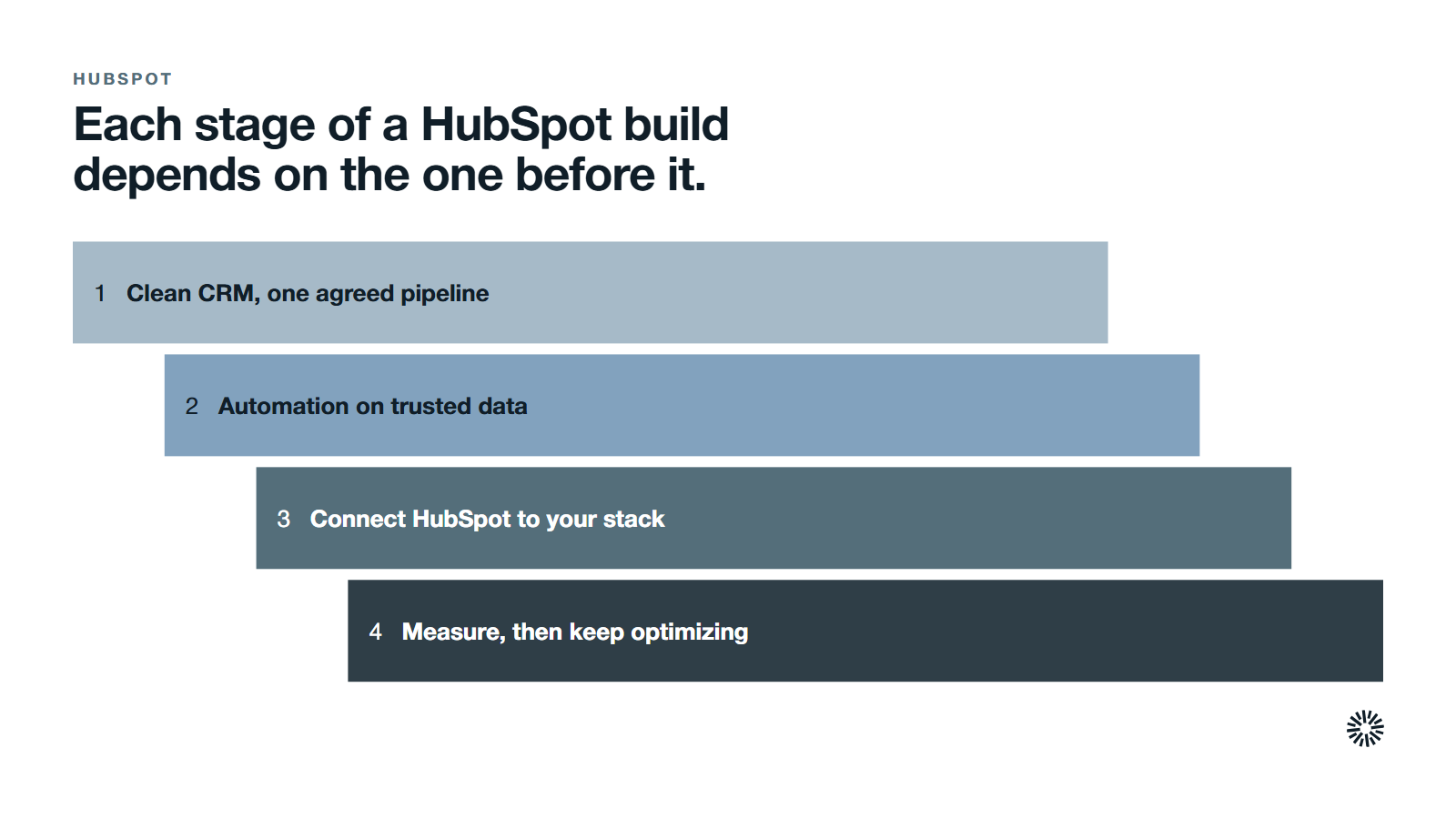
The order matters more than who holds the keyboard. Each stage depends on the one before it, and skipping ahead is the most common reason HubSpot projects stall.
Start with a clean CRM and one agreed sales pipeline
Your marketing strategy, your wider business strategy and your sales process all depend on this step. HubSpot describes the HubSpot CRM as a single place that unifies customer data, which only helps if the records are clean. Define your lifecycle stages, deal stages and required properties first. Agree what makes a lead qualified, and write it down. Everything else, from scoring to reporting, reads from these definitions, so a mistake here spreads to every later stage.
Add marketing automation once the data can be trusted
With clean data, you can automate nurture sequences, route leads to the right owner and score them on fit and behavior. HubSpot says Marketing Hub workflows take routine tasks off people's hands and that lead scoring helps teams put high-value leads first, so marketing automation saves time and increases efficiency when the rules behind it are sound. Automating before the definitions are settled only makes the confusion faster. Strong inbound marketing depends on this base, because personalized messages need reliable contact data to work.
Connect HubSpot to the rest of your stack
Next, connect HubSpot to the systems that hold billing, product usage and support history. A shared view of customer interactions in the HubSpot CRM is what lets sales, marketing and customer success act on the same facts. Sort out ownership of each field before you build the sync.
Measure, then keep optimizing
Build reports that tie marketing effort to pipeline and revenue, and review them on a fixed rhythm. HubSpot positions its reporting dashboards as one view across marketing, sales and service data, so custom reports and dashboards tailored to your business needs give leaders data insights they can act on. A return on investment (ROI) view only helps when the data underneath it is sound, which is why reporting comes after the earlier stages and not before.
When your own team is enough and when it is not
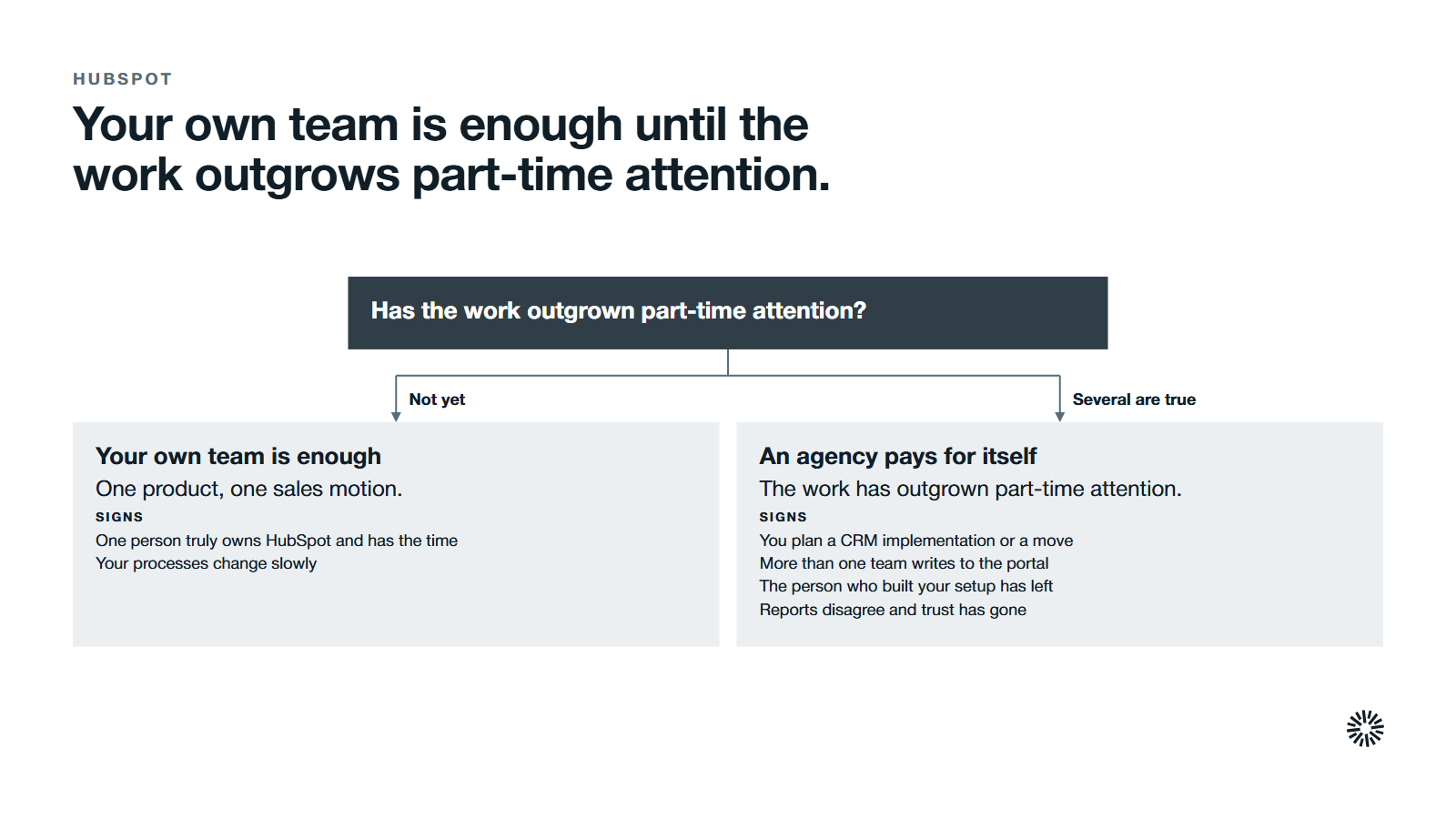
Outside help is not always the right call. A fair test looks at what you already have and what is coming.
Your internal team is probably enough when you run a single product with one sales motion, one person truly owns HubSpot and has the time, and your processes change slowly. In that case, HubSpot's own resources and a few focused training sessions may carry you a long way.
An agency starts to pay for itself when several of these are true:
- You are planning a CRM implementation or a move from another system.
- More than one team writes to the same portal, and no one owns the rules.
- Your business goals now need integrations with finance, product or support tools.
- The person who built your setup has left, or is stretched across other work.
- Reports disagree, and leadership no longer trusts the numbers.
The pattern is the same each time: the work has outgrown part-time attention. A HubSpot partner brings specialists who do this every week and usually move faster than a team learning on the job, and a good one trains your internal team so new team members can pick up the system quickly instead of depending on one person. If you also weigh a dedicated hire, our comparison of a GTM agency and an in-house GTM engineer sets out the trade-offs.
What a HubSpot agency partner can and cannot promise
Be careful with any agency that promises results before it has seen your portal. A good HubSpot partner will tell you what it has to look at first, and what it expects you to do.
HubSpot says its partners earn tiers based on the level of success they have achieved for their clients, ranked from Elite as the highest to Gold.
Directory profiles are ranked by review count as well as tier. Read a tier as a clue, not a verdict. Reviews, references and a direct conversation about your own situation tell you more about fit.
Not every one of the HubSpot partners in the directory fits every company, and a HubSpot solutions partner that suits a large enterprise may be wrong for a growing team. Ask for references that show a proven track record in work like yours, and speak to a few of the agency's clients. Most clients can tell you quickly whether the agency partner explained its work clearly and handled scope changes well. Then ask who will do the work, how decisions get made, what you receive at each stage and how you take over if you part ways. We cover the full process in our guide to how to choose a HubSpot partner.
Also look at how the agency handles the wider HubSpot ecosystem. HubSpot's platform is built to work with many other tools, and a HubSpot partner who understands how revenue systems fit together will save you from integrations that break later. For where this thinking leads, see HubSpot implementation vs GTM Engineering.
What you gain when this is done properly
The gains show up differently for each team, which is why it helps to name them.
Sales
Your sales team works from one record per customer, routing that follows rules and a sales pipeline that mirrors how deals actually move. Less of the day goes on updating records, and more goes on conversations with buyers. Forecasts become easier to defend because stages mean the same thing to everyone, and increased revenue is easier to trace back to the activity that produced it.
Sales enablement also improves, because content and playbooks attach to real deal stages. Our guide to sales enablement shows how to build on that.
Marketing
Marketing can follow a campaign from first touch to closed deal, so lead generation is judged on increased revenue rather than clicks alone.
Marketing automation and lead scoring send sales the contacts most likely to buy, and your marketing team can test ideas without breaking the rest of the portal. Marketing emails, content creation and website traffic can then be judged by the pipeline they produce, not only by opens and visits.
Inbound marketing and content work also become easier to judge, because your marketing strategy can be tested against closed revenue. You can create reports that show campaign performance by revenue, so data driven decisions replace guesswork about where marketing efforts pay off.
Customer success
Shared definitions also remove the silos between teams, so handoffs from marketing to sales to customer success stop losing context. Customer success gets a view of usage, support history and open deals in one place, and a partner can help set up the service processes and retention routines that sit on top of it. Renewal and expansion signals reach the right person early, and feedback from customers flows back to marketing and product. Ongoing support from the agency keeps those workflows healthy as the business changes.
Bring in help before the cost of waiting compounds
The cost of an unowned HubSpot portal rarely arrives as one event. It arrives as slower handoffs, weaker reports and a team that trusts the system a little less each quarter. Fixing it early is cheaper than rebuilding after two more years of drift.
Business growth makes the gap wider, and a plan built around your unique business needs closes it faster. A HubSpot partner agency that starts with a comprehensive strategy, writes down the project's scope and names an owner for every area gives the plan a good chance of holding.
Propello designs and builds connected GTM systems on HubSpot, and is a HubSpot partner. If you are not sure whether your portal needs outside help, an audit is the place to start.