If you lead sales, revenue or a growing B2B company, the short answer is this: deals stall when the buyer has no urgent reason, no clear owner or no clear next step, and the fix is to find out which of the three is missing before you follow up again.
Pushing harder rarely works. Asking a better question does.
This article is for CEOs, founders, CROs and sales leaders whose sales pipeline is full of deals that stopped moving. For the full system, read our guide to pipeline management.
You will get a plain definition, the causes behind a deal stall, the signals that show a deal is stuck, a restart sequence for sales reps, and the habits that keep deals moving in the first place.
|
Stalled Deal A stalled deal is an open opportunity where the buyer has gone quiet or stopped progressing, and no agreed next step with a date exists. |
A stalled deal is not a slow deal
Every sales cycle has quiet stretches. A buyer waiting for a board meeting, a budget release or a security review is slow, but the path is visible. Everyone knows what happens next and roughly when.
A stalled deal has no visible path. The last meeting ended with "let's keep in touch," the proposal went out, and then nothing.
The deal still sits in the forecast, which is why it does damage: it looks like pipeline and behaves like a dead deal. Stalled opportunities crowd out real ones, drain selling resources and slow revenue growth, and they make the whole sales pipeline harder to read.
The difference matters because the two need opposite treatment. A slow deal needs patience and a light follow up. A stalled deal needs a diagnosis, because the same message that worked last week is now ignored.
Six causes explain why most deals stall
Sales reps tend to blame the prospect: "they went dark," "the prospect flakes," "the timing is bad." Those are symptoms.
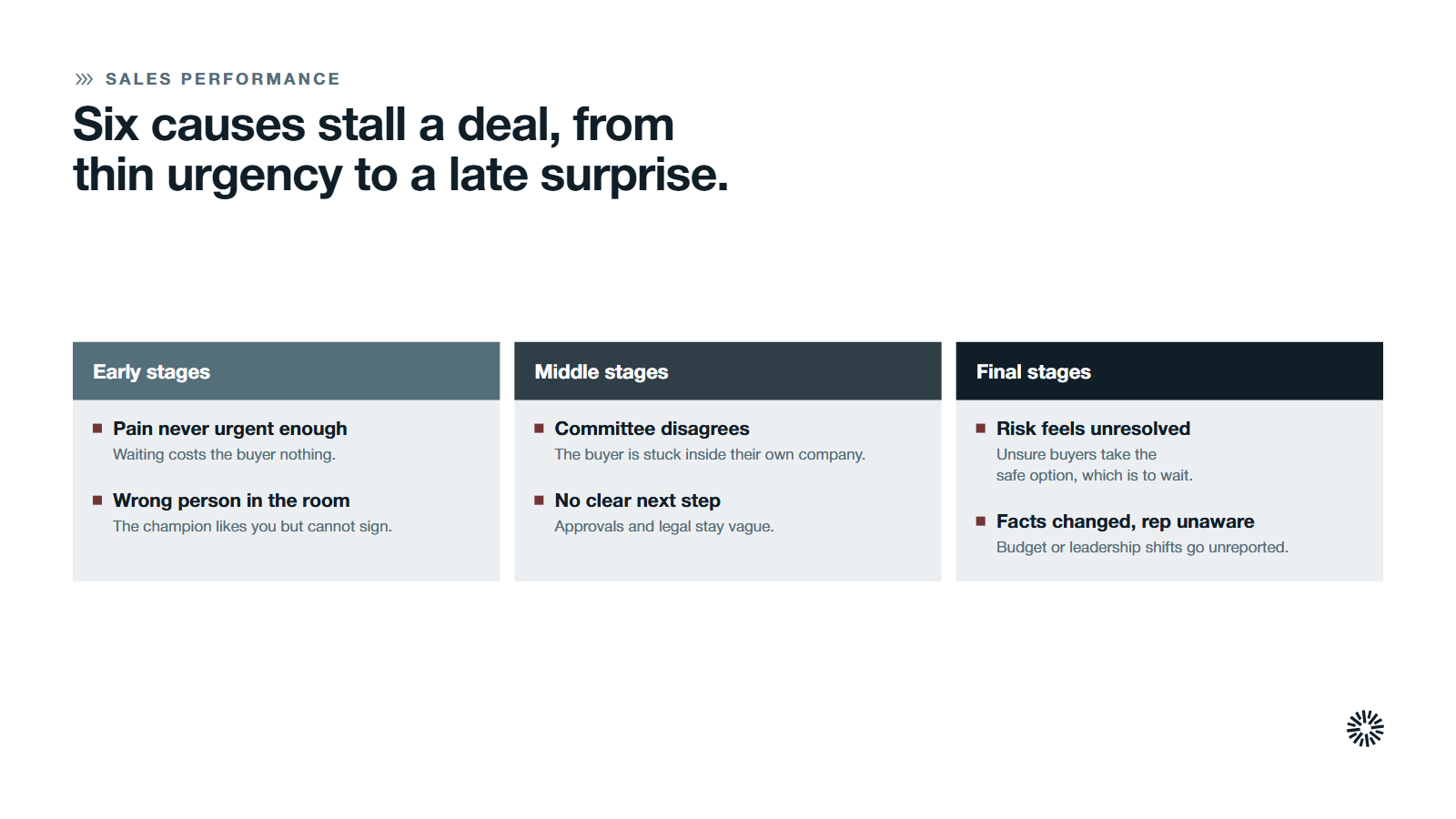
Underneath, most deal stalls trace back to one of six causes, and each points to a different fix. Two stalled deals rarely stall for the same reason.
Some show up in the early stages, when urgency is thin. Others appear in the final stages, when more people get a vote and the finish line suddenly looks risky.
The pain was never urgent enough
If the problem is real but tolerable, the status quo wins. Nothing bad happens to the buyer if they do nothing, so every other priority beats your proposal. Sales professionals should ask what waiting costs the buyer. If neither of you can name one, the deal was never well qualified.
Creating urgency starts with a compelling event, such as a renewal date, a deadline or a change in the market.
The real decision maker was never in the room
Your champion likes you, but they cannot sign. Sometimes you are simply talking to the wrong person.
Gartner reports that buying groups range from five to 16 people across as many as four functions, and that each member may hold different priorities. When you only know one person, you do not know who can say no. Complex purchases involve many stakeholders.
The buying committee disagrees with itself
This is the cause most sales leaders underestimate. In a 2024 Gartner survey of 632 B2B buyers, 74% of buyer teams showed unhealthy conflict during the decision making process. Groups that reached consensus were 2.5 times more likely to report a high-quality deal.
Complex internal processes, such as several approval layers, stall some deals on their own. Internal decision-making delays make it worse: one approver on leave can hold up everyone. Your prospect may be stuck inside their own company, not stuck with you.
The buyer does not know what happens next
Buyers stall when the path to yes is vague. Who approves? What does legal need? What happens after signature? If your sales process leaves those questions to the buyer, the easiest answer is to wait.
Trust is thin or the risk feels unresolved
Buyers who are unsure they can trust you, or who fear change, take the safe option, which is to wait. Risk aversion is normal, and an unanswered risk question quietly stalls a deal during negotiation.
Competitors add to it. When two options look alike, buyers can fall into evaluation paralysis and compare them without ever choosing.
Something changed and your rep never heard
A reorganization, a budget shift, a budget freeze, a new executive, a competing project. The primary contact often does not volunteer bad news, especially to a rep they like. The deal stalls because the facts changed and nobody told you.
Deals can end in no decision rather than in a competitor win, and stalling is common across the whole market. In a Forrester survey of more than 18,000 business buyers, 89% said they had a purchase stall, often because of budget limitations.
Spot a stalled deal early by what the buyer has stopped doing
By the time a deal is obviously dead, you have lost weeks. The earlier signals are behavioral, and most of them live in your CRM if your team records them.
Watch for these:
- The deal has sat in one stage far longer than similar deals did. Your own history is the benchmark.
- There is no meeting booked, only a vague "circle back."
- Only one person replies, and the real decision maker has never joined a call.
- Emails are opened but not answered.
- The close date has moved more than once with no new reason.
- The buyer stopped asking questions. Interested buyers ask about price, risk and rollout.
None of these proves the deal is dead. Together they prove it is stuck, and they give you a reason to act now instead of at the end of the quarter.
Clear stage definitions make this much easier. If your stages describe what the buyer has done instead of what the rep hopes, sales pipeline stages become a reliable early warning. A deal that cannot meet its exit criteria is stuck, and everyone can see it.
Restart a stalled deal in five moves
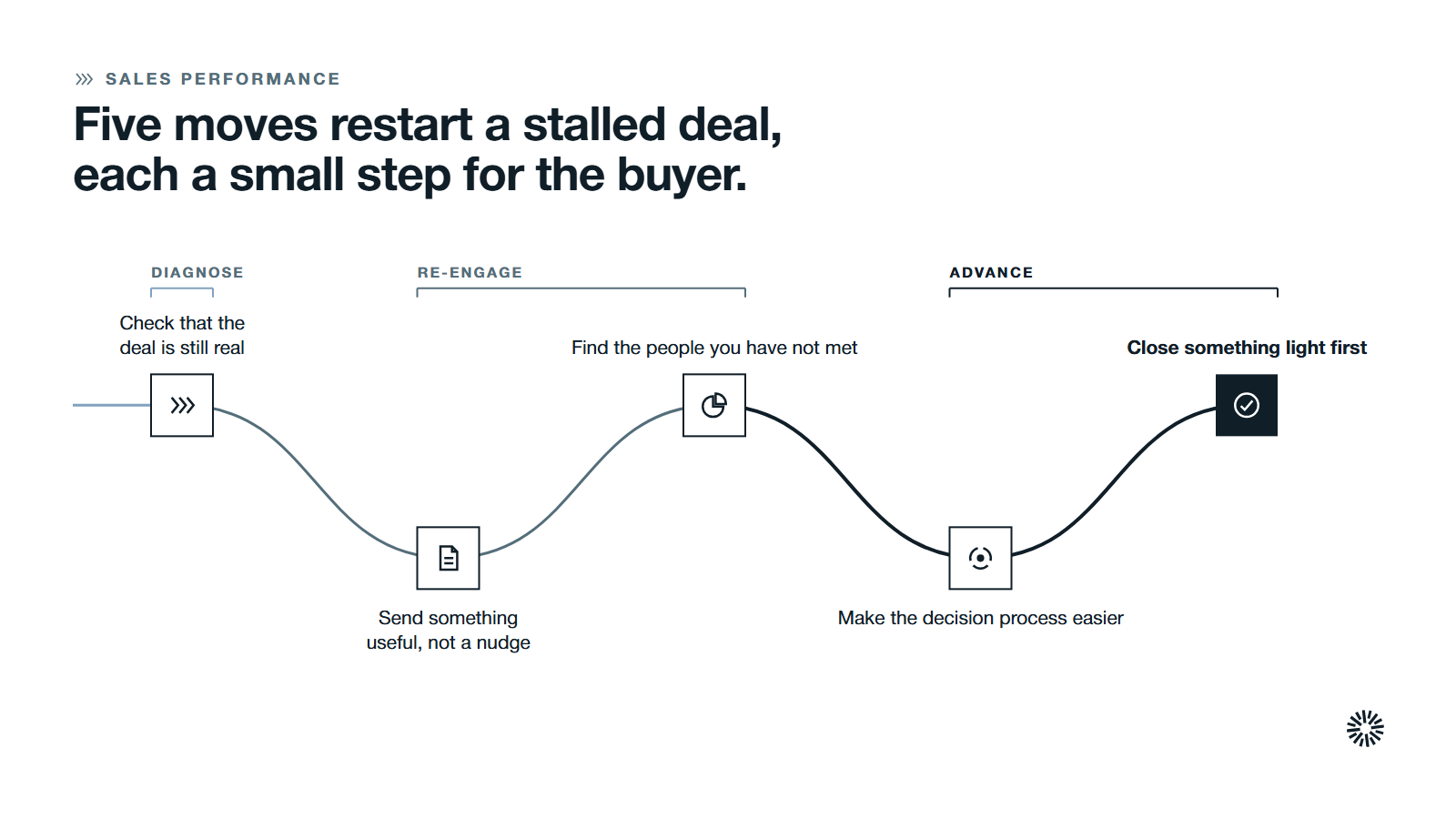
Sales teams can turn stalled deals around with a sequence that goes from the lightest touch to the firmest.
Each move is about moving stalled deals forward without adding pressure, and each one asks the buyer to move forward by a small, easy step.
Do not skip to the last move. Stalled deals usually take several follow ups before they close, so plan a rhythm of varied touches. These strategies turn stalled deals into live conversations when the buyer has a reason to answer.
1. Check that the deal is still real
Diagnosing the root cause comes first, because only the true blocker tells you what to send.
Before you spend time, confirm the opportunity is qualified. Is there a problem the buyer admitted, a budget owner and a reason to act this quarter? If not, move it out of your forecast and into a nurture track. Done looks like an honest pipeline instead of an optimistic one.
Recognizing when a deal should be paused or abandoned is part of the job.
2. Send something useful, not a nudge
"Just checking in" gives the buyer nothing, and a generic follow up never fixes a specific blocker. Re-engage with a targeted solution to the real blocker instead.
After a short phone conversation, or instead of one, send a note that helps with the work they still have to do, such as a one-page summary their finance lead can read quickly.
Good follow up adds value. It does not ask for a status update. A single follow up question about their next internal step is enough. Done looks like a reply that helps the deal move forward.
3. Find the people you have not met
Ask your champion: "Who else will have a view on this?" Then ask for an introduction. Internal champions can reach people you cannot.
Multi-threading is the strongest protection against a single contact going quiet. A new voice often moves things forward when the first contact cannot, and it helps the whole deal move forward. Done looks like a second stakeholder on the next call.
4. Make the decision making process easier
Offer a draft of the steps you think remain: approvals, legal review, security questions, kickoff. Ask the buyer to correct it. A buyer who corrects your list has told you the real path, and often volunteers a firm date. Done looks like a written plan with dates.
5. Close something light first
Instead of asking for the signature again, ask for a small, clearly defined request: a short call with finance, access to a stakeholder, a pilot scope.
If cost was the barrier, a revised scope or a new pricing structure can also reopen the talk. Make the next request only after the first yes. Each small yes gives the deal momentum and shows the buyer is still engaged. Done looks like a booked next meeting that carries the deal to the finish line.
If the buyer will not agree even to a light request, ask a direct and kind question: "Should we close this out for now?"
A clear no is worth more than a silent maybe, because your sales reps can spend their valuable time on deals that are moving.
Keep the close prospect centered: a prospect feeling valued is more willing to tell you the truth.
Avoid the habits that make a stall worse
Most sales reps feel the pull to push harder, and every close involves a request the buyer may not be ready to answer. Sales reps can be their own worst enemy here: pressure gives the prospect ample exit opportunities, and the stereotypical pushy salesperson is easy to avoid. These common reactions usually backfire.
- Repeating the same close. If the initial question did not work last week, the same question will not work now. An unsuccessful close followed by the same closing language only teaches the buyer to ignore you.
- Rolling several asks into one conversation. Asking for a meeting, a signature and an introduction at once gives the buyer three reasons to avoid replying. This is a compound close, and multiple questions in one message make it easy to skip the reply. A compound question, such as asking about budget, timing and an introduction together, gets a compound answer or none at all. A buyer who feels cornered looks for escape routes, and silence is the easiest one.
- Threatening with an expiring discount. It tells the buyer the price was never real. If the deal expires and the offer quietly returns, the buyer learns your deadlines are not real either.
- Chasing the same contact. If one person is silent, more messages to that person only repeat the silence.
- Talking only about your product. A question prospect centered on their goals earns a successful answer more often than a pitch. Ask what is happening on their side.
Speed matters earlier in the process too. If a deal was slow from first contact, speed to lead is worth reviewing, because buyers form their sense of how responsive you are at the start.
Keep deals moving with a dated next step on every deal
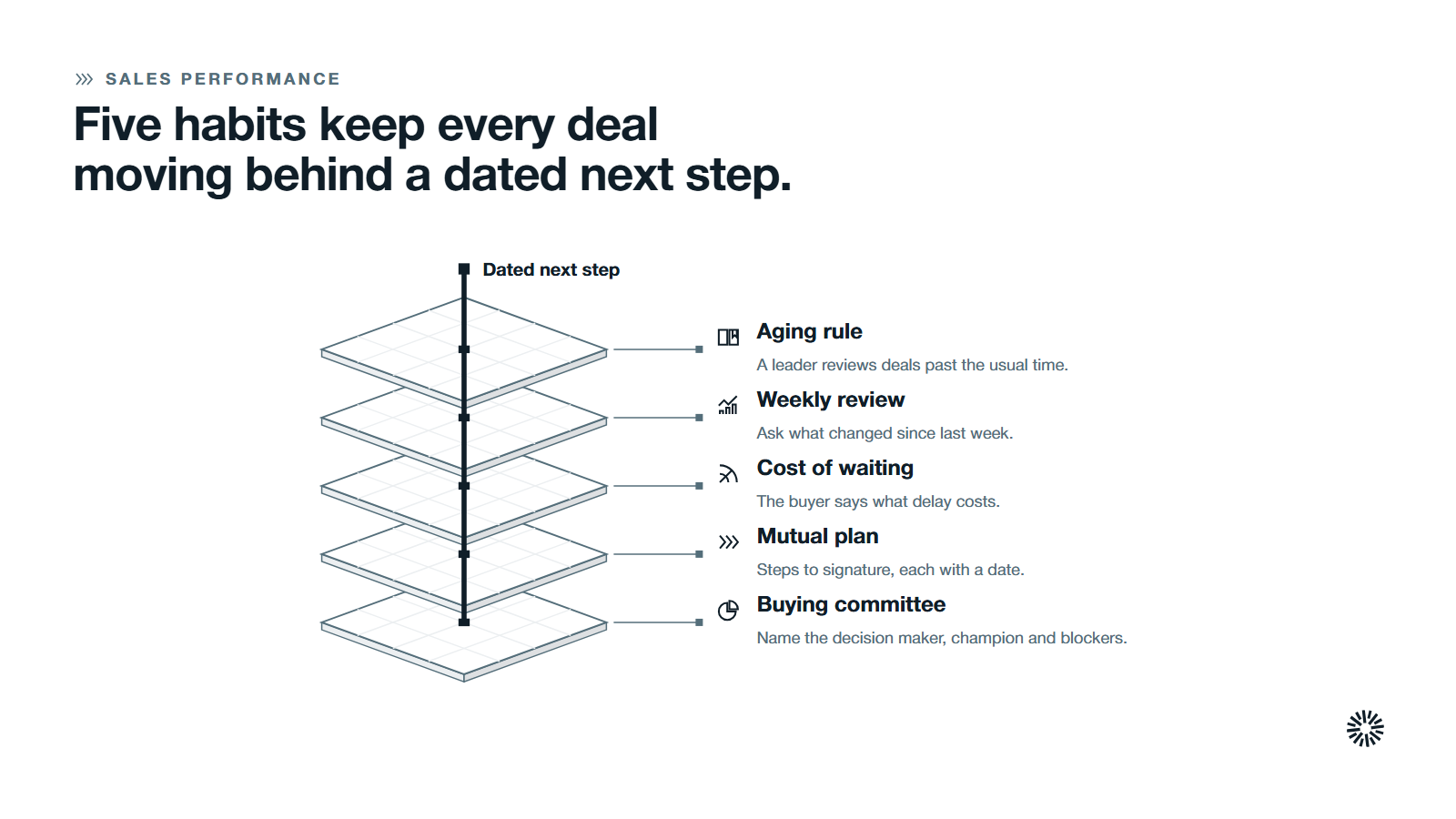
Prevention costs less, and it comes from how your team runs the sales process, so write the sales process around the buyer's steps, not your own. Anything that prevents deals from drifting, such as a dated next step, is worth the effort.
Set one rule: every open deal has a next meeting with a date, an owner on each side and a stated purpose. If a deal has none of those, it is already at risk.
Then build the rule into how you work:
- Map the buying committee. Name the decision maker, the champion and anyone who can block. Mark who your team has not yet met.
- Agree a mutual plan. Write the steps to signature together with the buyer, with a date beside each one.
- Qualify the cost of doing nothing. Make the buyer say what happens if they wait.
- Review stuck deals weekly. A pipeline review that asks what changed since last week surfaces stalls before the quarter closes.
- Set an aging rule. When a deal exceeds your typical time in stage, a sales leader reviews it.
When the CRM captures stakeholders, next steps and dates, a stall becomes visible instead of a surprise on the last day of the quarter.
What you gain when this is done properly
When deals stop stalling silently, the whole revenue team works from the same picture.
Sales
Sales reps spend time on deals with a real path and release the ones without it. Forecasts get more honest because every deal has a dated next step. Managers coach on specific blockers, such as a missing decision maker, instead of general advice to follow up more.
Marketing
Marketing sees, alongside sales teams, which kinds of buyers stall and why, so the team can help buyers feel confident earlier. That feeds better targeting and better content for buying committees, such as material a champion can forward to finance or legal. Campaign reporting stops crediting pipeline that was never going to close.
Customer success
Deals that close with the full buying group involved arrive with shared expectations. Customer success inherits named stakeholders and a clear record of why the customer bought, which makes onboarding smoother and renewals easier to plan.
Where Propello fits
Propello designs and builds connected go-to-market systems on HubSpot. If deals keep stalling and nobody can say why, an audit is the place to start.