If you lead a growing B2B company and you are weighing sales enablement vs sales operations, the short answer is this: sales enablement makes your sales reps better at the conversations they have with buyers, and sales operations makes the machinery around those conversations run cleanly. Most teams need both, in a deliberate order. For the full picture, read our complete guide to sales enablement strategy.
Pick the one that matches where deals are actually getting stuck. If reps are unprepared, you have an enablement gap. If reps are prepared but buried in admin, broken stages and unreliable forecasts, you have an operations gap.
This article is for CEOs, founders, CROs and sales leaders. You will get a plain definition of each function, a side-by-side comparison of goals, owners and metrics, a view of where each one ends and RevOps begins, and five decision rules for choosing what to build first.
|
Sales Enablement Sales enablement is the ongoing process of giving sellers the content, training, coaching, data and tools they need to have better buyer conversations and close more deals. |
|
Sales Operations Sales operations is the function that supports the sales team with the process, data, tools, territories and reporting it needs to sell efficiently and reach its sales goals. |
Sales enablement and sales operations solve different problems
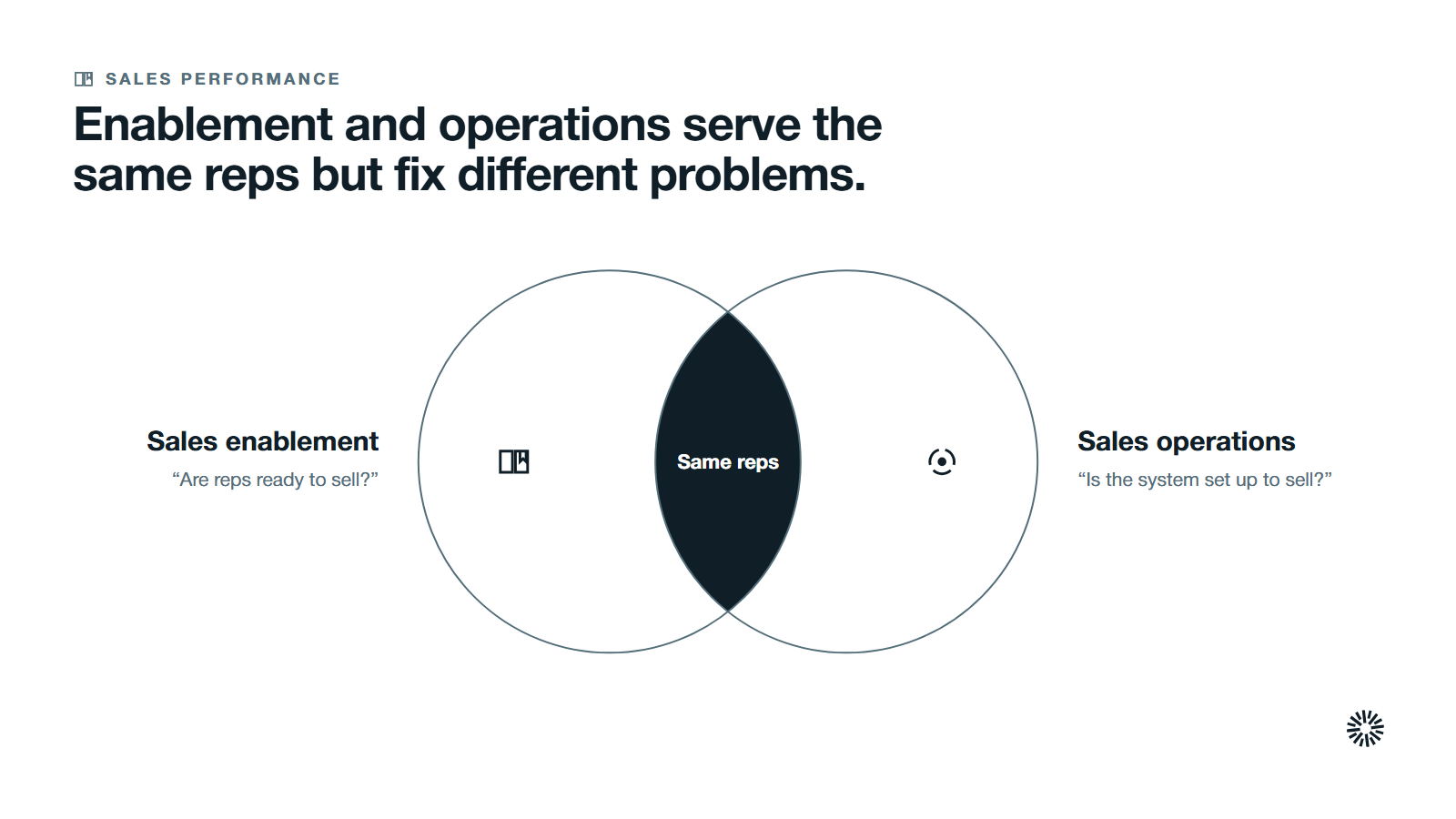
Sales enablement and sales operations both exist to help the sales team win, which is why the two get confused. They approach the job from opposite ends.
Sales enablement works on what a sales rep knows and says. Sales operations works on what the sales organization measures, routes and administers. Both aim to increase sales productivity, but they pull different levers.
Sellers have little time to spare for either. In Salesforce's 2026 State of Sales report, a survey of 4,050 sales professionals, the average seller spends 40% of their time selling. The rest goes to administration and everything else around the sale.
That one number shows why the split matters. Some of the lost time is a process problem that operations can remove. Some of it is a skills and preparation problem that sales enablement can fix. Which one you tackle first shapes your wider sales strategy.
What sales enablement does
Sales enablement prepares sales reps for the buyer in front of them. It covers sales content, sales training, coaching programs, playbooks and the product knowledge a rep needs to run a credible call.
Sales enablement teams also choose and run sales enablement tools, such as a shared content library, so a rep can find the right asset in seconds. Our guide to what sales enablement is covers the full scope.
Good enablement programs onboard new sales reps quickly. Training programs cover product knowledge, sales techniques and messaging for each buyer persona, and coaching continues after the first weeks. Sales enablement teams then track rep performance and content use, so they know which training programs deserve more investment.
The work is judged by how well people sell, not by how much material exists.
What sales operations does
Sales operations, often called sales ops, runs the system the sales team works inside. A sales operations team handles sales process design, territory assignment, sales quotas, forecasting, reporting and the CRM data that feeds all of it.
It also manages the sales tech stack and works with finance on compensation plans. Sales operations analysts build the reports, and a sales operations manager usually leads the function and answers to the head of sales.
Keeping CRM data clean is data management in practice, and a sales ops team also adopts technology that streamlines the sales process. One note on terms: this sales operations is not S&OP, the sales and operations planning process that balances demand with production.
Sales enablement vs sales operations compared side by side
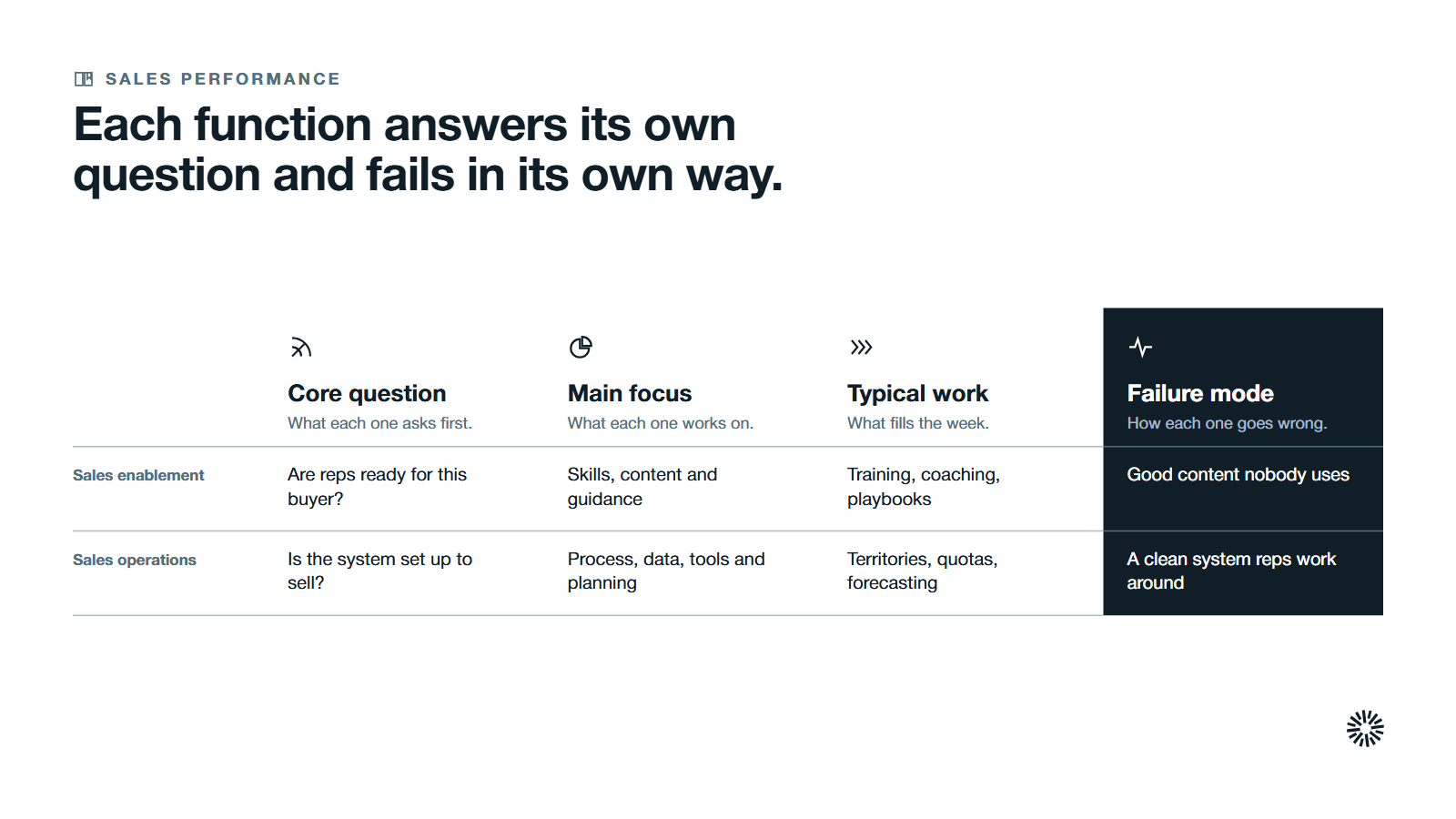
The table sets the two functions against the same criteria. Read it as a map of where each one starts and stops, not a ranking.
| Criterion | Sales enablement | Sales operations |
|---|---|---|
| Core question | Are reps ready to sell this to this buyer? | Is the sales system set up so reps can sell efficiently? |
| Main focus | Skills, content and guidance | Process, data, tools and planning |
| Typical work | Training, coaching, playbooks, sales collateral | Territories, quotas, forecasting, CRM administration |
| Usual owner | Sales leadership, product marketing or an enablement manager | Head of sales or a sales operations manager |
| Core metrics | Ramp time, win rate, content use, rep readiness | Forecast accuracy, pipeline coverage, quota attainment, data quality |
| Time horizon | Builds capability over quarters | Keeps the engine reliable week to week |
| Failure mode | Good content that nobody uses | A clean system that reps work around |
Both functions touch the same reps and the same deals. They differ in what they change: enablement changes behavior, and operations changes the structure that behavior happens inside.
Goals, owners and metrics: how each function is run
The table shows the gap in outline. Three practical questions show it in daily work: what each function is trying to achieve, who should own it and how you know it is working.
The goals are different
The goal of sales enablement is better selling. It aims to shorten the time new sales reps need to become productive and to raise the quality of customer interactions at each stage.
The goal of sales operations is a sales process you can run, forecast and scale. It aims to remove friction, keep sales data trustworthy and let sales managers spend their week coaching sales representatives instead of compiling spreadsheets.
The owners are different
Sales enablement is usually shared between sales and marketing teams. Marketing builds the sales collateral, sales leadership supplies the real objections, and a larger company adds an enablement manager to keep training and content from drifting apart.
Sales operations sits close to the head of sales. In a small company it may be one person who owns the CRM and the pipeline report. As the sales organization grows, it becomes a team with analysts and a manager.
The metrics are different
Sales enablement success shows up in rep performance: how fast new hires ramp, whether win rates improve at a key stage, whether the average sales cycle length shortens across the entire sales cycle and whether reps use what you built. Those are slow-moving measures, so look for movement over quarters.
Sales metrics for operations are about system health: forecast accuracy, pipeline coverage, quota attainment and the share of deals with complete CRM data. They move faster, and they tell you whether the data enablement depends on can be trusted.
Track metrics as clues, not proof. A faster ramp can come from a hiring change rather than better training, so pair numbers with call reviews and rep feedback.
How enablement and sales operations work together on a deal
The two functions depend on each other more than their separate descriptions suggest. Sales operations produces the data that tells sales enablement where to aim, because it can analyze CRM data to inform training. Enablement produces the behavior change that operations then sees in the numbers.
A simple loop shows how. Sales ops reports that deals stall after the demo stage. Enablement reviews calls, finds that reps skip the business case, and builds a short training initiative and a talk track. Operations then checks whether stage conversion improves.
The reverse also happens. When a company changes its sales methodologies, or adds a new stage to the sales funnel, operations updates the process and the CRM fields, and enablement teaches reps how to work the new stage, so customers get a consistent experience from every rep.
The two commonly collide over tools. One function buys a new sales tool without the other, and reps get either a system with no training or training for a system nobody configured.
Agree who decides on new tools before you buy any, and keep one list of existing systems so you do not duplicate them.
Buyers add a third reason to coordinate. Gartner's March 2026 survey of 646 B2B buyers found that 67% prefer a rep-free experience. Gartner says enablement must move beyond static content to support that buyer, and that takes the data and workflows operations controls.
Where each one ends and RevOps begins
Both functions serve the sales team. RevOps does not. Revenue operations runs marketing, sales and customer success as one connected revenue system, with shared data, shared definitions and shared goals.
Sales operations is the sales-only part of that picture. Our comparison of revenue operations vs sales operations shows how the scope widens, and our explainer on what RevOps is covers the full discipline.
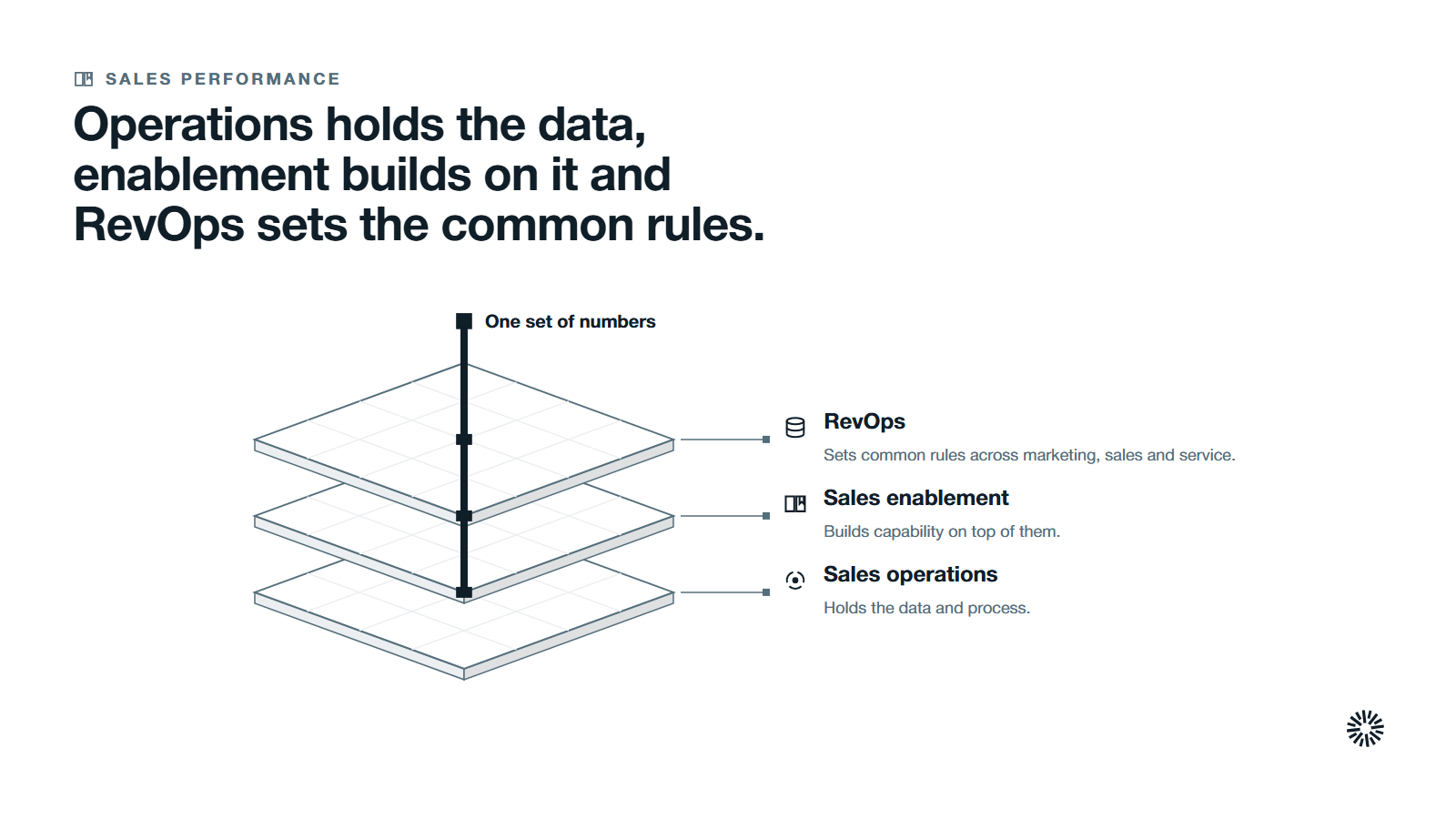
Sales enablement sits on a different axis. It is not a smaller version of RevOps, because it concerns rep capability rather than the shared revenue system. In a mature company the three work as layers.
Operations holds the data and process, enablement builds capability on top of them and RevOps sets the common rules across marketing teams, sales and service. It helps the whole sales force align sales and marketing around one set of numbers.
A useful test is to ask who feels the problem. If only sales feels it, start with sales operations or sales enablement. A sales pipeline that leaks at one stage points to one function. If marketing, sales and customer success all feel it, the seam between teams needs an owner, and that is RevOps work.
Which one to build first: five decision rules
Choose by the problem, not by which title sounds more advanced. These rules are our reading, and they are meant to be argued with.
Start with sales operations when the system is broken
If stages mean different things to different reps, forecasts miss every quarter or nobody trusts the CRM, training will not hold. Reps cannot use what they learn inside a process that contradicts it. Fix the sales process and the data first.
Start with sales enablement when reps are unprepared
If the process is sound and reports are reliable but new reps take months to sound like your best sellers, you have a capability gap. Build the playbook, the onboarding path and the coaching routine before you add more operational reporting.
Look at where deals stall
Pull the last quarter of lost and stalled deals. If they stall at the same stage because reps handle one objection badly, that is enablement. If they stall because handoffs are missed or records are incomplete, that is operations.
Assign one owner for each function
A function nobody owns decays. Name the leader for enablement and the leader for operations, even if one person holds both roles for now. Write down who decides on tools, who owns the CRM data and who approves changes to the sales process.
Sequence the work, then review it each quarter
Most growing companies fix the system first, then build capability on top. Review the choice each quarter against your metrics. As the company adds marketing and customer success handoffs, the shared work moves toward RevOps.
What you gain when this is done properly
When each function has a clear scope and an owner, the sales team stops losing effort to confusion over who fixes what. Sales reps get both a sound system and the preparation to use it, which supports steady sales performance and sales success that repeats.
Sales gets preparation and a system it can trust
Sales reps spend less time on admin and more with buyers. A fair quota and clear support make the role easier to stay in. Sales managers coach from reliable CRM data instead of impressions, and new hires follow a defined path to their first deals.
Marketing sees what the sales team actually uses
Marketing learns which assets reps share and which buyer questions go unanswered, so content follows demand. Shared definitions of a qualified lead reduce the argument about lead quality.
Customer success inherits a full record
Accounts arrive with the context sales gathered: what the buyer wanted, who was involved and what was promised. Onboarding starts from facts instead of a search through inboxes.
Decide on the problem, then name the owner
Sales enablement and sales operations are two answers to two different questions. One prepares people to sell, and the other keeps the sales engine reliable. Confusing them wastes budget on the wrong fix.
Propello organizes its work around commercial problems rather than marketing tactics. It designs and builds connected go-to-market systems on HubSpot, and Propello is a HubSpot partner. That gives us a view, so test the rules above against your own deals.
If you want an outside read on whether your gap is capability, system or both, an audit is the place to start. The same logic applies to your pipeline review, where stalled deals show which function to fix first.