If you are a CEO, founder or revenue leader at a growing B2B company, you are probably weighing whether to pay an outside team to run your revenue operations function instead of building it yourself. For many companies the answer is yes, but only under specific conditions, and this article shows which ones.
You will get a way to judge the cost against what it replaces, the costs worth weighing, the point at which the service pays back, and the situations where it does not. The aim is a decision you can defend to your board, whichever way you go.
The decision in one paragraph: RevOps as a service is worth the cost when your revenue operations are broken or undefined, no one inside owns them, and you cannot fill a full-time role every week. It is not worth it when the process is stable, an owner already exists, or leadership will not act on the findings.
|
RevOps as a Service RevOps as a service is an arrangement in which an outside team runs the strategy, processes, data and systems that connect marketing, sales and customer success, without you hiring that function in house. Our comparison of fractional RevOps and a full-time hire helps you weigh the in-house option. |
What breaks when no one owns revenue operations
Most growing companies do not decide to have no revenue operations. It happens by default. Each team adds tools and rules to solve its own problem, and nobody is responsible for how the whole revenue engine fits together.
Revenue generating teams, meaning marketing, sales and customer success, end up working from different versions of the truth.
Revenue data stops agreeing with itself
Marketing counts leads one way, sales counts opportunities another, and customer success tracks renewals in a third place. Reports disagree, so meetings turn into arguments about whose number is right.
Validity's 2024 State of CRM Data Management report, a survey of 631 CRM users and stakeholders, found that 24% said less than half of their data is accurate and complete.
Nobody owns the fix
Bad data persists partly because responsibility is vague. The same Validity report found that 35% of respondents were unsure who holds responsibility for data accuracy at their organization. Without an owner, problems are noticed, discussed and left in place.
Sales time goes to work that is not selling
When handoffs and records are manual, reps fill the gaps by hand, and sales performance suffers. Salesforce's State of Sales report, a 2026 survey of 4,050 sales professionals, found that the average seller spends 40% of their time selling. The rest goes to admin, data entry and research that a working system would reduce.
Forecasts turn into guesses
If lifecycle stages mean different things to different people, pipeline numbers cannot be trusted. Leaders then add buffers to every forecast, which hides real problems and makes it hard to tell market trends from noise in your own data.
Forecast accuracy suffers first, and confidence in the entire revenue cycle follows. Revenue performance becomes hard to explain, and revenue outcomes become hard to repeat.
What RevOps as a service replaces
A service does not replace sales, marketing or customer success. It replaces the connective work between them, and the senior judgment that decides how that work should run. It also goes further than sales operations, which usually looks after the sales team alone.
Sales operations tends to address only the middle of the revenue cycle, from qualified lead to closed deal. Revenue operations sits across marketing, sales and customer success, and across the entire revenue journey from product development to cash collection.
The work a service takes on
The scope varies by provider, but the work usually falls into a few groups:
- Revenue operations strategy: agreeing the revenue strategy, the owners and the metrics that prove it works.
- Process design: defining lifecycle stages, handoffs and deal rules so sales processes run the same way for every rep.
- CRM and tech stack: configuring customer relationship management so the process is enforced by the system, and removing tools that overlap.
- Data management: setting rules that keep customer data clean, and checks that catch drift early.
- Workflow automation: removing manual steps so revenue generating processes run without chasing.
- Reporting and forecasting: one set of dashboards for pipeline, forecast accuracy and retention.
- Training and handover: teaching your team to run what has been built.
What it replaces inside your company
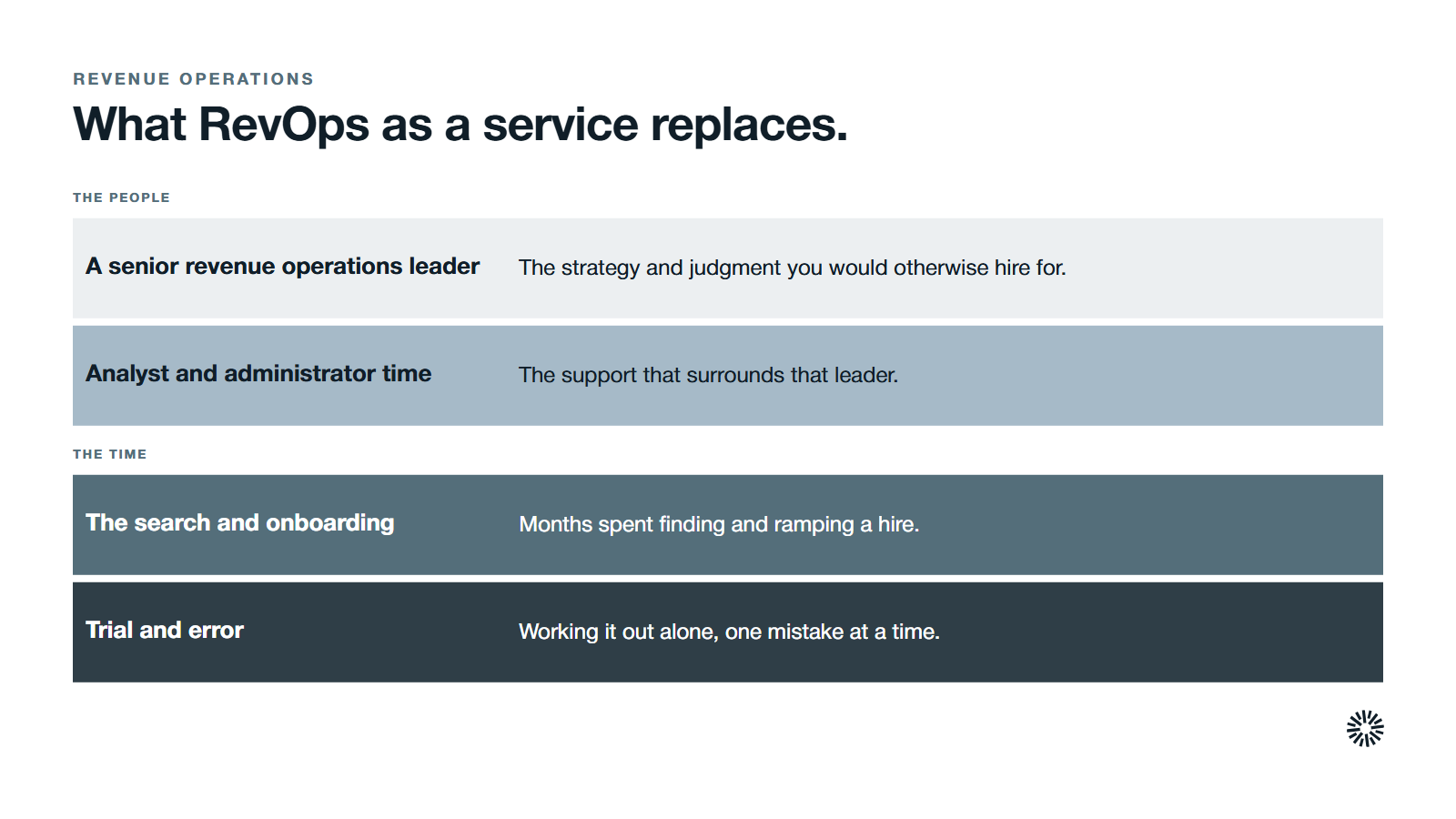
The revenue operations infrastructure a service builds substitutes for four things you would otherwise buy or build: a senior leader for the revenue operations function, the analyst and administrator time that supports that leader, the months spent searching for and onboarding them, and the trial and error of working it out alone.
Larger companies build whole revenue operations teams for this, which a growing company rarely can. Revenue operations is important here because it keeps the entire revenue engine pointed at one goal. It does not replace your sponsor. Someone senior inside the company must still approve changes and settle disputes between teams.
How the work follows the customer lifecycle
Revenue does not stop at the signed contract, so a good service manages the entire customer lifecycle and not just the pipeline. Customer lifecycle management links the revenue lifecycle into one system and follows the customer journey from first touch to renewal.
Marketing campaigns and lead scoring
Early work connects marketing campaigns to the pipeline they create. A shared lead scoring model then tells sales which leads deserve a call first, so the handoff between marketing and sales stops being a matter of opinion.
Sales processes and pipeline management
In the middle, the service sets stage definitions, pipeline management routines and deal rules. Reps know what a qualified opportunity looks like, and leaders can read the pipeline without asking for a spreadsheet.
Shared sales processes also give sales teams one view of the revenue cycle, which lifts sales performance without adding headcount. The same routines streamline lead routing and customer onboarding.
Customer success operations and retention
After the sale, customer success operations covers onboarding, health signals and renewals. Linking customer success data to the same records as sales shows which accounts are at risk, and it reveals customer behavior that points to a renewal or a problem.
Clean customer data makes this possible. Customer success teams then know when to step in, which supports customer retention, expansion and recurring revenue.
The costs to weigh before you decide
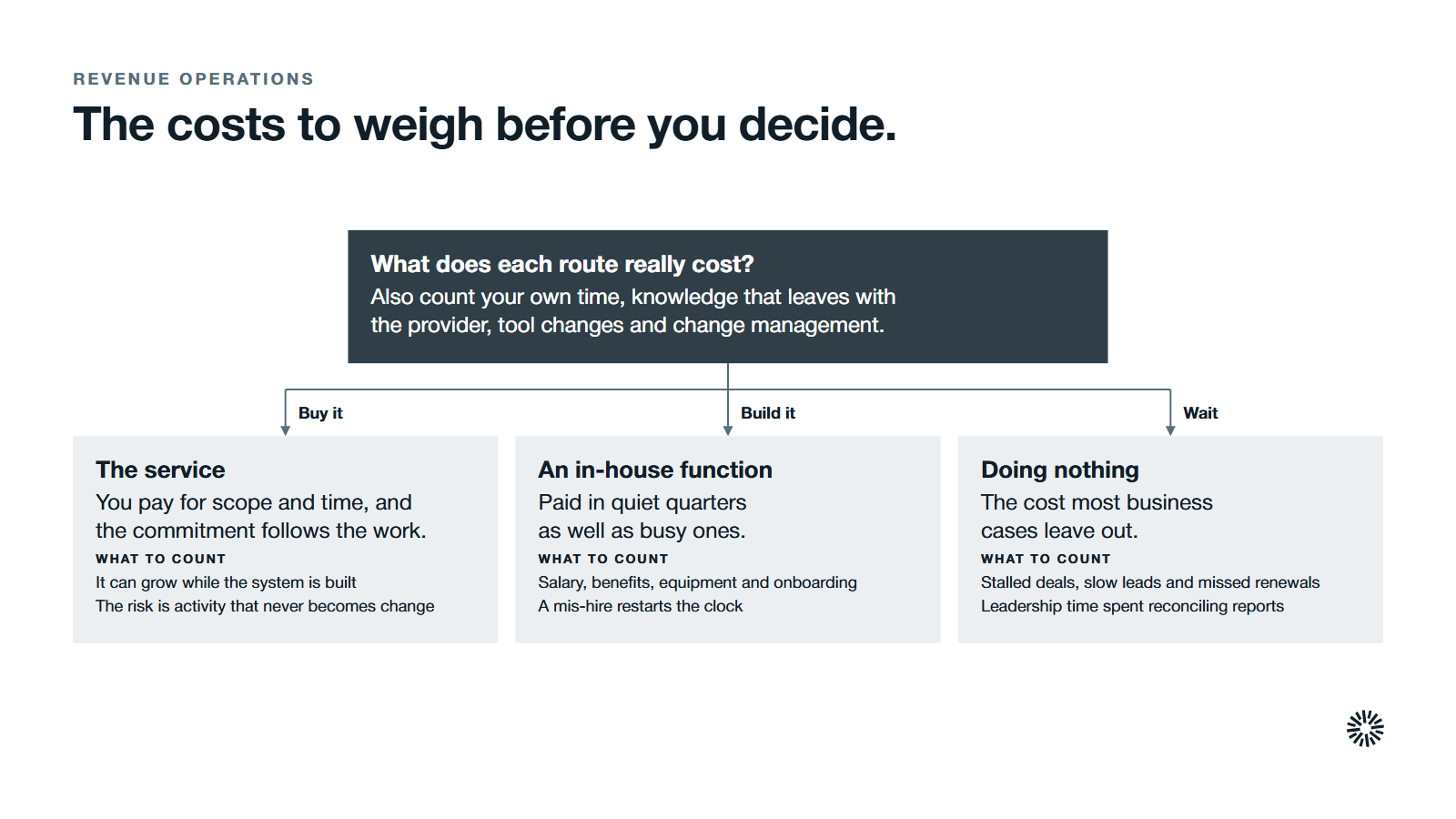
The fee is only one line. A fair comparison counts all of it, on both sides.
The cost of the service itself
You pay for the scope and the time. The advantage is that the commitment follows the work: it can grow while the system is being built and shrink once it runs. The risk is paying for activity that never turns into changes your team applies.
The cost of building it in house
An internal function carries salary, benefits, equipment, onboarding and the search itself. It is paid in quiet quarters as well as busy ones, and a mis-hire restarts the clock. If you are weighing outside help against a hire, read how revenue operations consulting compares with GTM Engineering to see where each model fits.
The cost of doing nothing
This is the cost most business cases leave out. It shows up as deals that stall at a broken handoff, leads that wait too long, renewals nobody saw coming, delays to final revenue recognition when contracts and invoices do not match, and leadership time spent reconciling reports.
The costs that are easy to miss
Some costs only appear after you sign:
- Your own time: someone senior must brief the team, review its work and make decisions.
- Knowledge that leaves with the provider: unless documents, definitions and dashboards are handed over, you rent understanding you should own.
- Tool changes: fixing the process can mean new configuration, licenses or integrations.
- Change management: teams must adopt new rules, and that takes attention.
When RevOps as a service pays back
The service pays back when the value of fixing the problem is larger than its cost, and when your team is able to apply the fix.
A simple way to test the return
Use this worked example, which is illustrative arithmetic and not a benchmark or a client result. Suppose broken handoffs cost you four qualified deals a quarter, and your average deal is $20,000. That is $80,000 of total revenue value at risk each quarter.
If a service recovers just one of those deals, it has returned $20,000 in a quarter. The question is whether that is more than the fee.
Replace the numbers with your own. Count deals lost to slow follow-up, stalled handoffs and missing data, then multiply by your average deal value. Compare that with what you would pay.
The key metrics that show it is working
Agree the measures before the work starts, so the result is not a matter of opinion:
- Forecast accuracy: the gap between forecast and actual closed revenue.
- Sales cycle length: how long deals take from first meeting to close.
- Lead-to-opportunity conversion: whether marketing campaigns produce pipeline.
- Net revenue retention: whether existing customers renew and expand.
- Customer lifetime value: how much each customer is worth over the relationship.
- Average revenue per account: whether accounts grow after the first sale.
- Time spent on manual reporting: hours your team gets back.
These revenue metrics give both sides a fair test of the engagement, because they were agreed before any work began.
Where the payback shows up first
Quick gains usually come from the cheapest fixes: shared definitions, a clean handoff between marketing and sales, and a single view of pipeline.
Gains in customer satisfaction take longer, because they depend on how well the customer journey is run after the sale. A consistent customer journey shows how satisfied customers are before they renew.
What to build at each stage of growth
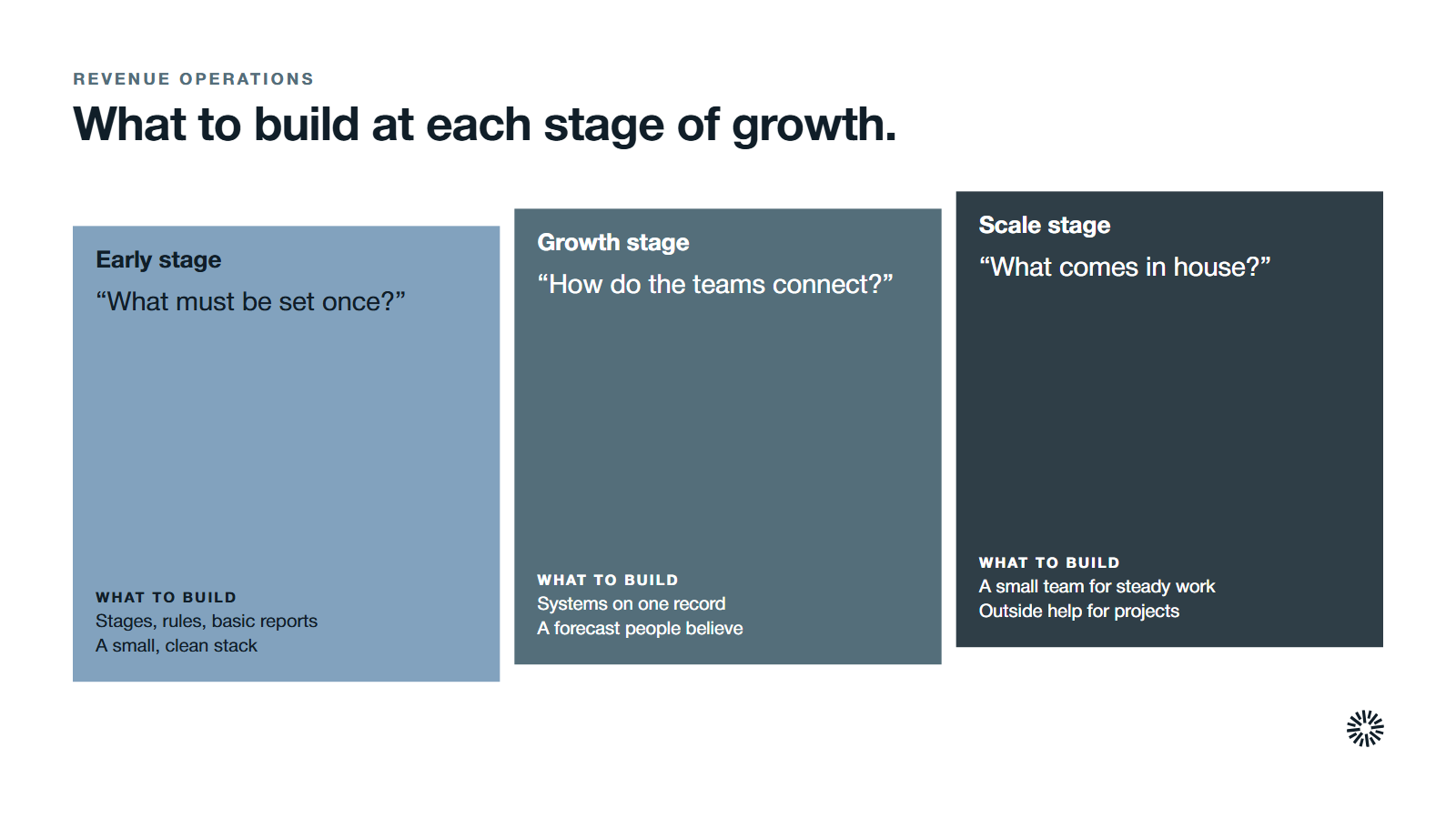
The right amount of outside help depends on where your company is. Build in this order, whoever does the work.
Early stage: set the foundations once
With a handful of reps and one CRM, the job is to define lifecycle stages, lead rules and basic reporting properly the first time. A service is often the cheapest route here, because the design is a project that ends. It also keeps the tech stack small and lays the base for sustainable growth.
Growth stage: connect the teams
Once sales teams, marketing and customer success all depend on the same data, the work shifts to integrated systems and a forecast people believe. This is where outside leadership usually earns its keep, because the cost of drift is rising. Centralizing revenue data improves decision-making and operational efficiency, and good revenue data management becomes the thing that holds the business together.
Scale stage: decide what to bring in house
When the work is steady and fills a role every week, build an internal revops team of one or two people and keep outside help for strategic initiatives and specialist projects. The service can write the hiring brief and train the first hire. Our guide to the revenue operations manager describes what that role involves.
What an engagement looks like and how to choose a provider
Engagements usually move through four phases: an assessment of how revenue flows today, a foundation of agreed definitions and data rules, implementation in the CRM and connected tools, and ongoing optimization. Because the provider brings proven frameworks, deployment can be quicker than building the same thing from scratch.
The model also flexes. Support can scale up while the system is built and down once it runs, and it often works on a retainer or subscription basis. You get immediate access to specialist expertise in strategy, systems and reporting that would be hard to hire in one person.
What to check in a provider
Look for industry experience with companies like yours and real technical capability in your CRM and automation tools. Ask how the provider will remove silos so data flows between teams, and which bottlenecks it would tackle first.
When RevOps as a service is not worth it
Some situations make the spend a poor bet:
- The process is stable and owned: if an internal leader already runs it well, outside help adds cost without much change.
- No sponsor will act: advice that nobody applies is expensive.
- The problem is not operations: weak product fit or an unclear market cannot be fixed with better handoffs.
- The scope is vague: without clear expectations, you cannot tell whether it worked.
- The work is daily and constant: a steady operational load at scale usually fits an employee better.
What you gain when this is done properly
Done well, revenue generation becomes a shared effort between sales, marketing and customer success.
The result is one set of definitions, one set of numbers and an owner for every handoff. That helps you drive revenue growth with fewer surprises, because leaders can make informed strategic decisions and data driven decisions from numbers they trust.
Revenue growth stops depending on heroics. It rests on revenue processes that every team follows, and that supports sustainable revenue growth.
Sales spends more time with buyers
Reps work from clean territories, clear stage definitions and a forecast that holds up. Less time goes to reconciling records and more goes to conversations that close, which helps revenue targets stay realistic.
Marketing sees what happens to its leads
Marketing can trace its work to pipeline and revenue, so budget moves toward what works. The argument about lead quality becomes a question about numbers both sides trust.
Customer success starts with the full story
Customer success teams inherit what was promised, who the buyers were and what was agreed. That supports onboarding, renewals and net revenue retention, and customers stop repeating themselves at every handoff. Over time, customer lifetime value rises and the result is predictable revenue growth, with steadier business performance across the entire revenue journey.
How Propello fits when you are weighing the cost
Propello offers RevOps as a service, so an experienced team can run revenue operations alongside your own people while you decide what to build in house. Propello also designs and builds connected go-to-market systems on HubSpot, and is a HubSpot partner; see about Propello.
If you want the problem sized and the first priorities agreed before you commit, an audit is the place to start.