
If your revenue data is unreliable, your handoffs between teams leak and nobody owns the fix, you are weighing fractional RevOps, also called fractional revenue operations, against a full-time hire. The short answer: choose fractional RevOps when you need senior direction without a permanent salary, and hire full time once the work is steady enough to fill the role every week.
This article is written for CEOs, founders and revenue leaders at growing B2B companies. It compares the two on cost, speed, scope and risk, then gives decision rules by company stage, so you can tell which one makes sense now and when to move from one to the other.
|
Fractional RevOps Fractional RevOps is an engagement in which an experienced revenue operations leader works with your company on a flexible basis, owning strategy and systems for part of the week instead of as a full-time employee. |
|
Full-Time RevOps Hire A full-time RevOps hire is a salaried employee who owns revenue operations inside your company every working day, usually as a manager or leader reporting to the CEO, the COO or a chief revenue officer. |
What fractional RevOps leadership looks like in practice
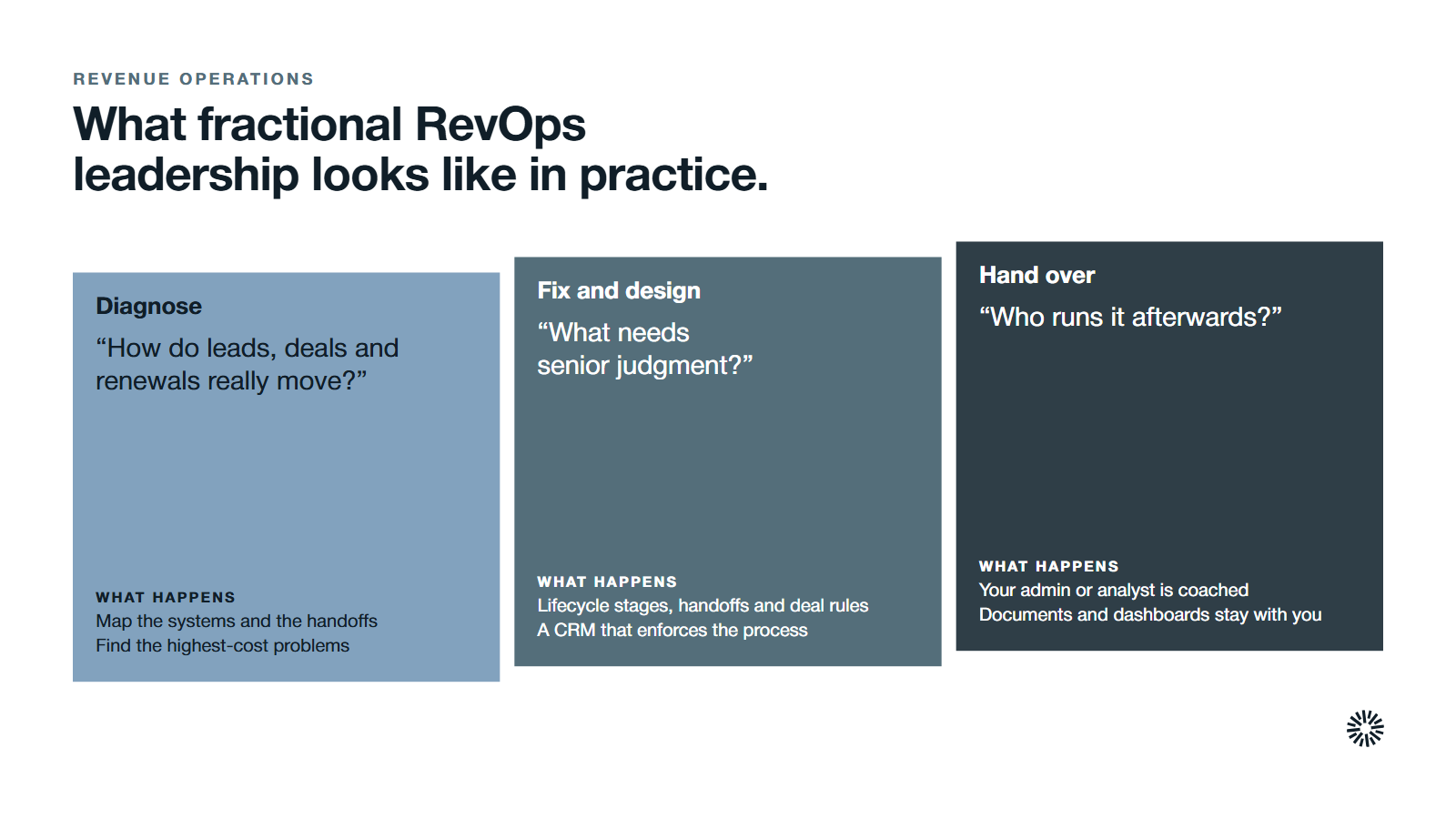
Fractional RevOps gives a growing company a senior revenue operations leader without making the role a permanent post. That fractional leadership model suits companies that need strategic oversight more than a daily operator. The fractional RevOps leader joins your leadership rhythm, looks across marketing, sales and customer success, and sets the revops strategy that your own team then runs.
Most engagements start with a diagnosis of how leads, deals and renewals actually move through your systems. From there the leader fixes the highest-cost problems first: unreliable data, unclear lifecycle stages, handoffs with no owner and reports that disagree.
Leaders in these engagements usually work at VP level, and they improve decision quality, not just task execution. Companies use the model to maintain momentum during growth phases, to close operational gaps during growth or restructuring, and to scale support up or down as phases and project needs change. The expertise arrives without the learning curve of a new hire, so improvements to processes can start early.
The work a fractional RevOps leader takes on
The scope is wide but selective. A fractional engagement concentrates on decisions and designs that need seniority, and it leaves routine tasks to your internal teams once the system is in place.
- Strategic direction: agreeing what the revenue process should be and which metrics prove it works.
- Process design: writing down lifecycle stages, lead handoffs and deal rules that every team follows.
- CRM configuration: shaping the CRM so the process is enforced by the system and not by memory.
- Data hygiene: setting the rules that keep records clean, and the checks that catch drift early.
- Data alignment and tech stack optimization: connecting the systems so data, workflows and analytics work across departments.
- Forecasting and customer journeys: building consistent revenue forecasting and mapping the customer journey from first touch to renewal.
- Coaching your own team: teaching an admin or analyst to run the day-to-day work alongside the leader.
How a fractional RevOps engagement is structured
Engagements take different shapes. Some are project based, such as a rebuild of lifecycle stages. Others are an ongoing engagement on a flexible basis, with a regular rhythm of planning and review. Most engagements agree the scope and clear expectations at the start, so both sides know what done looks like.
Most agencies and independent providers offer one of two shapes. A single fractional leader owns the strategy and the relationships, or a fractional team splits the work: a leader for strategy and a specialist for CRM implementation and CRM optimization. That gives you wider skills than a single hire, and the cost stays tied to the work.
Where fractional wins
Fractional wins on speed, range and flexibility. You start in weeks, you borrow the judgment of someone who has solved the same problem in other companies, and you can scale the commitment up or down as your needs change. The focus stays on outcomes, not on filling a seat.
Where fractional RevOps falls short
A fractional leader is not in the building every day. That suits design, planning and oversight, but it fits poorly when the business needs someone to answer a rep's question within minutes or manage a team of five operations specialists.
The model also depends on clear expectations. If nobody inside the company owns the follow-through, advice can pile up without being applied.
What a full-time RevOps hire gives you
A full-time RevOps hire gives you a permanent owner. The person learns your product, buyers and politics in depth, sits in every planning meeting and is available the moment a quota, forecast or system breaks.
A full-time RevOps leader can also grow a revops team around them and keep the operational execution in house. The trade is that you carry that commitment even in quiet quarters.
The role is covered in detail in our guide to the revenue operations manager, including what the job involves and how it differs from a sales operations post.
Where a full-time hire wins
Hiring in-house wins when the work is constant and the company can support the role. Three conditions usually point that way:
- Daily operational load: tickets, reports, territory changes and system admin fill the week.
- A team to lead: the function already has analysts or admins who need a manager.
- Depth over breadth: the business needs one person with years of context on its own data and customers.
The costs and risks of hiring full time
A permanent hire means a salary, benefits, equipment, onboarding and a search that can take months. The fully loaded cost is higher than the salary alone, and it is paid whether the workload is heavy or light.
Finding RevOps talent at the right level is slow, because the best candidates are often already employed and a full time executive profile commands a high salary. Your own team carries the load of the search while the problems keep growing.
The larger risk is a mis hire. A single leader rarely holds strategy, systems and day-to-day execution at the same level, so the person you hire for one strength may leave a gap in another. Replacing them restarts the clock.
Fractional RevOps vs full-time hire: how they compare
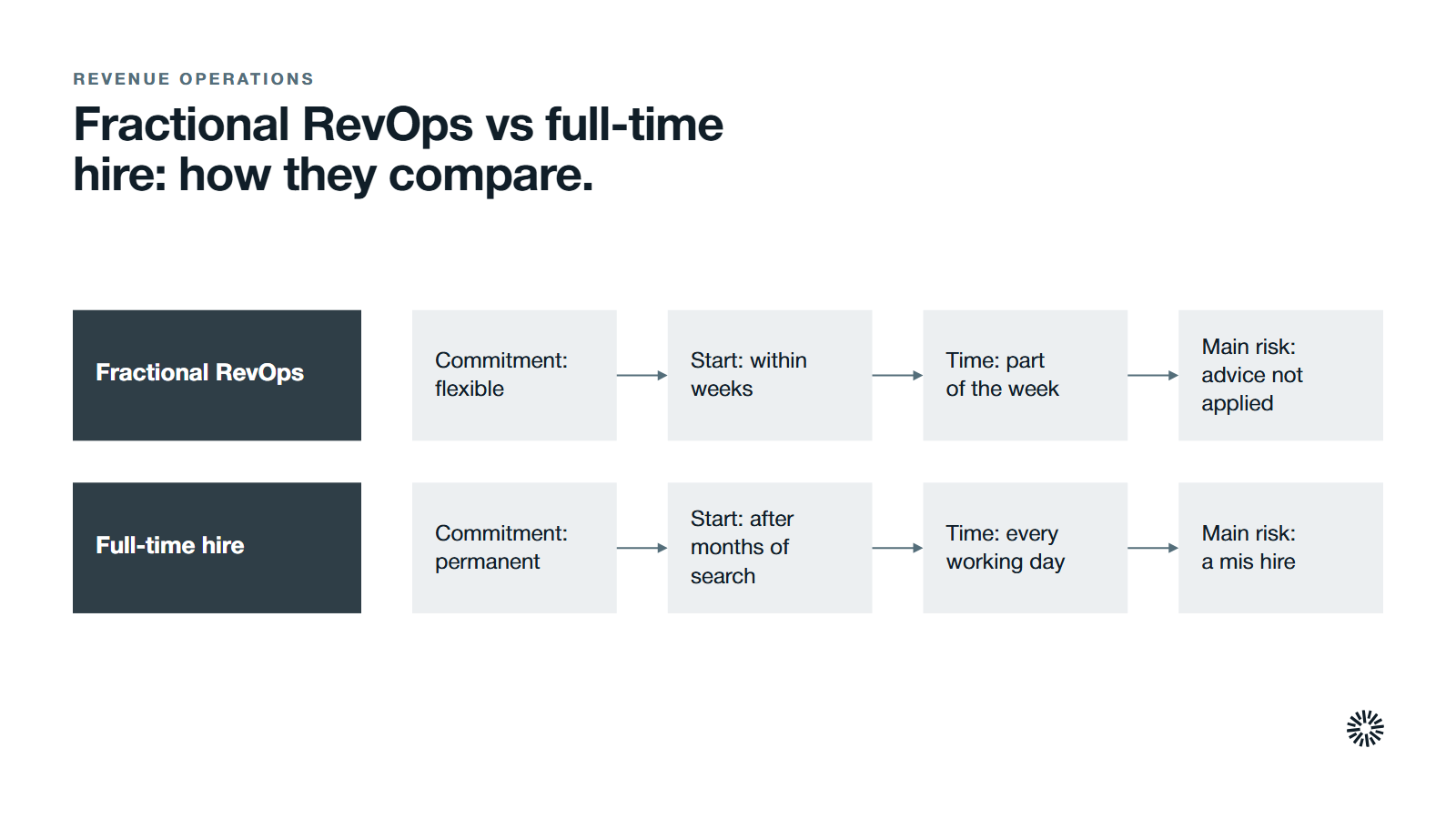
The two models differ less in what gets done than in how the cost, speed and commitment are arranged. The table sets them side by side on the criteria leaders ask about most.
| Criterion | Fractional RevOps | Full-time RevOps hire |
|---|---|---|
| Commitment | Flexible basis, scoped engagement | Long term commitment, permanent employee |
| Cost shape | Pay for the time and scope you need | Salary, benefits and overhead, whatever the workload |
| Time to start | Weeks, since no recruiting process | Months, after search, interviews and notice periods |
| Seniority | Senior leader at a fraction of the time | One person, level set by what you can afford |
| Availability | Part of the week, planned in advance | Every working day |
| Knowledge of your business | Builds up over the engagement | Deepens year after year |
| Best for | Design, repair and direction | Steady execution and team leadership |
| Main risk | Advice that no one inside applies | A mis hire, or a role with too little work |
The deciding factor is the shape of the work
Cost gets most of the attention, but the shape of the work matters more. Project-based work, such as a rebuild of lifecycle stages or a CRM clean-up, fits a fractional model because it ends. Continuous work, such as daily support for a large sales team, fits a full-time employee because it never does.
The market also points toward flexible talent. Many experienced revenue operations specialists now choose to work with several companies at once, so senior part-time help is easier to find than it used to be.
Which one fits your stage: decision rules by company stage
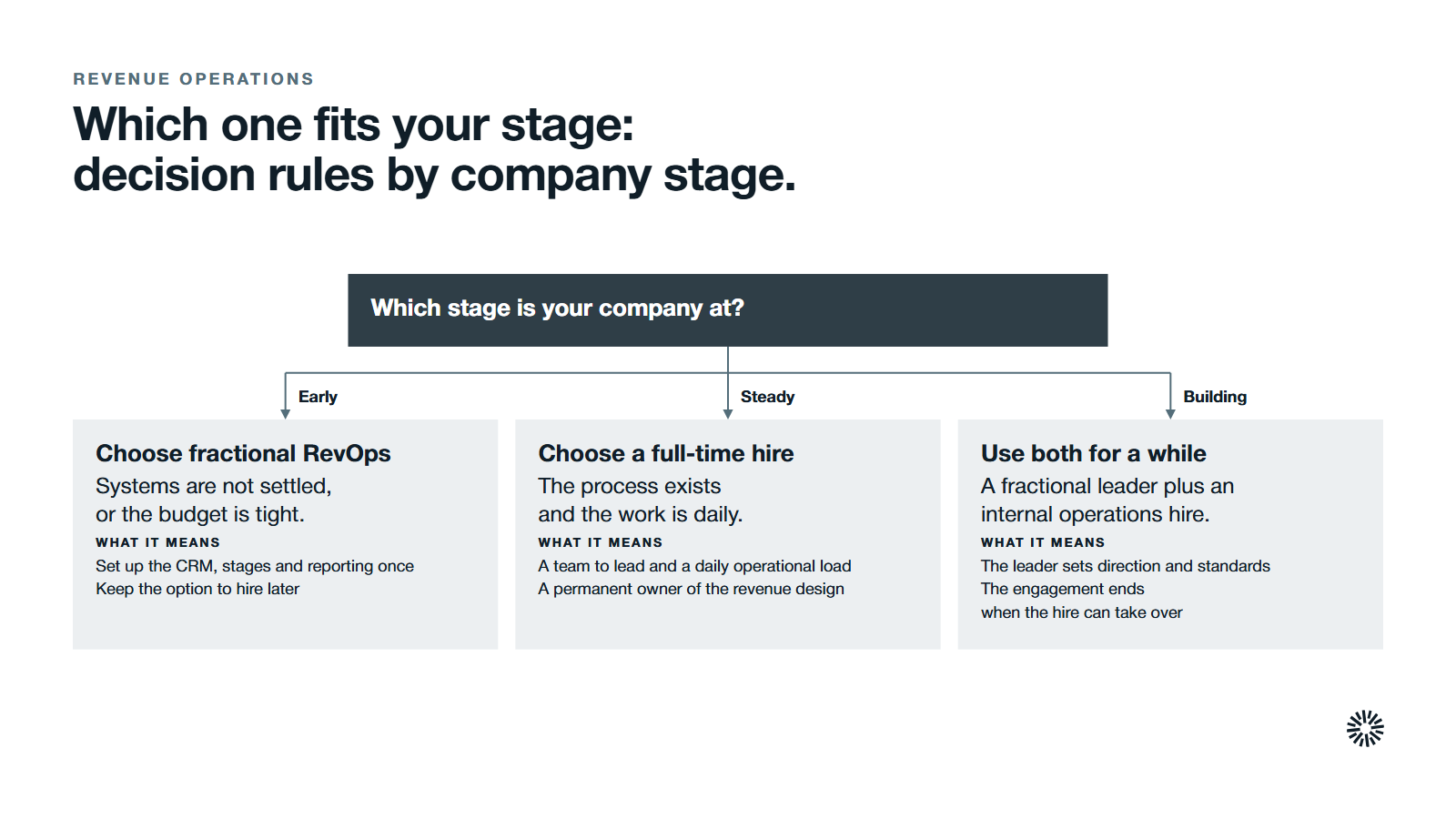
Pick by the stage and the problem, not by which title sounds more serious. Five rules cover most cases.
Choose fractional RevOps when you are early and the systems are not settled
A tech startup that has found product market fit and is adding reps, channels and tools does not need a full-time operations employee yet. It needs someone who has seen the pattern before, to set up the CRM, the lifecycle stages and the reporting once, correctly.
Choose fractional RevOps when budget constraints are real
If hiring a senior leader would take most of the operations budget, an engagement gives you experience you could not otherwise afford. You invest in the design now and keep the option to hire later with a clear brief.
Choose a full-time hire when the workload is daily and steady
Once the process exists and the work is constant, a full-time employee is more efficient than paying for scarce hours. That is the point where a revops team starts to form, with a leader and one or two analysts, and where the business can invest in a permanent owner of its revenue architecture.
Use both while you build the team
Many companies run a fractional leader and one internal operations hire together. The leader sets the direction and the standards, the hire handles operational execution, and the engagement ends when the hire is ready to take over the strategic work.
Do not hire full time to fix a design problem
When the real problem is that nobody has defined how revenue should flow, a new employee inherits the confusion. Settle the design first, ideally with outside help, then hire for the role the design requires. For the wider question of outside help, see revenue operations consulting vs GTM Engineering.
How to get the most from a fractional RevOps engagement
A fractional RevOps leader works best when the business is ready to act on the advice. The revops function is only as strong as the owner inside your company who applies it, so set up the engagement to make that easy.
- Name one sponsor: a single executive who approves changes and settles disputes between teams.
- Define your specific pain points first: the two or three problems that cost the business most, written down before the leader starts.
- Agree clear deliverables and timelines: so both sides can hold the engagement accountable.
- Measure against business metrics: judge the effectiveness of the engagement on the specific metrics and objectives you set at the start.
- Pair the leader with your own people: a revops team of even one analyst keeps the work running between sessions.
- Plan the exit from the start: every fractional engagement should leave documents, dashboards and definitions that your team can run alone.
Questions to ask a RevOps leader before you commit
Treat the first call as an interview, even when the leader is not joining as an employee. Ask what the difference is between what they will decide and what your team will decide. Ask which projects they have led at a business of your size, and which clients kept the results after they left.
Ask about their ability to work inside your systems, not only to advise on them. A leader who can configure the CRM, write the rules and train the team gives the business more than a slide deck. It also makes sense to ask how they handle services and tools you already pay for, so the plan builds on your resources and supports growth as you scale.
Mistakes to avoid when you choose
Most poor outcomes trace back to a handful of avoidable errors. Check your plan against this list before you commit to either model.
- Hiring before the scope is clear: a job description written without a diagnosis tends to describe the last person's strengths.
- Buying hours with no owner: a fractional leader needs one executive sponsor who can approve changes.
- Expecting one person to do everything: strategy, systems and daily admin rarely sit in one skill set.
- Skipping the handover: documents, definitions and dashboards should outlive any individual, fractional or not.
What you gain when this is done properly
Whichever model you pick, the result you want is the same: one agreed set of definitions, one set of numbers, and an owner for every handoff. Standardizing definitions and processes aligns departments, supports customer retention and expansion through systematic processes, and gives you consistent revenue forecasting. HubSpot's 2026 State of Marketing report found that 27.6% of more than 1,500 marketers named sales-marketing alignment among their top challenges, and that alignment is the problem a RevOps function exists to solve.
Sales spends its time on buyers
Reps and managers work from clean territories, reliable stage definitions and forecasts that hold up. Less time goes to arguing about the pipeline report, and more goes to conversations that can close. Sales and marketing agree on what a qualified lead is, which supports growth that does not depend on heroics.
Marketing sees what happens to its leads
With shared definitions, marketing teams learn which campaigns produce pipeline and which produce noise. Budget moves toward what works, and the argument about lead quality becomes a question about numbers both teams trust.
Customer success starts with the full story
Customer success inherits the record of what was promised and who the buyers were. That supports onboarding, renewals and expansion, and it stops customers repeating themselves at every handoff.
How Propello fits when you are choosing between the two
Propello offers Fractional RevOps: an experienced revenue operations leader who works alongside your own team, so you get senior direction without adding a permanent post. The focus is on your specific needs and the resources you already have. Propello also designs and builds connected go-to-market systems on HubSpot, so the leader works on a system that is built to last.
If you want the scope, the model and the first priorities settled before you hire, an audit is the place to start.
