
A revenue operations analyst turns revenue data from your CRM, marketing platform and billing records into reports, forecasts and recommendations that sales, marketing and customer success can act on. This article is for CEOs, founders and revenue leaders at growing B2B companies.
It matters because decisions made on unreliable numbers cost deals, and the analyst makes the numbers trustworthy. You will see the responsibilities, a typical week, the skills, how the role differs from the manager and the sales operations analyst, and when to hire one.
|
Revenue Operations Analyst A revenue operations analyst is the person who collects, checks and analyzes revenue data across sales, marketing and customer success, then turns it into reports and recommendations that improve revenue performance. |
What a revenue operations analyst does in the revenue engine
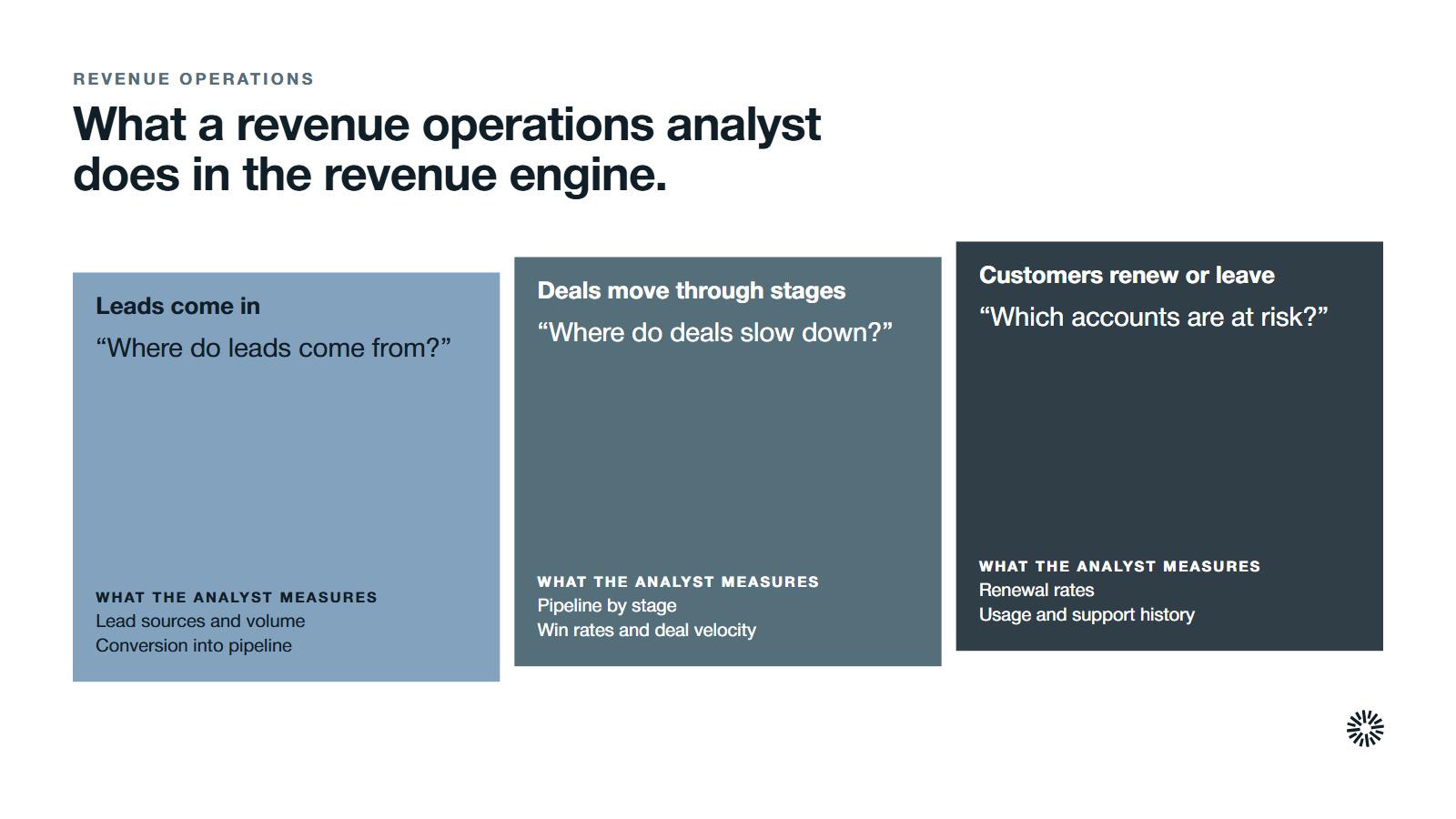
Every company has a revenue engine, even if nobody calls it that. Leads come in, deals move through stages, customers renew or leave. The analyst measures each part of that engine and tells leaders where it is running well and where it is losing power.
The role sits inside the wider discipline of revenue operations (RevOps). For the full picture of that discipline, read our guide to what revenue operations is.
A revenue operations analyst sits between the raw data and the leaders who use it. The revenue operations analyst role is also called a RevOps analyst, and job ads for it appear as revenue operations analyst jobs.
Where a manager decides what to change, the analyst supplies the evidence for the decision. Without that evidence, leadership meetings turn into arguments about whose spreadsheet is right.
The analyst turns fragmented data into one coherent view of the go-to-market motion, finds bottlenecks in the customer journey that slow sales, and gives the business a sound base for sustainable growth.
The key responsibilities of a revenue operations analyst
Job descriptions vary, but five areas of work appear in nearly every one. Together they explain why a growing company needs a dedicated revenue operations analyst rather than a few spreadsheets kept by whoever has time.
Data analysis and reporting
The core of the job is data analysis. The analyst tracks key performance indicators and builds the reports leadership reads every week: pipeline by stage, sales conversion rates between stages, deal velocity, win rates and renewal rates.
Clear revenue reporting standards mean every report uses the same definitions, so a number means the same thing in every meeting. The analyst builds shared metrics that sales, marketing and customer success all use, which keeps the teams aligned.
The analyst also answers questions nobody planned for. Why did conversion drop in one segment last month? Which lead source produces customers that stay? This ad hoc analysis is often where the role earns its keep.
It also helps leaders identify trends in buyer behavior and market trends that change demand, so planning does not rest on last year's pattern.
Pipeline and revenue forecasting models
Forecasts are only as good as the model behind them. The analyst builds and maintains revenue forecasting models that use historical data, current pipeline and stage-to-stage conversion rates to predict what will close, using performance metrics that sales and finance both accept.
Accurate forecasts depend on clean, reliable data. Then the analyst compares each forecast with what actually happened and adjusts the model.
That feedback loop is what moves sales forecasting from opinion to method. It also lets the chief revenue officer see early when pipeline coverage ratios are too low to hit the target, a point our guide to revenue operations metrics covers in more depth.
Data management and data integrity
Reports are worthless if the records beneath them are wrong. The analyst protects customer data by watching for duplicate companies, missing owners, stale deal dates and fields that people fill in differently. Protecting data integrity means setting rules for each field and checking that they hold.
Data governance standards like these stop errors from turning into revenue leakage, and clean CRM data speeds up every decision that follows. Expect a good share of the analyst's time to go on data cleansing.
This is quiet, repetitive work, and it matters. Salesforce's 2024 State of Sales research found that only 35% of sales professionals completely trust the accuracy of their organization's data. Our article on CRM data quality explains why that gap hurts.
CRM management and tech stack management
The analyst works inside your CRM systems daily: building properties, reports and dashboards, and checking that integrations pass data correctly between systems. Good CRM management keeps every report tied to a field someone owns.
The analyst documents workflows so handoffs between teams stay smooth, and tech stack management also means watching for tools that overlap, fields that no longer feed any report and connections that have quietly broken.
Larger changes, such as a new routing model or a platform migration, usually belong to the manager. The analyst tests the data before and after, so nobody has to guess whether the change worked, and brings the numbers to strategic planning sessions across departments.
Process optimization and revenue leakage
Revenue leaks where handoffs are slow, records are incomplete or a stage has no clear owner. The analyst reviews revenue operations processes such as lead routing, approvals and renewals, looks for those places in the data, measures how much they cost, and proposes process optimization that closes them.
A deal that waits a week for approval shows up as a long gap between two stage dates.
Finding and sizing revenue leakage gives the team a ranked list of fixes rather than a list of complaints. Those fixes feed the strategic initiatives that leadership funds each quarter.
What a revenue operations analyst does in a typical week
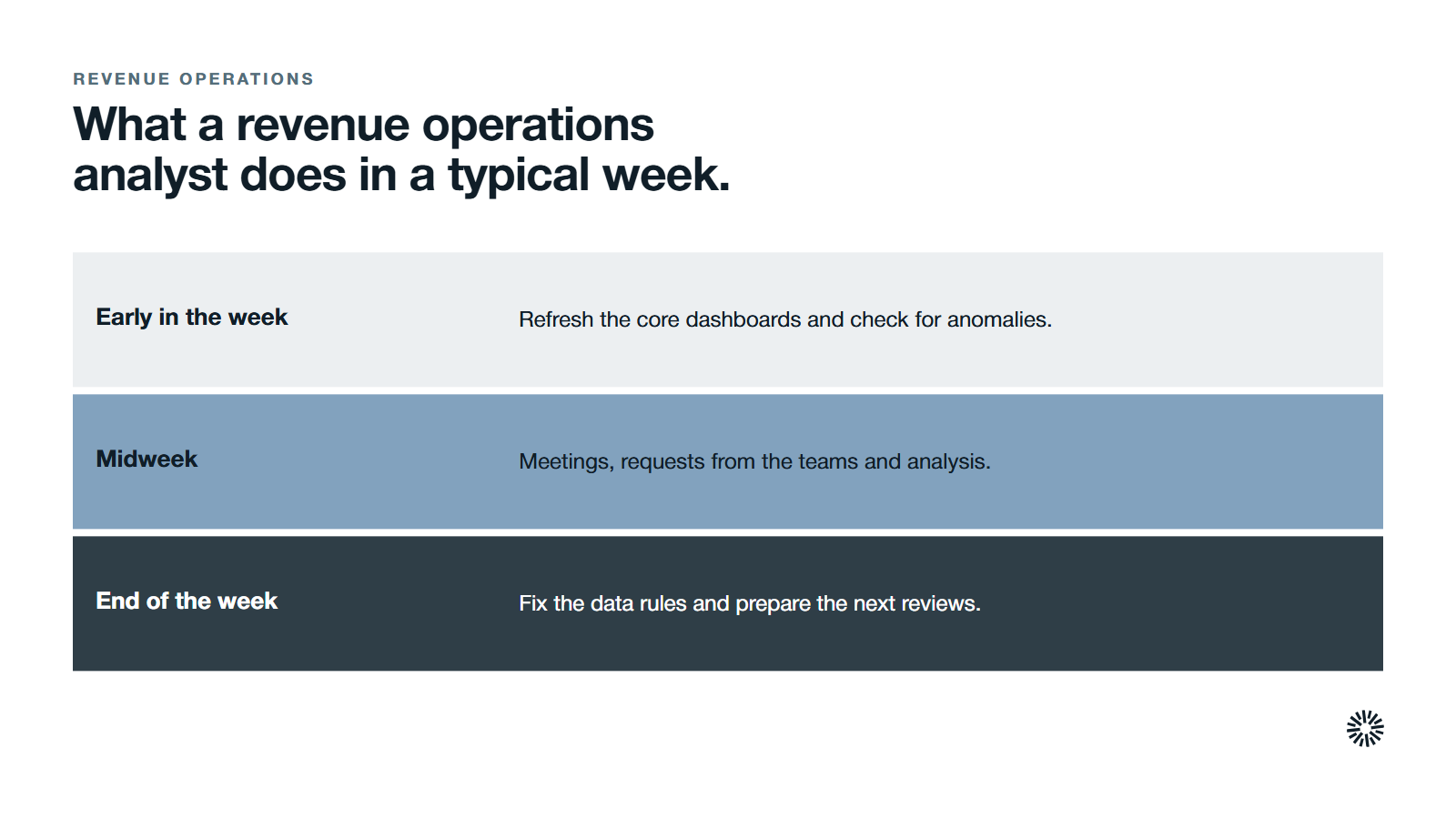
The shape of the week changes with company size, but the rhythm is steady. Early in the week the analyst refreshes the core dashboards and checks for anomalies. Midweek goes to meetings and analysis. The end of the week is for fixes and for preparing next week's reviews.
A typical week includes four kinds of work:
- Refreshing and checking the dashboards leadership uses to run pipeline reviews.
- Answering requests from sales, marketing and customer success teams, such as a cohort comparison or a lead source report.
- Cleaning data and fixing the rules that let bad records in.
- Preparing the monthly or quarterly business review, including the story the numbers tell.
Much of this work is repetitive, so a good analyst automates routine tasks wherever the data allows. Salesforce's 2026 State of Sales survey of 4,050 sales professionals found that the average seller spends 40% of their time selling.
The analyst's reporting and data work removes some of the manual effort behind the rest.
How the analyst works with sales, marketing and customer success
The analyst serves several audiences at once, and each wants something different. Sales teams want clean pipeline views, marketing wants proof of what works and finance wants numbers that reconcile.
Good cross functional teams agree early on definitions, because most disputes about performance are really disputes about what a number means.
With sales and marketing teams, the analyst tracks how leads become pipeline and revenue, and shows which campaigns and segments produce deals that close. Sales leaders get conversion and cycle length by rep and by segment, which helps them coach.
With customer success teams, the analyst joins product usage, support history and renewal dates in one view. That makes it possible to spot accounts at risk before the renewal conversation, and to find accounts ready for expansion.
With finance, the analyst reconciles bookings and billing so that both teams report the same revenue streams. That shared view of the revenue lifecycle is where trust in the numbers comes from.
The skills a revenue operations analyst needs
Strong candidates combine technical depth with the judgment to know which question matters. Tool lists on job ads change every year, but these skills last.
Analytical skills and business intelligence
The analyst must be comfortable with analyzing data: pivoting, segmenting, building formulas and reading a trend line without being fooled by it. Attention to detail prevents costly mistakes, and a firm grasp of core SaaS and B2B metrics is essential.
Familiarity with business intelligence tools, basic SQL and financial analysis helps, because it lets the analyst go past the reports a CRM provides by default. Data visualization tools then turn the results into dashboards that show revenue performance at a glance.
Equally important is knowing which metric answers which question, and spotting when a definition has distorted a number.
CRM systems and data tools
Hands-on experience with CRM systems is the entry ticket: objects, properties, workflows, permissions and reporting. Add data analysis tools such as spreadsheets and dashboards, plus knowledge of how marketing automation platforms pass leads into the CRM.
Candidates do not need to know your exact software. They need to learn it quickly and understand the data model underneath.
Communication and stakeholder management
An analysis that nobody understands changes nothing. The best analysts explain findings in plain language, name the decision the data supports and make a recommendation. They work with key stakeholders across departments without taking sides in turf disputes.
Data storytelling, meaning a clear chart plus one sentence on what to do about it, is a skill worth testing in interviews.
Project management and problem-solving
Most fixes cross several teams, so the analyst needs enough project management to scope a change, assign owners and follow up. Problem-solving ties it together: finding the cause of a metric swing instead of reporting the swing.
Increasingly the role includes using AI features in the CRM to flag anomalies and summarize reports. Those tools help only when the underlying data is sound, so data accuracy stays the foundation.
How the role differs from the revenue operations manager and the sales operations analyst
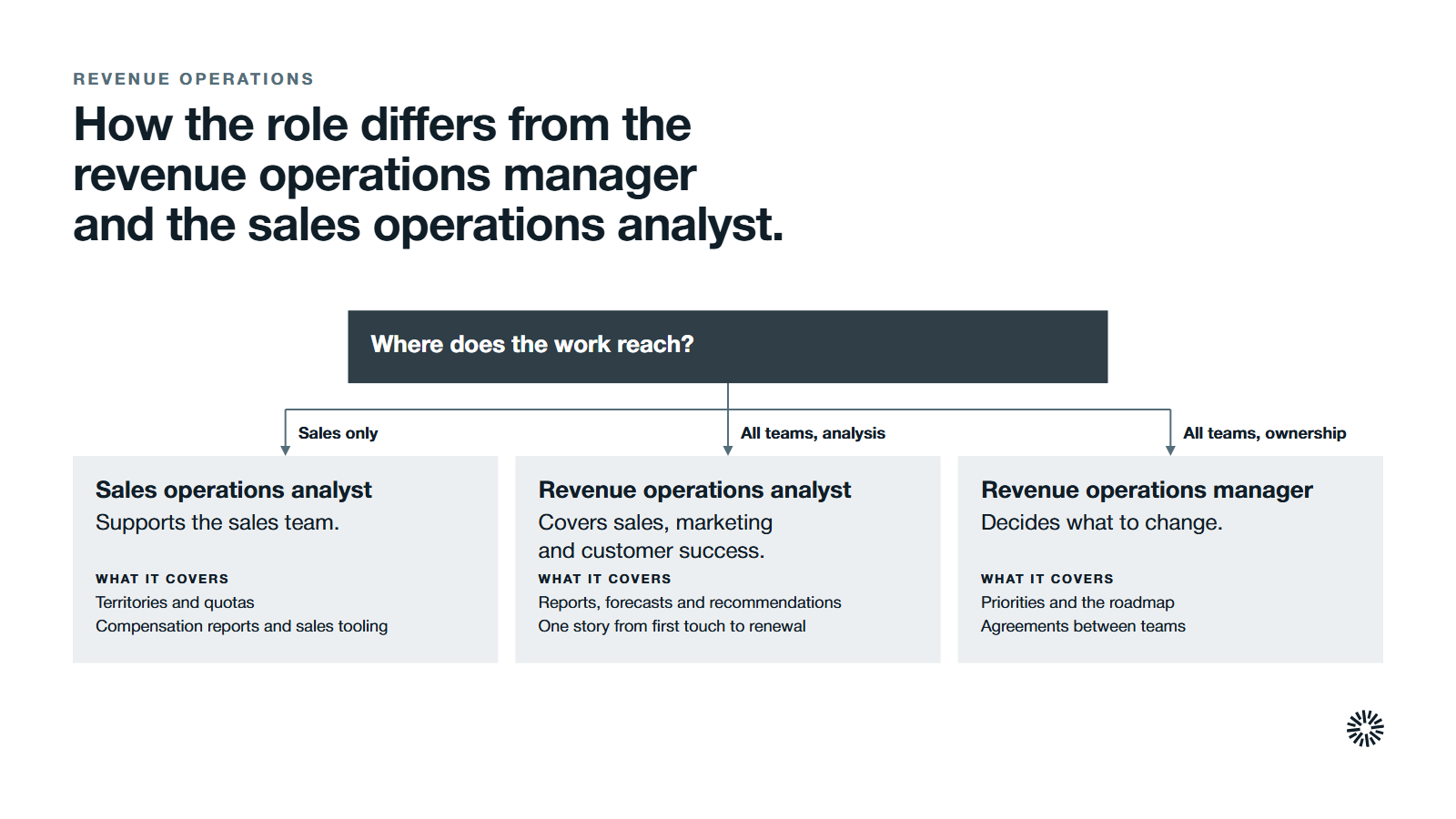
These titles overlap, and employers use them loosely. Scope is the cleanest way to separate them.
A revenue operations manager owns priorities, the roadmap and agreements between teams. Our guide to what a revenue operations manager does covers that role in full. In a revenue operations team the analyst typically reports to the manager, or in a small company to the head of revenue operations.
A sales operations analyst covers the sales side only: territories, quotas, compensation reports and sales tooling. A revenue operations analyst covers the same analytical ground but across marketing and customer success too, so the same data tells one story from first touch to renewal.
A marketing operations analyst, in turn, focuses on campaign systems, lead flow and attribution, and a mature setup keeps marketing operations and revenue operations on the same definitions. Our guide to what marketing operations is explains that function.
A data analyst or business analyst in another department may use similar methods, but without the revenue context the work stays generic.
How a revenue operations analyst supports revenue growth
The analyst does not close deals or run campaigns, so the contribution to revenue growth and revenue generation is indirect. It appears in the quality of decisions leaders make with better information.
When pipeline coverage is thin, the analyst shows it while there is still time to act. When one segment converts better than another, the analyst gives leaders the evidence to shift investment there.
Informed decisions about where to hire, spend and focus are what help a company maximize revenue growth, open new revenue streams and strengthen revenue management overall. Data driven decision making of this kind is the point of the role.
The same analysis improves operational efficiency. Removing duplicate entry, fixing a slow handoff or retiring an unused report gives hours back to people who sell and serve customers.
What you gain when this is done properly
When a dedicated analyst owns revenue reporting, the debate shifts from whose number is right to what the number means. Every team benefits from the same trusted facts.
Sales
Reps and sales leaders see pipeline, conversion and cycle length from one agreed source. Coaching is based on data rather than anecdotes, and forecast calls spend less time on reconciliation and more on the deals that matter.
Marketing
Marketing can show which channels and campaigns lead to revenue rather than only to leads. Lead definitions match the ones sales uses, so budget conversations rest on results both teams accept.
Customer success
Customer success gets a single view of usage, support history and renewal dates. Accounts at risk surface earlier, and expansion conversations begin with facts about how the customer actually uses the product.
When to hire your first revenue operations analyst
The signals are practical. Reports take days to assemble and still get challenged. Forecasts miss and nobody can explain why. The CRM is full of fields that nobody trusts. Leaders keep asking for analysis that sales operations or marketing cannot produce alone.
If two or three of those sound familiar, a dedicated revenue operations analyst will pay for itself. Decide the first questions the person must answer, who they report to, and which systems they need access to.
Career growth opportunities are good for the right person. The usual path runs from analyst to senior revenue operations analyst, then to manager and director. For a small company, a fractional RevOps arrangement can cover analysis until the workload justifies a permanent hire.
A revenue operations analyst gives your revenue engine a trusted set of numbers
The role exists because growth creates more tools, more teams and more definitions, and someone has to make the numbers agree. The right analyst gives every revenue team the same facts and gives leadership time to act on them.
Propello designs and builds connected go-to-market (GTM) systems on HubSpot, and is a HubSpot partner (see about Propello). If you are weighing this role against what your data can support today, an audit is the place to start.
