Your pipeline looks healthy. Your team is active. Demos are booked, proposals are sent, and your CRM is full of records. Yet closed revenue stays flat, retention is choppy, and forecasts miss quarter after quarter. Revenue leakage is quietly draining the results your team has already earned.
You have already hired more reps, coached harder, and added tools. The problem is not effort. Revenue leakage occurs in the gaps between stages, in manual processes that depend on someone remembering the next step.
This article shows where revenue leakage hides across your go-to-market journey and how a designed, automated system closes each leak. If you are new to GTM Engineering, it is the discipline built to solve exactly this.
|
Revenue Leakage Revenue leakage is revenue you earned the right to win or keep and lost through process gaps inside your own go-to-market, not through competition. |
What revenue leakage looks like in your business
Look for these symptoms in your CRM and your weekly reviews:
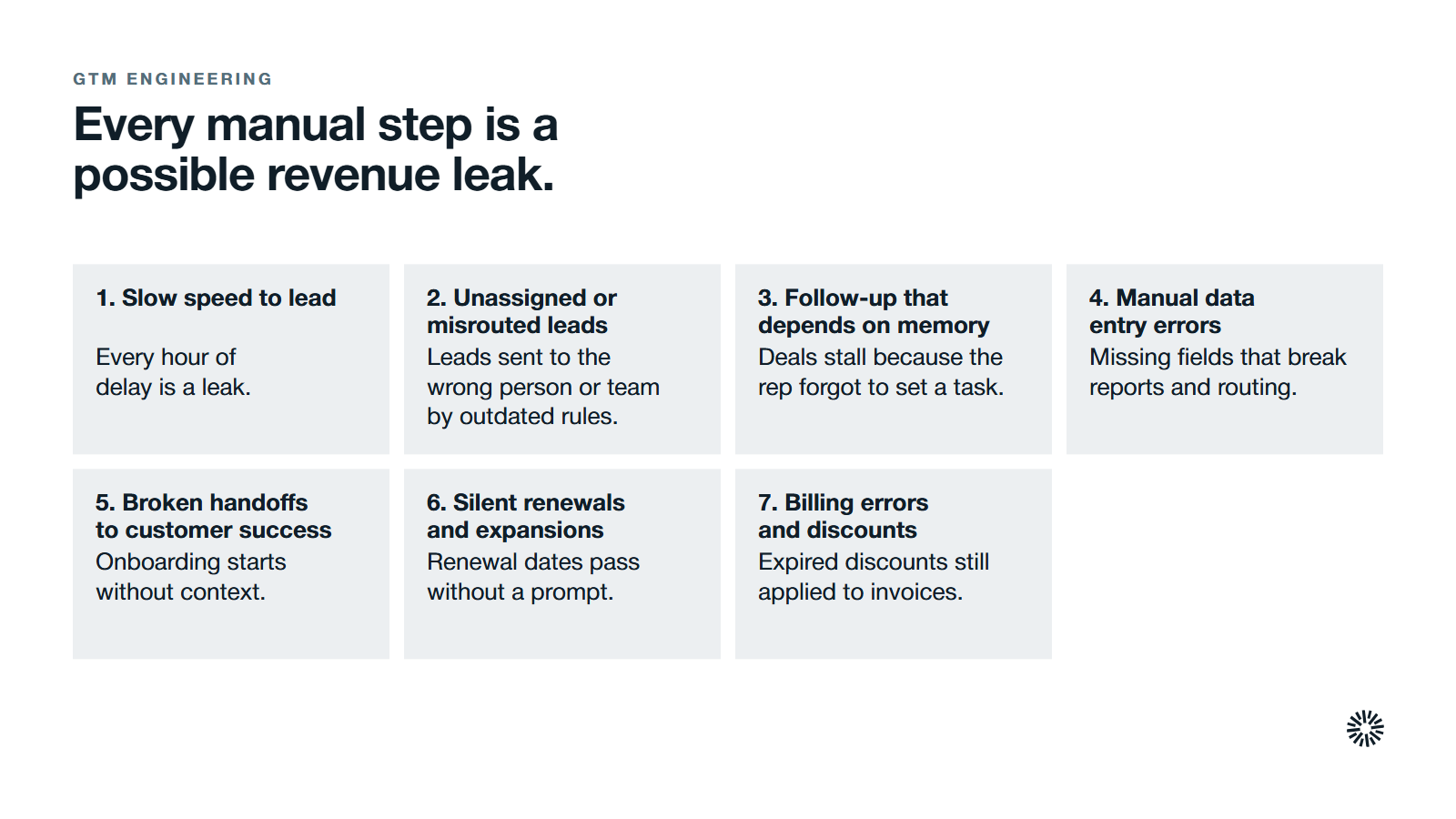
- Slow speed to lead. Inbound leads sit for hours or days before anyone makes contact. Every hour of delay is a leak.
- Unassigned or misrouted leads. Records created with no owner, sitting in a queue nobody checks. Leads sent to the wrong person or team by outdated rules.
- Follow-up that depends on memory. Proposals go out with no next step scheduled. Deals stall because the rep forgot to set a task, and no workflow caught the gap.
- Manual data entry errors. Lifecycle stages updated by hand. Deal values typed incorrectly. Missing fields that break reports and routing. Human error is normal here, and the process invites it.
- Broken handoffs to customer success. Sales closes the deal, but onboarding starts without context. Customer success never receives qualification notes, expectations, or usage goals.
- Silent renewals and expansions. Renewal dates pass without a prompt. Expansion opportunities are never surfaced because nothing tracks usage or triggers outreach.
- Billing errors and discounts. Expired discounts still applied to invoices. Contract terms not carried correctly into billing systems, so you under-bill or collect late.
Common examples of revenue leakage
Revenue leakage is most often described as a finance and billing problem. That meaning is real, and it belongs to your go-to-market too, because the errors start in sales and operations long before they reach finance.
Pricing errors are the plainest case. A rep offers a discount nobody approved, or the contract document carries old pricing, and you sell for less than you intended. Unbilled services work the same way: the work is delivered and never invoiced.
Contract terms that nobody enforces leak quietly. A price increase goes unapplied, a renewal rolls over on old rates, or a customer passes a usage limit without being charged. Failed payments nobody chases do the same. Manual checks also leave room for fraud, and one wrong transaction can sit unseen in the records.
Purchase order mismatches follow the same pattern. The line items on a purchase order differ from what you invoiced, and nobody reconciles them. For example, a rep who copies an old contract PDF into a new deal can carry outdated pricing along.
Each mismatch is a small transaction, but invoices, payment terms, and service documents all have to agree with the contract, and manual processes rarely check that they do.
Compliance matters too. Discount approvals and contract terms are controls, and bypassing them hurts both your cash and your revenue recognition. Role based access in your CRM, so only approved people can change prices, is one of the most effective ways to protect them.
Companies of every size meet these patterns. A business that sells software or services will find an example of each in its own invoices, and the document trail behind each sale shows where the process broke. Each example costs little alone, but the value lost adds up.
In product businesses, a mistyped order can even cause inventory management errors that end in missed payments.
All of this is revenue leakage, not revenue loss. Revenue loss comes from missed sales or a shrinking market. Revenue leakage occurs after the obligation to pay exists, when the money was yours and your business processes failed to collect it. Tightening the order-to-cash process, from quote to payment, is how you close it.
The scale is not small. In a December 2025 research note, MGI Research describes revenue leakage as a problem that represents at least three to five percent of every company's revenue.
Why revenue leakage happens in manual operations
Your employees are not careless. The business processes they work inside were never designed end to end.
Your go-to-market runs on memory instead of workflows
In most teams, tasks, reminders, and follow-ups live in personal inboxes, chat threads, or spreadsheets. No shared workflow enforces what happens next. Routing is decided ad hoc, by whoever notices the inquiry first or whoever is free.
Lead response time is where this shows first. A 2011 Harvard Business Review audit of 2,241 U.S. companies found that only 37% responded to a web lead within an hour, and 23% never responded at all.
Among the companies that did reply within 30 days, the average response took 42 hours.
What is speed to lead?
Speed to lead is how fast a person gets a real reply after showing interest.
What is the five minute rule for leads?
The five minute rule is a common sales rule of thumb: respond to a new lead within five minutes. The Harvard Business Review study above measured responses within an hour, and it points the same way. The sooner you respond, the better your odds.
Manual data entry corrupts the signal your teams depend on
Reps and customer success managers retype data between tools, update fields after calls, and adjust deal stages from memory. Small errors pile up: a wrong owner, a skipped lifecycle stage, a missing renewal date. Finance then struggles to apply revenue recognition rules cleanly.
Reps also carry the load. Salesforce's 2024 State of Sales research found that sales reps spend 70% of their time on non-selling tasks, which leaves little room to keep records clean. The effect on sales productivity is its own cost.
Trust follows. In the same research, only 35% of sales professionals completely trusted the accuracy of their organization's data. When the records are the problem, nobody can identify discrepancies because the reports built on them look fine.
Handoffs between teams break the customer journey
Marketing, sales, and customer success each hold their own view of the customer. Marketing defines a qualified prospect one way. Sales defines it differently. When a prospect moves between teams, context disappears and expectations set during the sale never reach the person running onboarding.
In HubSpot's 2026 State of Marketing survey, 27.6% named sales-marketing alignment among their top challenges.
Nobody owns the end-to-end revenue system
Marketing ops, sales ops, finance, and customer success each own a piece. No single business area owns the full journey from first touch to renewal, and the gaps between those teams are where leakage lives. Tool sprawl widens those gaps.
Slow response, missing follow-up, and silent renewals recur because nobody has the mandate to map, monitor, and fix the whole engine. This is why GTM teams need GTM Engineering as a discipline, not just more headcount in each silo.
Why revenue leakage stays hidden
The true value of what you lose never appears on a report. No report shows a deal that never started. There is no line item for a lead nobody called, a renewal nobody pursued, or an expansion nobody was prompted to raise. Revenue leakage is the absence of an event, and dashboards only count events.
It can sit unnoticed until a financial audit surfaces it, hurting cash flow and profitability in the meantime. Billing errors, for instance, tend to surface only then, and your employees cannot report what they never see.
You are not alone in this. A July 2020 article by Boston Consulting Group reported that, in an international survey of more than 2,000 business leaders, 45% said revenue leakage is a systemic problem facing their companies.
The damage shows up indirectly: forecasts become lumpy and cash arrives late, even when demand is healthy.
Every manual step in your business processes is a possible leak, and every leak compounds.
How to find the leaks in your own business
Revenue leakage is easiest to find by tracing one journey end to end and timing every handoff. Pick a recent closed-won deal and follow it from first touch to renewal. Write down who touched it, how long it waited between each touch, and where a person had to remember something or retype data.
Then use saved views in your CRM to find unowned leads, deals with no scheduled next step, and records owned by reps who have left.
Do the same on the billing side. Compare what was sold with what was invoiced. Look for invoiced amounts that differ from contracted pricing, unbilled services, and renewals that lapsed. Regular audits like this keep gaps from piling up, and each gap is a leak with a location, an owner, and a cause.
How to stop revenue leakage once you find it
The best strategies start small. Treat earned revenue as an asset your team protects, and address one leak at a time. Review your business processes where the trace showed delay, and automate the step where each leak starts, such as routing, quote approval, or payment reminders.
Assign an owner for every account and renewal, check each transaction against its contract, and alert on overdue invoices. Integration between your CRM and billing is the usual place to begin.
Establish a monthly check on payment status, billing accuracy, and account health, and create one source of truth for contract terms, with the document stored beside the deal. Add a short compliance checklist for pricing and discount approvals.
Automation can flag a mismatched invoice, a missed payment, or a lapsed discount on a key account before it costs you. Software helps, but design comes first: decide who owns each step, then let the technology enforce it and collect the money you earned.
What a designed, automated system looks like
A lead fills out a form and is routed to the right account executive within minutes, based on territory, company size, and fit with your ideal customer. No person decides where it goes. No lead sits unassigned. Speed to lead is measured and enforced by the system.
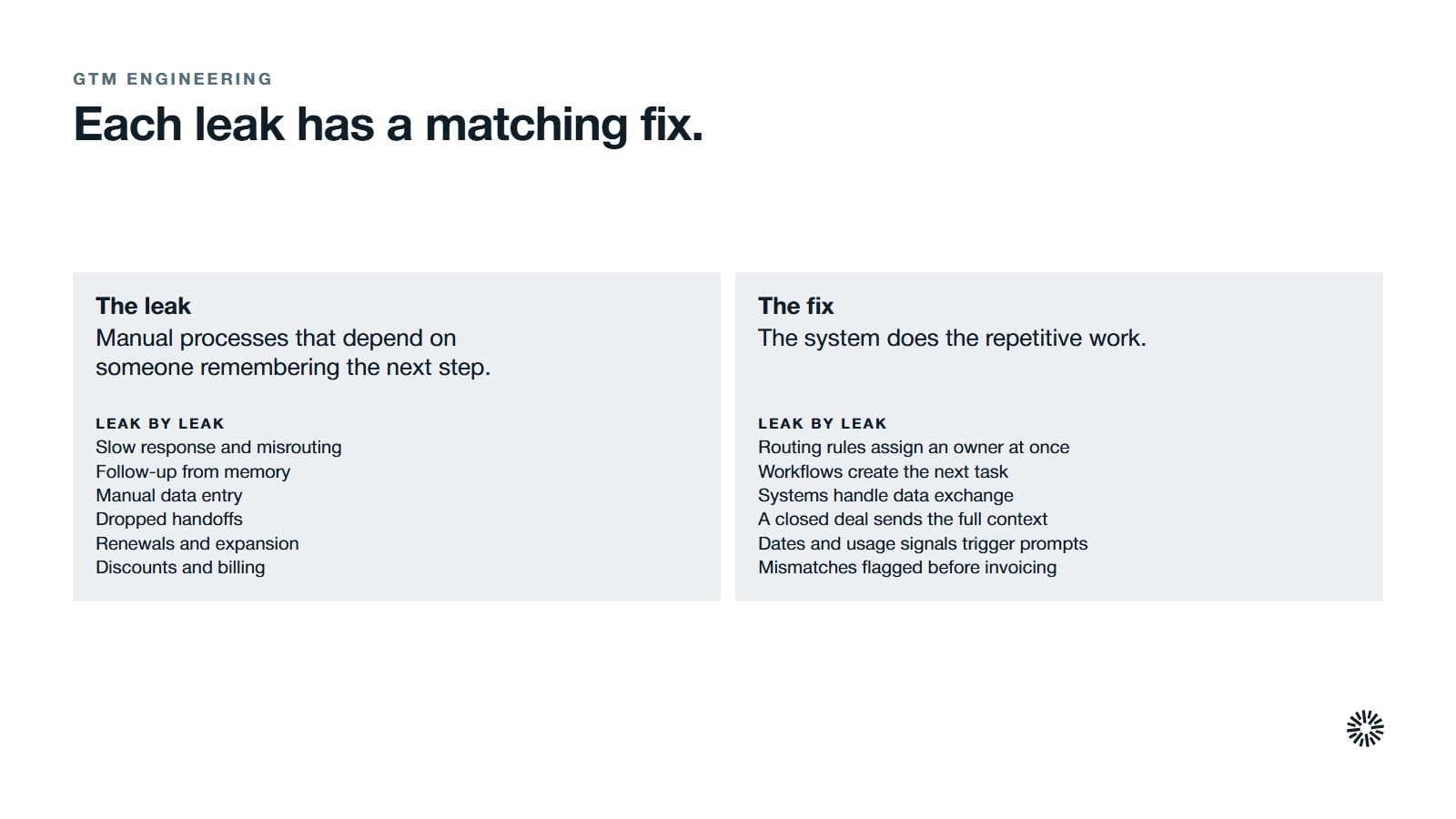
Each leak has a matching fix:
- Slow response and misrouting: routing rules assign an owner at once and alert them, with escalation if nobody acts.
- Follow-up from memory: workflows create the next task when a stage changes.
- Manual data entry: connected systems handle data exchange between stages, so nobody retypes fields.
- Dropped handoffs: a closed deal sends customer success the full context automatically.
- Renewals and expansion: contract dates and usage signals live in one place and trigger prompts well before the moment passes.
- Discounts and billing: integration between the CRM and billing systems carries contract terms into invoice generation, which improves billing accuracy, and mismatches are flagged before invoices go out.
HubSpot, treated as revenue infrastructure rather than a marketing database, becomes the backbone. Workflows replace memory, and the system does the repetitive work so your employees can do the human work.
What you gain when this is done properly
When your go-to-market is designed and automated, each team sees the difference without adding headcount.
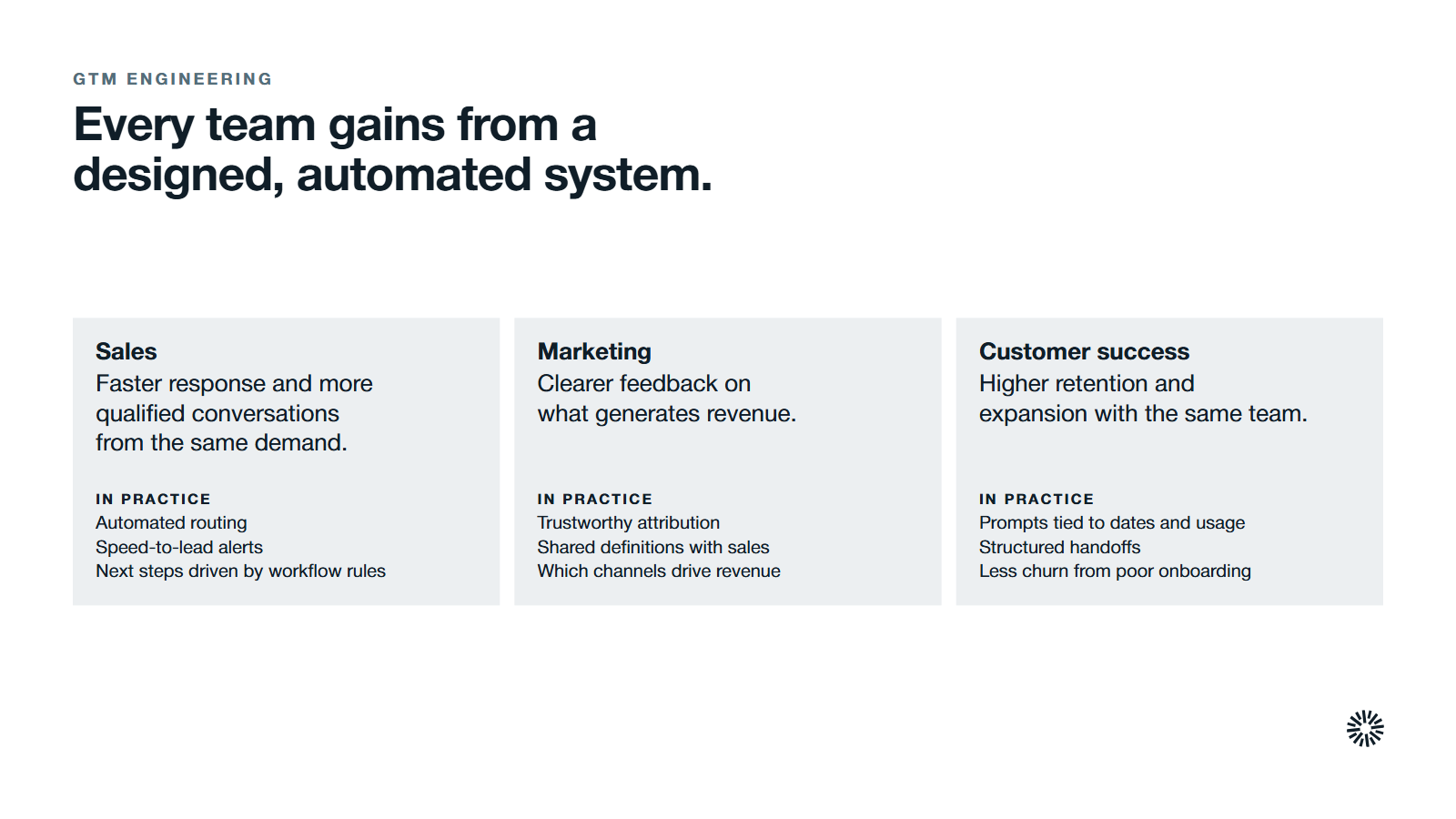
Sales: faster response and more qualified conversations from the same demand
Automated routing and speed-to-lead alerts mean reps engage while intent is fresh. The same HBR article reports that firms contacting potential customers within an hour were nearly seven times as likely to qualify the lead as those that tried even an hour later.
Clean, auto-updated deal data gives managers accurate forecasts and easier coaching. Next steps are driven by workflow rules, not by whether someone remembered. Reps spend their time selling instead of typing into spreadsheets.
Marketing: clearer feedback on what generates revenue
With manual errors removed, marketing gets trustworthy attribution from campaign to closed-won and on to renewal. You can determine which channels and content drive revenue, not just leads. Shared definitions keep marketing and sales on the same page, so fewer leads are lost between them.
See how demand generation fits into a designed revenue engine.
Customer success: higher retention and expansion with the same team
Renewals, business reviews, and expansion plays are driven by system prompts tied to dates and product usage, not by a manager checking a spreadsheet. Structured handoffs reduce churn caused by poor onboarding.
Where to start
You can begin without buying new software or technology, especially if HubSpot is already in place. Here are three first moves.
- Trace one customer journey end to end. Map every step from first touch to renewal and time every handoff. Mark each point that relied on memory or hand entry.
- Build a leakage ledger. List each leak by category, with an owner and a rough estimate of its cost. Rank them by money lost and ease of automation.
- Redesign one workflow. Start with speed to lead or renewal prompts. Automate the routing, the task, or the alert, and establish one person as the owner. A GTM engineer is the right role to lead this work.
Manual operations quietly drain compound growth
Revenue leakage is earned revenue lost between stages because your go-to-market is manual, fragmented, and invisible in reports. It is not a people problem. It is a system problem, and most companies never audit for it until the cost is impossible to ignore.
Fixing the system lets growth compound, because every leak you close makes the next revenue investment work harder.
Propello designs and builds connected go-to-market systems on HubSpot. If you suspect revenue leakage is costing you between stages, an audit is the place to start.