Revenue feels harder than it should. Your people are strong, your product has traction, and effort is not the issue. Yet deals stall, handoffs break, reports contradict each other, and your GTM systems feel held together by memory and manual effort.
The problem is structural, not personal. This article is a diagnostic. It gives you seven observable signs to check in your own revenue engine this week, so you can name what is costing you and decide what to fix first. For deeper context, start with what GTM Engineering is.
|
GTM System A GTM system is the connected data, processes, tools and automation that move a buyer from first signal to renewal across marketing, sales and customer success. |
Seven signs your GTM systems were never designed
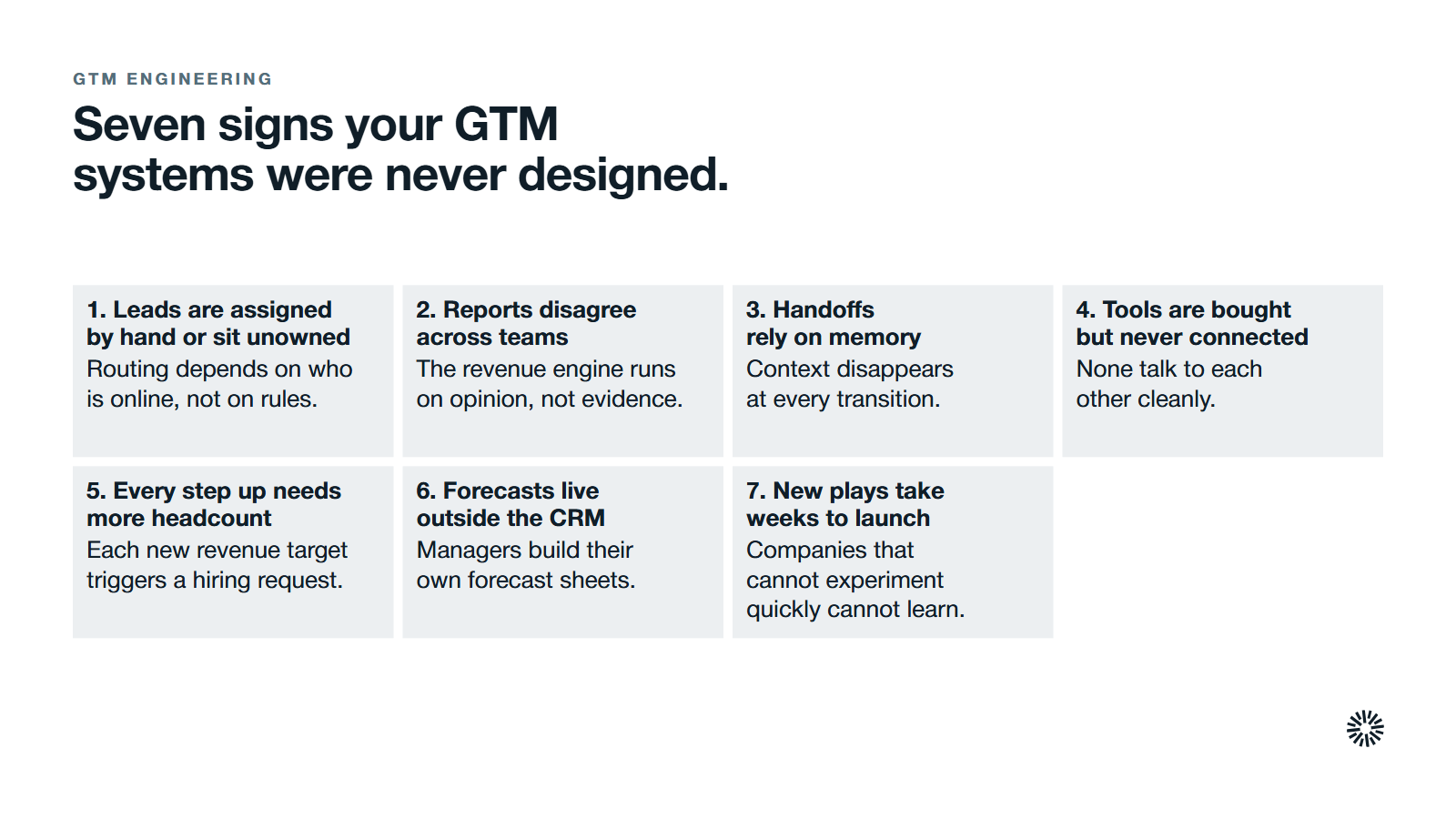
Each sign below is something you can verify in your CRM, your reports or your next leadership meeting. For each one, you will see what it looks like day to day, what it costs you, and what a designed system does instead.
1. Leads are assigned by hand or sit unowned
Sales reps claim leads through chat messages. Contacts age in marketing queues with no follow up, and lost leads pile up quietly. Routing depends on who is online, not on rules. Disputes over ownership surface in meetings that should be about pipeline.
The cost compounds. Research shows that speed matters: a Harvard Business Review audit in 2011 of 2,241 US companies found that only 37% responded to a web lead within an hour. Teams duplicate outreach to the same accounts while high-value buying signals go unnoticed, and you hire to cover gaps that automation should handle.
A designed system routes leads automatically based on territory, lead source, account hierarchy and defined rules. Leads are scored against your ideal customer profile criteria.
Faster routing gives every lead a real chance. Ownership is visible in the CRM, response times are monitored, and your sales reps work more deals because the right rep gets each one without a hallway conversation.
2. Reports disagree across teams and CRM data quality is nobody's job
Marketing shows one pipeline number in the Monday meeting. Sales shows another. Finance exports a spreadsheet that contradicts both. The room spends its time arguing definitions instead of making decisions.
Poor CRM data quality is the root of the argument. Salesforce's 2024 State of Sales research found that only 35% of sales professionals completely trust the accuracy of their organization's data. Course corrections come late, and the revenue engine runs on opinion, not evidence.
Clean CRM data underpins every fix that follows. In a designed system, definitions are shared: what counts as an opportunity, what qualifies a lead, what each stage means. Reporting lives in one place with governed fields, and the team can keep data clean because the system checks it at entry.
CRM data becomes a trusted asset for your revenue teams, and unified data gives marketing, sales and customer success a single source of truth.
3. Handoffs rely on memory instead of a designed journey
A deal closes, and customer success gets a forwarded email thread. A development rep qualifies a lead and pings the account executive in chat. Onboarding steps live in personal notes. Context disappears at every transition.
Buyers feel it. They repeat themselves and wait. Expansion signals get missed because nobody carried the knowledge forward. Marketers feel it too: in HubSpot's 2026 State of Marketing survey, 27.6% named sales-marketing alignment among their top challenges.
A designed journey maps each stage, assigns clear ownership, and uses automation to carry context from first touch to renewal. Playbooks replace memory, so the person who picks up the account starts with the full story.
Marketing automation captures intent data when a prospect engages with your brand, and that signal reaches the next owner without manual transfers. The sales process and the buying process finally line up.
4. Tools are bought but never connected into a go-to-market engine
Your GTM stack has an enrichment provider, a sequencing tool, a separate analytics platform and a handful of point solutions. Each has its own login, fields and reports. None talk to each other cleanly.
The scale is real. Okta's Businesses at Work 2025 report found that the average company in its customer data uses 101 apps. Day to day, teams run manual CSV uploads, copy data between systems, and troubleshoot partial integrations that break silently. You lose the full picture of the customer because data lives in fragments. This is tool sprawl, and buying more software does not fix it.
A designed go-to-market engine treats HubSpot as core infrastructure. Integrations are mapped, monitored and documented, so first party data flows across systems and every tool adds visibility instead of noise. Software then multiplies effort instead of wasting spend. For the full argument, read how to move from martech stack to GTM system.
Buying tools is easy, and connecting tools is the work. Tools that share data give your teams the power to change plays without waiting.
5. Every step up in growth needs more headcount
Each new revenue target triggers a hiring request. More development reps, more account executives, more customer success managers. Output per person stays flat because repetitive tasks, manual effort and inconsistent processes cap what each person can do.
The cost is structural. Salesforce's 2024 research also found that sales reps report spending 70% of their time on non-selling tasks. Margins shrink, acquisition cost rises, and leadership hesitates to set bigger targets because scaling feels expensive and fragile.
A designed revenue engine automates repeatable work: routing, follow up, data enrichment, task creation. Output grows faster than headcount, because revenue growth comes from scalable processes and not only from more people.
6. Forecasts live in spreadsheets outside the CRM
Managers build their own forecast sheets. Sales leaders consolidate by hand each week. The HubSpot pipeline exists but nobody treats it as the source of truth. Deals sit with stale close dates and no next steps.
The effect is late surprises, sandbagging, and little coaching value from pipeline reviews. Strategic decisions rest on fragile numbers, and there is no closed loop between plan and execution.
In a designed system, the forecast process is built into the CRM. Stages have exit criteria, pipeline hygiene is routine, key performance indicators are visible, and activity, pipeline and booked revenue connect clearly. Leaders steer instead of guess, and win rates become something you can study and improve.
7. New plays take weeks to launch and break quietly
A new ideal customer profile, a new offer, a new channel. Each one takes weeks of coordination, manual mapping and last-minute fixes. Hidden dependencies and undocumented workflows create drag, and teams become afraid to change anything for fear of breaking what already runs.
The cost is missed windows and an inability to test. Companies that cannot experiment quickly cannot learn, and without learning, growth cannot compound.
A designed GTM system uses modular workflows, documented dependencies and monitoring that flags failure early. Launching a new play becomes configuration, not construction.
Why GTM systems end up under-engineered
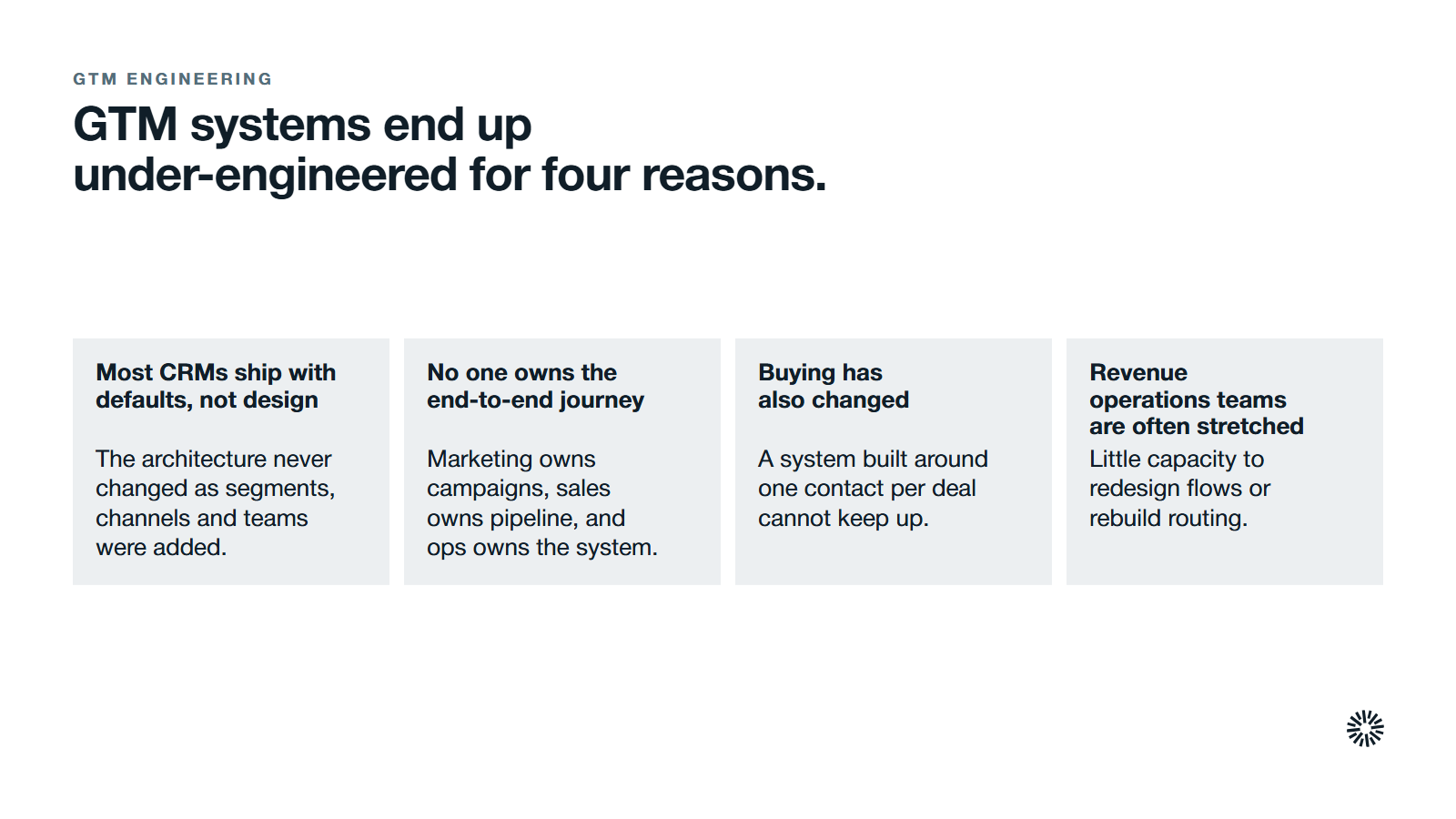
These signs do not come from bad people, and GTM teams rarely see them from the inside. They come from how fast-growing B2B businesses build piece by piece, without stepping back to design the whole.
Most CRMs ship with defaults, not design. Yours was set up quickly for an early-stage model, and the architecture never changed as segments, channels and teams were added. Marketing owns campaigns, sales owns pipeline, and ops owns "the system," but no one owns the end-to-end journey.
What a revenue engine is
A revenue engine is the set of connected systems, people and routines that turn attention into pipeline and pipeline into revenue. When it is designed, each part supports the next.
When it is not, every team keeps its own parts running and the whole go-to-market engine stalls in the gaps between them.
What CRM data quality covers
CRM data is everything your teams record about accounts, contacts, deals and activity. Good CRM data quality means those records are accurate, complete, consistent, current and unique. Human error leads to messy data, and automating data capture reduces errors.
Research shows how far records drift from reality. In a 2023 analysis of 1,000 closed-lost deals, Clozd found that the competitor tagged in the CRM was wrong in nearly 7 out of every 10 deals compared with buyers' own accounts, and that 44% of closed-lost reasons in the CRM were outcomes, not reasons.
How AI agents and small businesses raise the stakes
Small businesses feel under-engineering first, because every handoff depends on one or two people. Larger businesses feel it later, at higher cost.
AI agents and automation make it sharper: they multiply whatever design already exists, and on a messy system they multiply the mess. Organizations that add AI agents before fixing the system pay for the problem twice.
Why buying changed
B2B decisions are made by groups, and a buying group gives a more nuanced view of the buying process than a single contact record can. Sales cycles stretch when stakeholders are spread across that group, and a system built around one contact per deal cannot keep up.
High-performing teams tailor outreach to each stakeholder's role and multi-thread across the group, which protects a deal when one contact goes quiet and can improve win rates and deal size. That takes insight and training for your sales teams, and the data to back both.
Enablement matures from reactive, to project-based, to integrated. A designed system is how you move from the first to the last on purpose, with the right resources behind each step.
Where RevOps and sales ops fit
Revenue operations and sales ops teams are often stretched across reports, admin and requests, with little capacity to redesign flows or rebuild routing. GTM Engineering emerged to fill that gap, and a GTM engineer is the person who does the work. If you are weighing the case, read why GTM teams need GTM Engineering.
What you gain when this is done properly
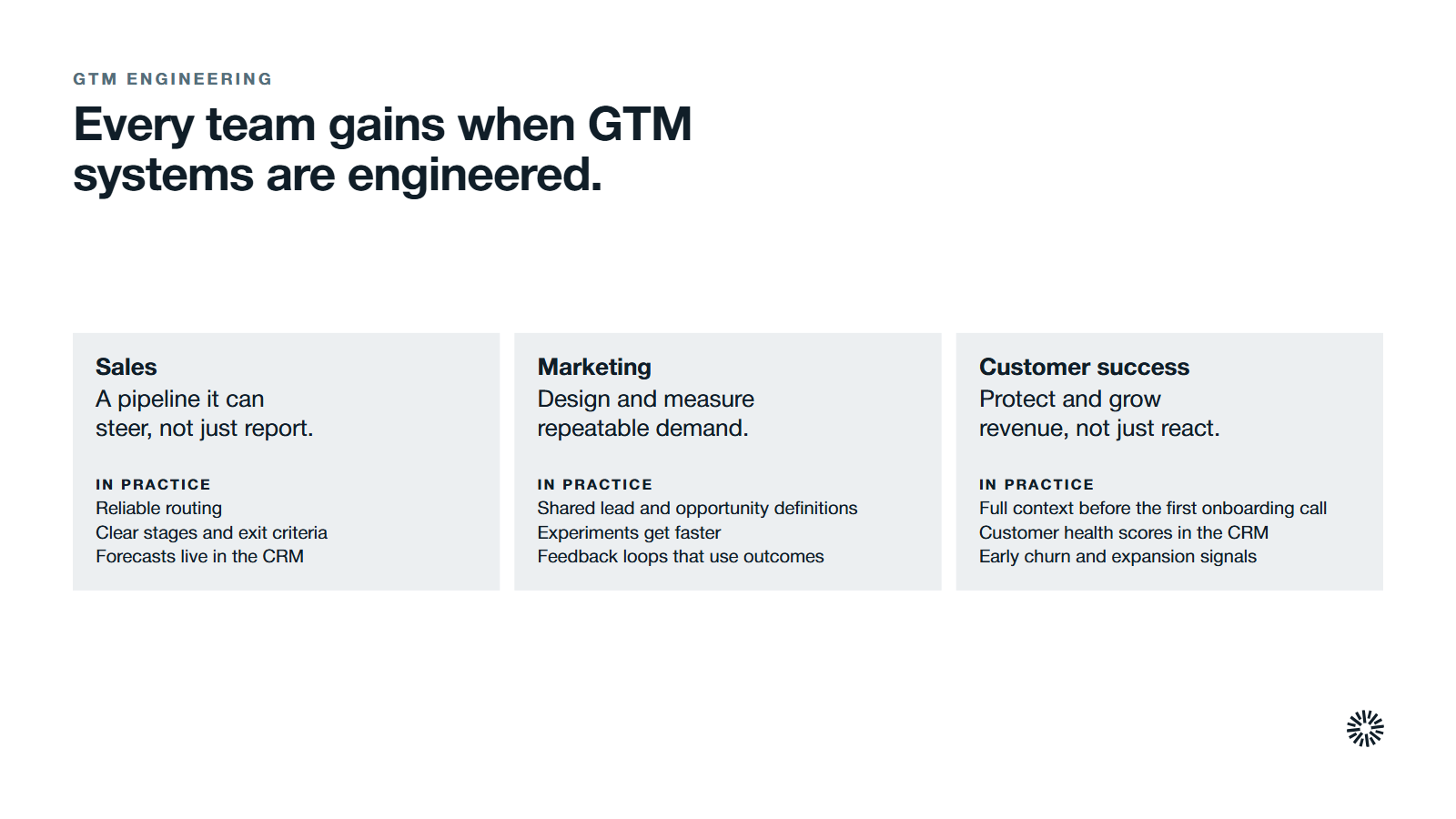
The seven areas that cause drag become sources of speed when the system is engineered. Revenue operations can then spend its time improving the engine instead of patching it, and revenue generation becomes something you can plan, not hope for. Better revenue generation starts with a system that does not rely on heroics.
Organizations that reach this point stop treating growth as a staffing problem. GTM systems that connect marketing, sales and customer success data drive revenue on purpose.
Sales gets a pipeline it can steer, not just report
Reliable routing puts more deals in front of the right rep. Clear stages and exit criteria make coaching conversations productive. Forecasts live in the CRM. Sales teams spend time selling, not cleaning records or chasing assignments.
Routing, follow up and handoffs follow rules instead of habit, which gives win rates room to improve. Sales enablement also works better, because sales enablement content and coaching rest on trusted data.
Marketing can design and measure repeatable demand
Shared lead and opportunity definitions close the loop between campaigns and revenue. Marketing can track which content and channels lift win rates and move deals through the pipeline, and put the right resources behind what produces more revenue. Feedback loops use outcomes to refine the next play.
Customer success can protect and grow revenue, not just react
Full context on the buyer journey arrives before the first onboarding call. Product usage and customer health scores surface in the CRM, which protects retention, so you can identify early churn and expansion signals in time.
Customer success teams can rely on shared knowledge instead of calls to find context. Support moves from reactive to proactive account work.
What to do first
You do not fix under-engineered GTM systems by buying another tool or redesigning everything at once. The power of a designed system comes from focus, so optimize one journey before you touch the rest. Start with these steps this week.
- Score yourself against the seven signs using a simple low, medium or high friction rating. Be honest about where the drag is worst.
- Pick the sign that costs you most and map that journey end to end, from first touch to renewal. Identify who owns each step.
- Note where ownership is unclear, data is missing and work is manual. Choose one small change to test in HubSpot within a month.
The key is to give the owner the resources and support to change tools, fields and rules. Keep your focus on that one journey, review it in short weekly calls, and track one report that shows whether the change worked.
Intentional GTM systems are how growth compounds
The struggle you feel is structural. Under-engineered GTM systems drain time, trust and learning from every team, and they stop growth from compounding because each quarter starts from scratch instead of building on the last.
Diagnosing and then engineering the revenue engine is the shift from campaigns to systems. Teams run coordinated plays on shared data and automated workflows, and every stage feeds the next.
Businesses that optimize the whole system, not each tool, grow without adding friction, and GTM teams that share one platform and one set of definitions learn from every deal. If you want structured help naming and fixing what is broken, take the first step.