

If you lead marketing, sales or growth at a B2B company and your website needs work, the short answer is this: choose a traditional website redesign when the existing website is broken beyond repair, and choose growth-driven design when it mostly works and you want it to keep improving.
Many companies need both, in that order. Rebuild once if you must, then run the site on a continuous improvement cycle so you do not repeat the project in three years.
This article is for CEOs, founders, CROs and marketing leaders who are weighing a website redesign. You will get a plain definition of each approach, a side-by-side comparison, the cases where each one wins, and a checklist of what to protect either way.
|
Growth-Driven Design Growth-Driven Design is a web design methodology that launches a focused first version of a website quickly, then improves it in short sprints using real user data, instead of rebuilding the whole site every few years. |
|
Traditional Website Redesign A traditional website redesign is a one-time project that rebuilds a site's design, structure and content in a single build, then launches the entire new site on one date. |
The traditional website redesign process bets everything on one launch
The traditional redesign process is familiar. A team agrees on goals, audits the current site, plans the site structure, designs every page, writes the content, builds the site and tests it. The whole new site then goes live on one date.
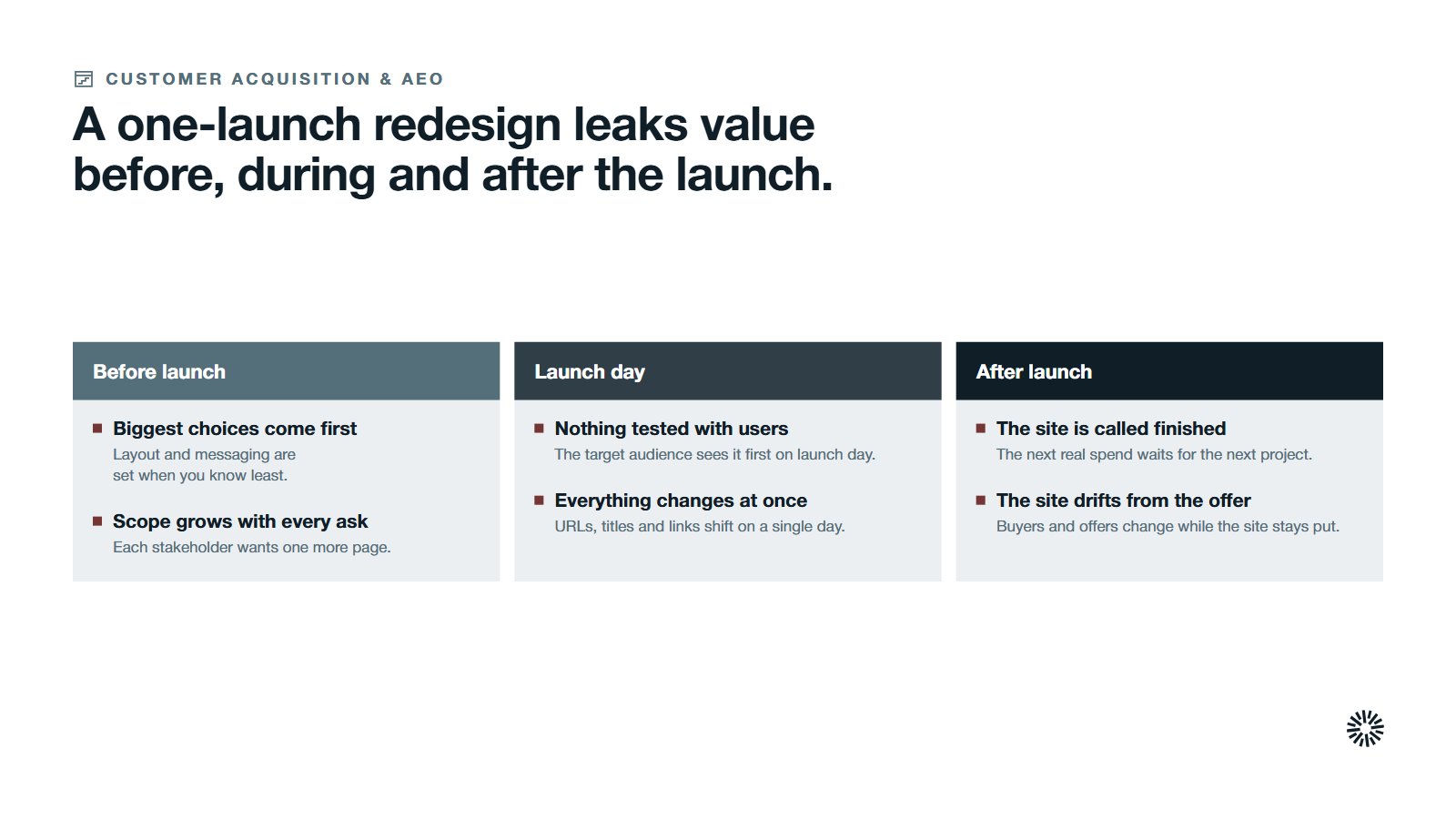
Traditional web design front-loads its biggest decisions. Page layouts, messaging and navigation are all settled when you know the least about how real users will behave on the new site. Nobody learns whether those guesses were right until the money is spent.
After launch the site is usually treated as finished. Small fixes happen, but the next real investment waits for the next redesign project. The business keeps changing in the meantime. Your offer shifts, your buyers ask different questions and the site drifts away from what your teams need.
That is the weakness of the model, not of designers. The design process itself is sound. The problem is that learning comes after the budget is gone.
Where traditional web design loses value in a one-launch project
Scope grows before launch because every stakeholder wants a page included. At launch, nothing has been tested with your target audience. A complete overhaul also changes URLs, page titles and internal links all at once, which puts website performance and search visibility at stake on a single day.
Growth-driven design launches a smaller site, then improves it in sprints
HubSpot introduced the method in 2017, and the author of its announcement, Luke Summerfield, is described there as the founder of the approach. Read HubSpot's own Growth-Driven Design certification announcement for the original framing. Our guide to what growth-driven design is covers the method in full.
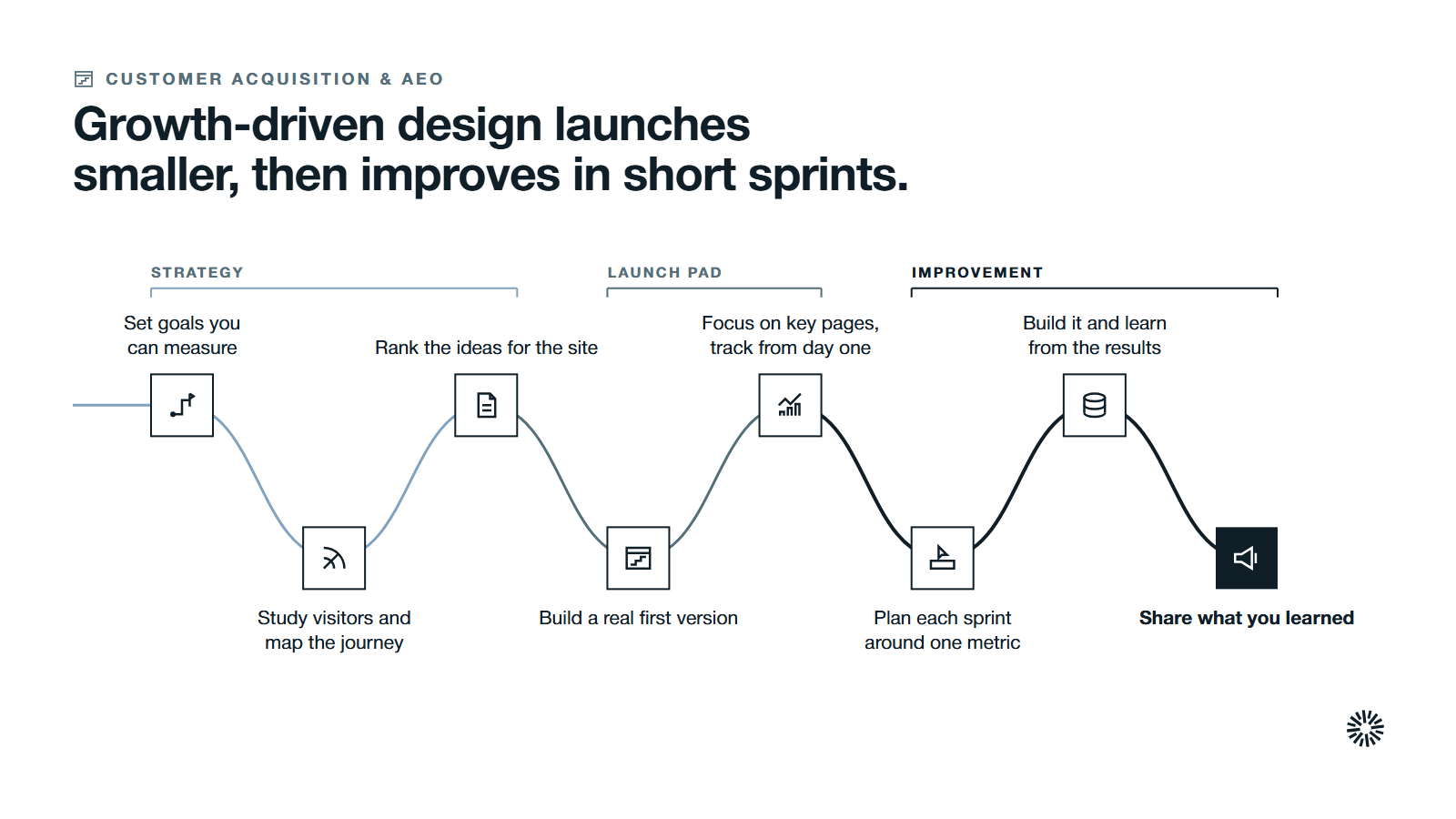
The method applies lean and agile ideas to web design. You commit a little, learn a lot and adjust. The official Growth-Driven Design methodology page describes three stages: strategy, launch pad and continuous improvement.
Strategy lets you gather user feedback before any page is designed
The strategy stage sets the direction. The methodology page puts it at 10 to 14 days. You set key business goals you can measure, study how visitors interact with the current site, and decide which problems the new site must solve.
This is where you gather user feedback and build short profiles of your target audience. You map the user journey from first visit to inquiry and note the main user flows. The stage also produces a ranked list of ideas for the site, which later sprints draw from.
The launch pad site is a real first version
A launch pad site is a fully developed first version that looks and performs better than your current site but is not the final product. The methodology page puts this stage at 60 to 90 days. It is designed to go live quickly, with room for future edits.
The launch pad stage concentrates on the three to five key pages that can drive the greatest impact. The rest of the site gets a fresh coat of paint as it migrates. Analytics and forms are in place from day one, so every visit produces evidence.
Continuous improvement runs in 14-day sprints
After launch, the team works in 14-day sprints. The continuous improvement stage follows four steps: plan around a focus metric, build, learn from the results and transfer what you learned to other parts of the company.
The site never reaches a finished state. Each sprint is a small, tested step toward a business goal, and the valuable insights from each one shape the next. That lets the site respond to user needs and feedback as your buyers change.
Growth-driven design and a traditional website redesign compared side by side
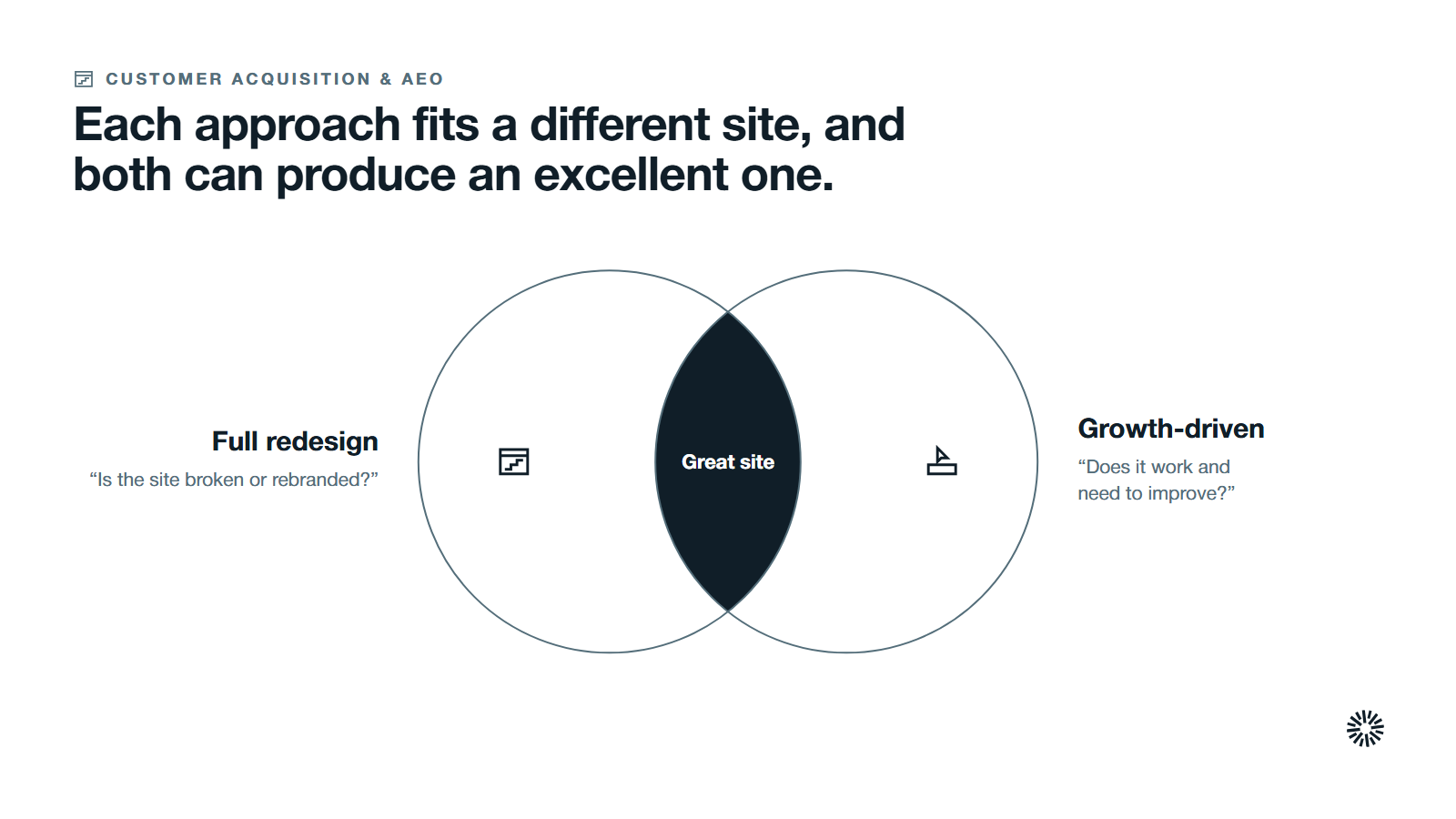
Both approaches can produce an excellent site. They differ in when you learn, when you spend and who stays involved after launch.
| Criterion | Traditional website redesign | Growth-driven design |
|---|---|---|
| When the site goes live | After one long build | After a focused launch pad build |
| What guides decisions | Stakeholder opinion and best guesses | Real user data from the live site |
| How spending is shaped | Concentrated before launch | Spread across launch and ongoing sprints |
| What happens after launch | Little change until the next project | Short sprints of testing and improvement |
| Risk profile | One large bet on a single launch | Many small bets, each followed by evidence |
| Who stays involved | The project team, then it disbands | Marketing, sales and customer success keep learning |
| Strongest fit | A broken, outdated or rebranded site | A site that works and should keep improving |
Read the last row as our reading, not a rule from the method's authors. The comparison is also not a verdict that every redesign is a mistake. A rebuild is sometimes the only honest answer.
A refresh may be enough, but some sites need a full website redesign
First decide how deep the problem goes. A refresh updates visual elements and minor user experience without starting from scratch. A website redesign involves significant structural changes to navigation, page templates and content.
Several signs suggest the existing website is underperforming. A low conversion rate points to a design or user journey problem. High bounce rates suggest visitors are not finding relevant content. Slow page load times drive people away, and an outdated design can make your brand look neglected. Review Google Analytics before you decide, because the signs tell you something is wrong, not which fix to buy.
Some situations do call for a complete overhaul. A site built on technology you can no longer update, a rebrand that changes your brand identity, a merger that combines two sites, or an ecommerce site that must move to a new platform are all cases where small sprints would be too slow.
Complex projects with several brands or languages also need a planned rebuild, because the structure itself has to change. So does a platform that can no longer receive security measures and fixes.
Even then, the rebuild does not have to be a one-launch project. You can treat the rebuild as the launch pad, limit it to the key pages that matter most, and move to sprints afterward. That gives you a clean digital foundation without the set-and-forget ending.
If you are not sure which case you are in, start with measurement. Our guide to website metrics to measure and track shows what to look at first, and our guide to inbound-ready websites describes what a site that generates leads needs.
When growth-driven design is the better fit
Growth-driven design earns its place when the existing website works well enough to learn from. If the site gets traffic, collects contact forms and loses people at specific pages, you have data to act on. The fix is a ranked list of changes, not a blank page.
It also suits marketing sites where the offer, the audience or the competition shifts often. Smaller websites and simpler marketing sites with a few key pages benefit because a single sprint can change the pages that matter. Teams without a large one-time budget can spread spend over time.
The method asks more of your team than a project does. Someone must own the backlog, protect the sprint cadence and read the results. If nobody can, the model stalls, and a well-run traditional project may serve you better.
The examples of specific growth-driven design applications show what typical sprint changes look like, from shorter forms to clearer calls to action on pages that already attract visitors.
How to redesign your website: what to protect in either approach
Both paths change a live website, so some work is the same whichever you choose. If you plan to redesign your website, treat these as requirements.
Audit your existing content before you move anything
A content audit lists every page, what it earns and whether it should be kept, merged or retired. Existing content that already ranks or converts is an asset, so rewrite it with care. Plan the content strategy first, then write content so the site architecture and information architecture follow what visitors look for.
Draw a clean sitemap and a clear navigation hierarchy, so each content block appears where visitors expect it and the user journey stays intuitive.
Map every old URL to a new one
Google's guidance on site moves with URL changes says to map your old URLs to the new ones and use server-side permanent redirects. It also advises avoiding redirect chains and keeping redirects for as long as possible, generally at least one year.
Google also warns that you may see ranking fluctuations while it recrawls and reindexes the site, and that for a medium-sized site it can take a few weeks or more for the new URLs to appear. A redesign proposal that does not mention redirects is incomplete. Check for broken links before and after launch, and build your SEO strategy and search engine optimization checks into the plan, not onto the end of it.
Treat site speed and mobile optimization as launch requirements
Google describes Core Web Vitals as measures of loading performance, interactivity and visual stability, in its guide to Web Vitals. Site speed, site performance and technical performance belong in the acceptance criteria for a launch, not in a later phase.
Audit images and heavy scripts, because they are common reasons pages load slowly. Responsive design and mobile optimization matter just as much, because mobile responsiveness decides whether a page works on a phone. Design mobile-first, and treat optimizing performance as part of the brief.
Keep the design process tied to user needs
Web design focuses on how pages look and are built. User experience covers the whole visit, from the first click to the form. A good design process starts from user needs and user expectations, then moves to visual design and mockups for desktop and mobile.
Your visual language, visual style and color scheme should express your brand personality, and the design elements and visual elements should make the site user friendly. Ensure color contrast adheres to accepted guidelines, with keyboard navigation and visible focus states, so every visitor can use it. The aim is to optimize user experience for the people you want to reach, not to please the design team.
Test on staging, back up, then measure against a baseline
Run usability testing with real users and accessibility checks on a staging copy. Test cross-browser behavior, test every redirect and run a security review. Back up the existing website before going live, so you can recover if something fails.
Record baseline measures before you change anything, then compare after launch. Heatmaps, session recordings and A/B tests show how visitors interact with the new pages. Use Google Analytics and Google Search Console from the first day.
Write down your redesign goals before you pick the approach
State your redesign goals in terms of the business: more qualified inquiries, shorter time to a booked meeting, better handoff to sales. Choose two or three measures. Without goals and a baseline, neither approach can show it worked.
How to decide: four rules
Choose by evidence, not by which method sounds more modern. These rules are our reading and are meant to be argued with.
If the site works but underperforms, start with growth-driven design
You have traffic and forms to learn from. Rank the changes by impact and effort, then run the first sprint on the page that loses the most visitors.
If the platform or brand is the problem, rebuild and then switch to sprints
Treat the rebuild as the launch pad. Keep it to the pages that carry your goals, migrate the rest with light updates, and plan the first sprints before the launch date.
If you cannot name an owner, fix that first
Neither approach works without someone accountable for the website. A project needs a sponsor. A sprint model needs a person who owns the backlog.
If leadership wants a fixed price and date, say what that costs you
A traditional website redesign proposal can fix scope and price because the scope is defined up front. That certainty has a price: the learning arrives later.
What a website redesign proposal should state before you sign
Whoever builds the site, ask for a website redesign proposal that answers the following in writing. Detailed documentation up front prevents arguments later.
- The business goals and how success will be measured after launch
- The key pages in scope and what happens to the rest of the current site
- The project timeline, team roles, technology requirements and financial constraints
- The redirect plan and how search visibility will be protected
- Who owns the site after launch and what the improvement cycle looks like
A proposal that lists pages and dates but no measures is a design brief, not a plan for results.
What you gain when this is done properly
When you choose the approach that matches the state of your site, and protect what already works, the website stops being a project and becomes a working asset for every team.
Sales gets a website that feeds better conversations
Forms and pages built from lead data send sales better-qualified inquiries. Sales can also pass back the questions buyers ask on calls, and those become the next items in the queue.
Marketing gets a site that improves with every campaign
Marketing sees which pages earn attention and which lose it, and can fix a weak page this month instead of waiting for the next redesign.
Customer success gets pages that answer routine questions
Customers who can find setup and usage answers on the site need fewer tickets. A site that improves over time keeps those answers current, which helps customer success spend time on accounts instead of repeated questions.
Rebuild only when you must, and keep learning either way
The real choice is not between two methods. It is between learning before you spend and learning after. Your digital presence works best when every change starts from your goals and your existing data.
Propello organizes its work around the commercial problems of its clients, building connected go-to-market systems on HubSpot for CEOs and revenue leaders at growing B2B companies, using revenue operations and account-based marketing to build systems that learn and improve.
If you want a second opinion on whether your website needs a rebuild or a better improvement cycle, an audit is the place to start.
