
If you lead revenue at a growing B2B company, a demand generation campaign is a planned push that builds awareness among the buyers you want, so more of them talk to you when ready. You plan one by setting a goal, choosing an audience, writing a message, building assets, picking channels, launching and reviewing.
This guide to B2B demand generation is for CEOs, founders, CROs and revenue leaders, and for the marketing and sales leads who will run the work. You get seven steps, each with a finish line, plus the checks to make before you spend and the mistakes that sink a first campaign.
|
Demand Generation Campaign A time-boxed set of coordinated marketing activities that gives a defined target audience a reason to know, trust and contact your company, measured by the pipeline it helps create. |
By the end you will have a campaign you can launch and defend
A good campaign plan fits on a few pages and survives questions from your sales team.
- One goal, with a start date, an end date and the number that decides success.
- A named target audience, with a short target account list.
- A single message and offer that speak to the problems those buyers have.
- A set of assets and a small number of marketing channels, each with an owner.
- A launch checklist and a review date where you decide to scale, adjust or stop.
What to have in place before you start
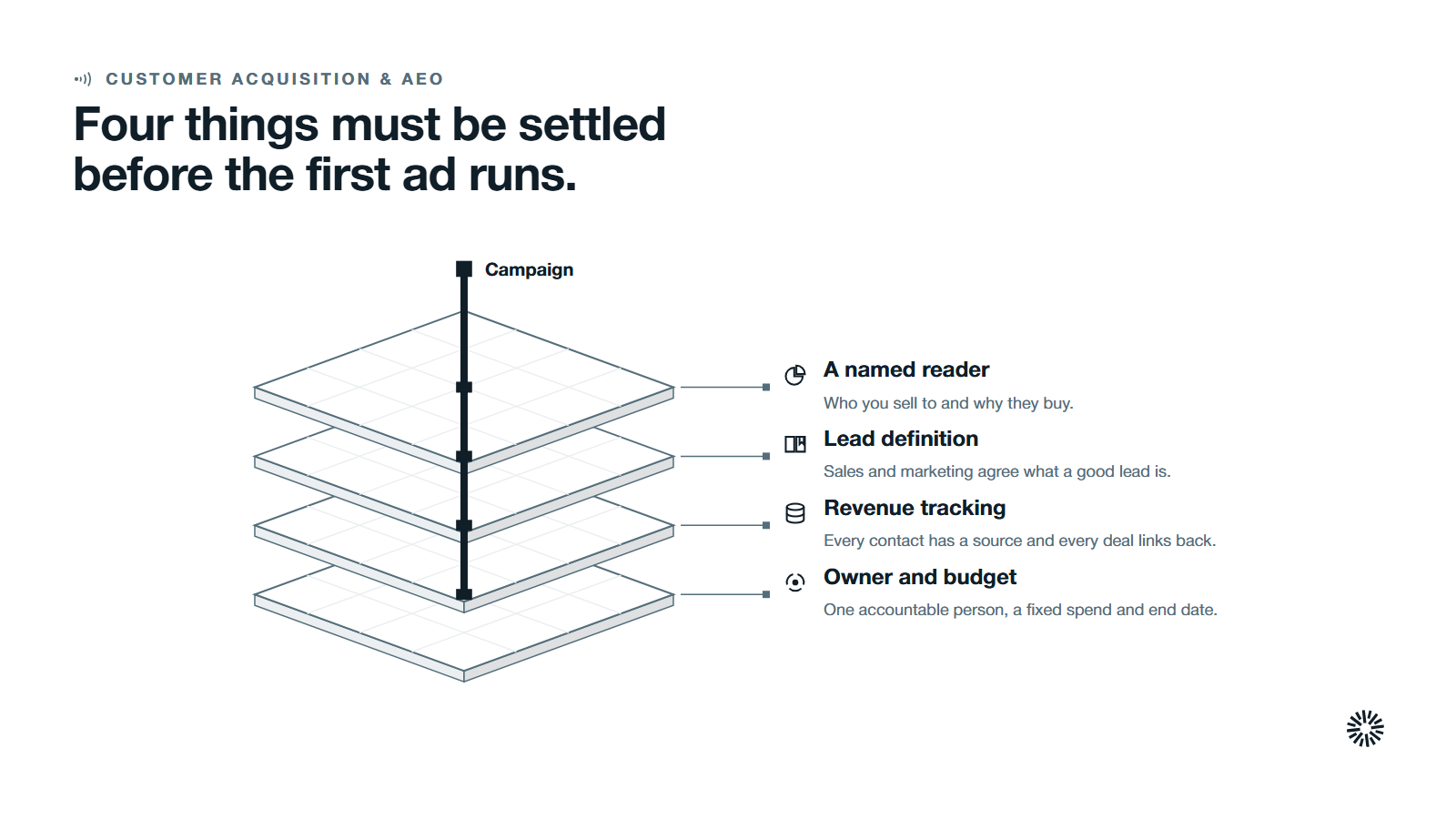
Most weak campaigns fail before the first ad runs. Close these gaps first, because each one is cheaper to fix now than mid-flight.
- A reader you can name. Write down who you sell to and why they buy. The ideal customer profile template is a quick way to do it.
- A shared definition of a good lead. Sales and marketing agree on what counts as a qualified lead before the campaign, not after.
- Tracking that follows people to revenue. Every contact needs a source, and every deal needs to link back to its contacts.
- One owner and a budget. A single person is accountable, with a fixed spend and a fixed end date.
The demand generation definition behind a campaign
Demand generation marketing is the ongoing work of creating demand for a product or service among people who do not yet know they need it. A campaign is one focused burst of that work, and your wider demand generation strategy decides how many bursts you run in a year.
For the full picture first, read what demand generation is.
Lead generation campaigns work at the other end: they capture people actively searching for an answer who are ready to hand over details.
Lead gen turns existing interest into contacts, while demand generation activities create the interest in the first place. Your marketing strategy needs both, and this guide covers the side that helps you generate demand.
A demand generation campaign in seven steps
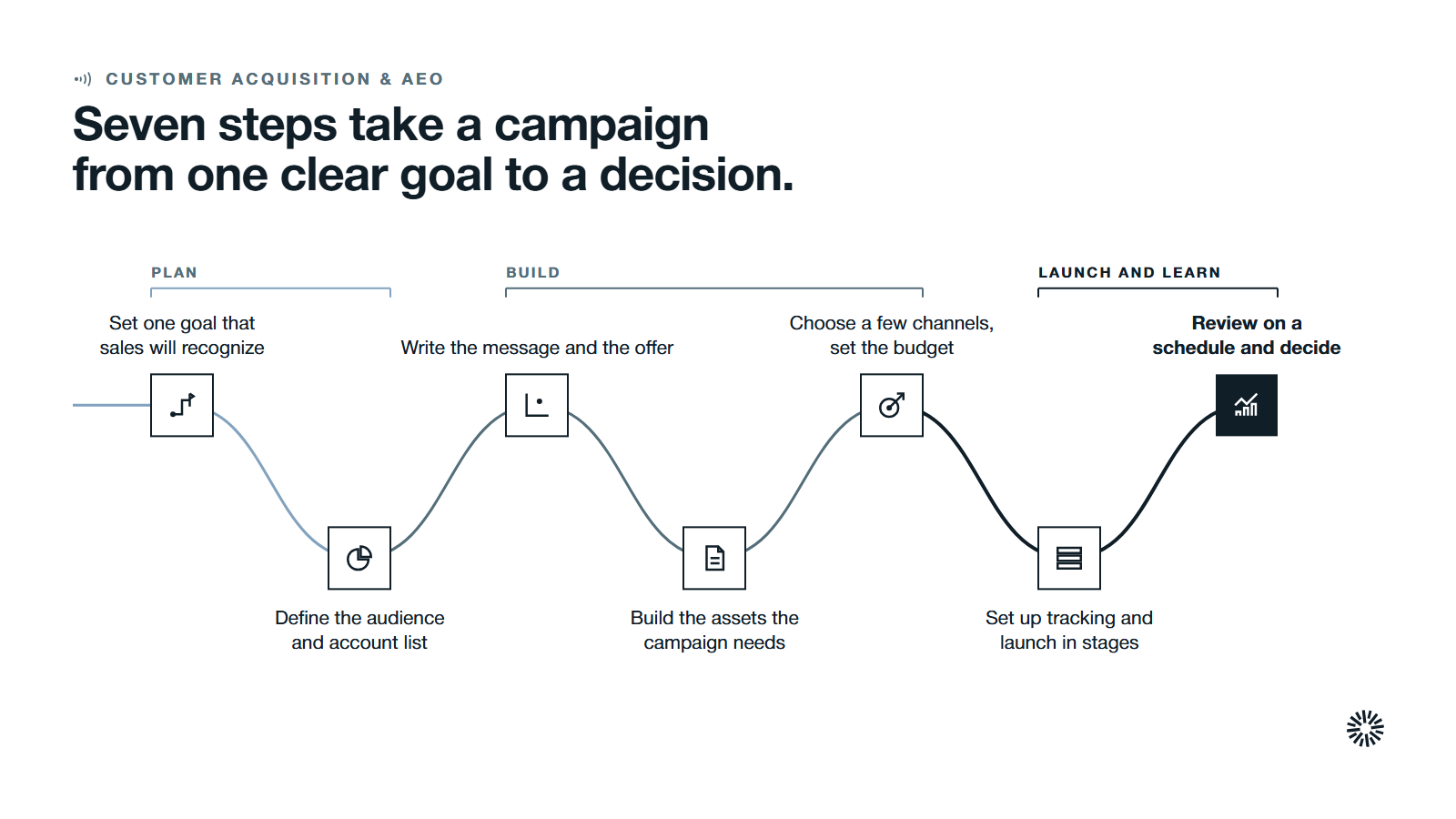
Work through the steps in order. They are the key elements of a successful demand gen campaign, and each ends with what done looks like, so you can tell whether to move on.
Demand generation work sits at the top of the marketing funnel and feeds the sales funnel below it. Every step should help potential customers move one stage closer to a conversation.
1. Set one goal that sales will recognize
Start with the business result, not the activity. A goal such as "more downloads" sounds good and tells you little. A better one names a pipeline outcome, such as a number of qualified conversations with target accounts by a set date.
Say whether the campaign should increase brand awareness among cold accounts or move warm ones toward a decision, because the two jobs need different plans.
Choose one primary goal and one or two supporting measures, and tie them to existing sales initiatives so nobody works on a rival target. A campaign that chases brand awareness, immediate sales and customer acquisition cost at the same time ends up measuring none of them well.
Agree the goal with your sales team before anything else. If they will not accept the measure as proof, they will not follow up on the leads it produces.
You are done when one sentence states the goal, the date range and the number, and the head of sales has signed it off.
2. Define the target audience and build the account list
Narrow the audience until you could name them. Pick the companies, the roles that buy and the roles that influence, then list the pain points each one wants solved. These are your potential buyers, and the clearer the list, the better your audience targeting will be.
For a B2B campaign, a target account list is your most useful asset. Start from your best existing customers, find the traits they share, and match those traits to accounts you have not yet won.
For high-value accounts, account-based marketing coordinates personalized campaigns around each buying group, so the message speaks to the specific roles involved.
Add the contacts you can reach at each account, and watch market trends that change what those target customers care about. Note any intent data or behavioral data you hold, such as repeat visits to your pricing page.
Plan for how these buyers research. Gartner's March 2026 survey of 646 B2B buyers found that 67% prefer a rep-free experience. Your campaign has to do its work in places the buyer visits alone: your site, search results and content that fits each stage of their buying journey.
You are done when you hold a list of target accounts, the roles you will reach at each, and one sentence on the problem each role wants solved.
3. Write the message and the offer
Your message is about creating awareness of a problem and showing why this audience should care now.
Lead with the buyer's problem in their own words, then show the outcome you help them reach and the proof that makes it believable. Keep one idea per campaign, so the audience remembers it and the work can drive demand for a single outcome.
The offer is the next step you ask for. For a demand generation campaign, that step should be useful before anyone talks to sales: an assessment, a benchmark, a working template or a short online course. A call to talk to a rep suits the buyers who are already convinced.
Match the offer to where buyers are. Someone who has never heard of you will not book a call, but they will read a clear explanation of a problem they recognize.
You are done when the message fits in two sentences, the offer is named, and a salesperson could repeat both without notes.
4. Build the assets the campaign needs
List every asset the buyer will meet, from the first touch to the offer. Typical sets include a landing page, a handful of educational content pieces, downloadable resources, an email series, ad creative and a short sales follow-up note.
Educational content does most of the work in demand generation, because it helps buyers learn before they are ready to buy. Interactive content, such as a calculator or self-check, tends to hold attention better than static pages and gives you a reason to follow up.
A live webinar does the same job, because attendees who stay are showing real interest. Content that educates potential buyers earns trust long before a sales call.
Reuse what you already have, and tie each piece to your content strategy so the campaign adds to the library instead of sitting beside it. Proof can come from customer stories and user generated content such as reviews.
A strong guide can become a webinar, three emails and a set of short posts. Make the assets once and cut them to fit each channel.
You are done when each asset has an owner, a due date and a link from the landing page, and the creative assets match the message.
5. Choose a few marketing channels and set the budget
Pick the marketing channels where your target audience already spends time, and use few of them. Digital campaigns are easy to launch on every channel at once, which is why a short list protects your budget. Three channels run well beat eight run thinly.
Common demand gen tactics include search, email, paid social, partner content and events, and sales outreach to the target accounts.
Personalized email lifts engagement when it speaks to a role. Direct mail can beat cold email on response when the list is small and well chosen. Inbound marketing, where useful content draws buyers to you, suits the early stages of the customer journey.
Ad campaigns and video ads can be part of the mix.
Paid search ads place your content at the top of results for people already looking, which captures existing demand instead of creating it.
One disambiguation matters here: in Google Ads, "Demand Gen campaigns" are a specific ad type that serves visual ads across YouTube, Discover, Gmail and the Google Display Network. That is one possible tactic inside a wider demand generation campaign, not the whole plan.
Choose demand generation tools only after the plan is set, since the CRM and email platform you already own usually cover the start.
Chatbots can handle first questions and follow-up reminders for your sales team.
Split spend by the job each channel does. Some reach new buyers, some nurture prospects who have shown interest, and some support the sales team's own outreach.
You are done when each channel has a stated job, an owner and a budget, and the total sits inside the limit you set in step one.
6. Set up tracking and launch in stages
Before launch, check that the pieces connect. In HubSpot, the campaigns tool lets you create, manage and report on a single marketing campaign with multiple assets in one place, with a budget, a goal and an audience on the record. That gives you one view of the campaign instead of five.
Agree how leads move. Decide who follows up on each kind of response and how quickly, and use lead scoring only where the signals are clear. Test every form and link as a buyer would.
Launch in stages. Release the first channel and watch the early numbers, then add the next. A staged launch lets you fix a broken form on day two instead of day twenty.
You are done when every asset is live, every response is routed to a named person, and each contact can be traced from first touch to deal.
7. Review on a schedule and decide what happens next
Review weekly for activity and at the end for results. The weekly check asks whether the plan is running as written. The end review asks whether it worked.
Tie every metric to a business outcome, not to marketing activity. Track these demand generation metrics, which sales and marketing can both read:
- Sales pipeline value. The total revenue from qualified opportunities the campaign helped create.
- Pipeline velocity. How fast opportunities move through your stages, which shows whether the pipeline is healthy or stuck.
- Customer acquisition cost. What you spend to win one customer, counting the campaign and the sales effort behind it.
- Cost per lead. What you spend to bring in one lead, useful only when read next to lead quality.
- Average deal size. Total revenue divided by the number of closed deals.
- Average sales cycle length. The time from first touch to signed contract.
- Marketing-sourced revenue and customer lifetime value. Revenue traced to the campaign, and what those customers are worth over time.
Look at campaign performance in terms of quality, not only volume. Sales teams track engagement signals, such as repeat visits and replies, to see when a prospect is ready for a conversation.
Buyers do much of their choosing before they speak to anyone. 6sense's 2025 Buyer Experience Report found that 95% of the time, the winning vendor was already on the Day One shortlist.
A campaign succeeds when it helps put you on that list early, so track branded search, website traffic from target accounts and the share of conversations that start with a buyer who already knows you.
Then decide: scale what worked, adjust what almost worked and stop what did not. Write the lesson down so the next campaign starts ahead. For more on how buyers decide, see the B2B buyer journey.
You are done when the review is held, the decision is recorded, and the next step has an owner and a budget.
Mistakes to avoid when you run a demand generation campaign
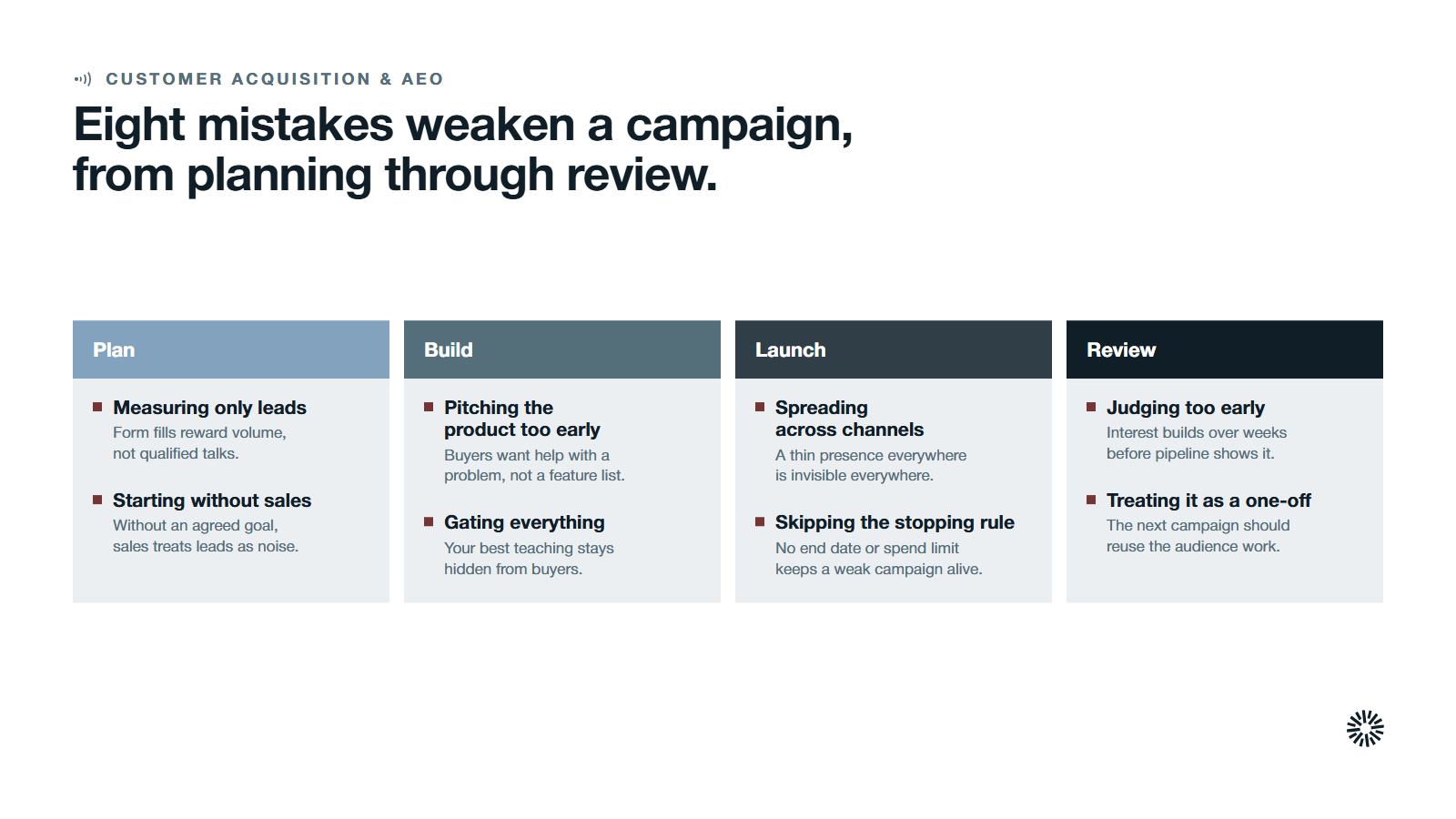
Most failed campaigns repeat a handful of errors. Check your plan against this list.
- Measuring only leads. Counting form fills rewards volume. Judge the campaign by qualified conversations and pipeline.
- Starting without sales. If sales did not agree the goal, they will treat the leads as noise.
- Talking about your product too early. Buyers who do not know you want help with a problem, not a feature list.
- Spreading across too many channels. A thin presence everywhere is invisible everywhere.
- Gating everything. Putting every asset behind a form hides your best educational content from people who would have trusted you.
- Skipping the stopping rule. Without an end date and a spend limit, a weak campaign keeps drawing budget.
- Judging too early. Interest builds over weeks, so set the review for when the pipeline can show it.
- Treating it as a one-off. The lessons only pay when the next campaign reuses the audience work, assets and tracking.
For worked illustrations of what these programs look like in practice, read our breakdown of demand generation examples.
What you gain when this is done properly
A planned campaign turns demand generation from a set of busy activities into a repeatable way to grow pipeline and support business growth. Each team gains something different.
Sales gets warmer conversations with the right accounts
Sellers start with named accounts and buyers who have already read something useful. They spend their time on high quality leads and more closed deals, not on cold lists with no context.
Marketing gets proof of what works
With one goal, one audience and connected tracking, marketing can show which activity reached target accounts and which did not. Budget then follows evidence, and the next campaign starts from a stronger base.
Customer success gets better-matched customers
When the message is honest about the problem and the outcome, the buyers who arrive are a better fit. Customer success inherits customers who know what they bought and why, and who are more likely to stay and expand.
Start the next campaign with a plan you can defend
A demand generation campaign is a sequence of decisions: the goal, the audience, the message, the assets, the channels, the launch and the review. Make each one in writing, and test the plan with a small first run before you scale spend.
Propello designs and builds connected go-to-market (GTM) systems on HubSpot, and Propello is a HubSpot partner. If you want your campaign plan, data and reporting set up before you commit budget, an audit is the place to start.
