
Hire a demand generation agency when you need programs running this quarter, your sales team already follows up on every qualified lead, and one person inside owns the result. Build in-house when your market is narrow and the work will run for years. Most B2B companies end up with a hybrid: strategy and measurement inside, specialist execution outside.
This article is for CEOs, founders, CROs and revenue leaders at growing B2B companies deciding whether to hire a B2B demand generation agency or build their own demand gen team. You will get what an agency replaces, what doing nothing costs, when each option pays back and fails, what breaks when the wrong one runs the work, and a decision rule by company stage.
|
Demand Generation Agency A demand generation agency is an outside firm that plans and runs the programs that create and capture buyer interest for a B2B company, and reports on the qualified pipeline those programs produce. |
What a demand generation agency replaces, and what doing nothing costs
An agency replaces capacity and specialist skill. It gives you people who can run content marketing, paid media, paid search, paid social, email and marketing automation at the same time, without you hiring and managing each of those roles. Its demand generation services may also cover SEO, intent data, account based marketing and reporting on pipeline metrics. A good one works across the entire buyer's journey and uses analytics to reach high-intent audiences and to optimize each campaign.
Demand generation has two jobs. The first is to create demand among people who are not yet looking. The second is demand capture, which turns interest that already exists into sales conversations. Most B2B teams need both, and a good partner is clear about which one it is running.
The nearby term is lead generation, which captures contact details for sales to act on now and is often short-term and transactional. Demand generation educates prospects and nurtures them over time, building trust before the sales conversation starts and connecting marketing investment to business growth.
An agency does not replace four things that only you can supply: a clear target market, a sales process that follows up fast, an offer worth responding to, and an internal owner who can say yes or no.
The cost of doing nothing is easy to miss because it never appears as a line item. Buyers form their shortlist before they talk to you. 6sense's 2025 B2B Buyer Experience Report, built on nearly 4,000 buyer responses, found that the winning vendor was already on the Day One shortlist ninety-five percent of the time, and that four out of five deals went to the pre-contact favorite.
If your company is not in the buyer's head before the first sales conversation, your sales team is competing for second place. That is the work demand creation does, and why a sound demand strategy starts early: it builds familiarity and preference with the people who will buy later, before any of them fills in a form.
The buying group is also larger than one contact. Forrester's State of Business Buying 2024 found that on average 13 people within an organization are involved in the buying decision, with 89% of purchases involving two or more departments. A program that reaches only the person who downloads a guide leaves most of the committee untouched.
Buyers also want to stay in control. Gartner's 2025 sales survey of 632 B2B buyers found that 61% prefer an overall rep-free buying experience and that 73% actively avoid suppliers who send irrelevant outreach. Quiet, useful demand gen reaches them where outreach does not, and it helps your marketing teams and sales team agree on what a good lead looks like.
Each option charges in a different currency
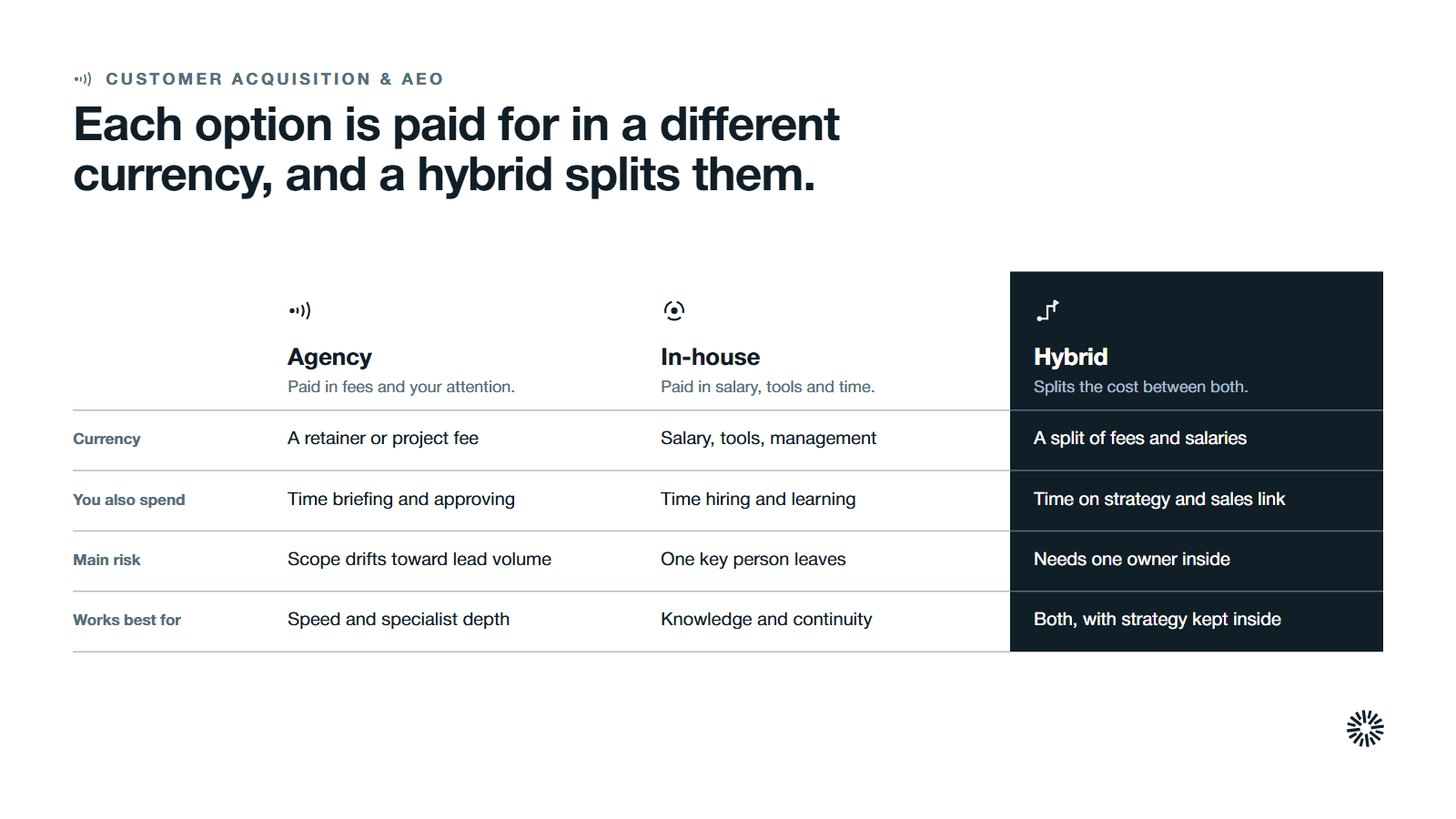
Two proposals can look equally sensible and still cost you very different things, because each option is paid for in a different currency. Compare them on the same terms before you compare any quote.
An agency charges in fees, usually a retainer or a project price, and in your attention. You spend time briefing, approving and correcting. The risk is a scope that drifts toward activity you can see, such as lead volume, rather than the qualified pipeline you need.
An in-house team charges in salary, tools and management time. There is no agency fee, but you carry the hiring, the learning curve, the marketing automation platforms and the risk that one key person leaves.
A hybrid splits the cost. Your people hold strategy, data and the relationship with sales, and a specialist team runs the channels that need depth or surge capacity.
A demand generation agency pays back when you need speed and specialist depth
Agencies are strongest where the work is broad, the deadline is near and the skills are specialist. They bring a repeatable method, a bench of people and experience across many accounts, which is hard to buy one hire at a time. This is why mid market SaaS companies and other tech companies with long sales cycles often start there. Most agencies are strongest in two or three channels, so ask which ones before you assume the rest.
What an agency is good at
- Speed to a running program. A team that has launched campaigns before can have content, paid media and nurture live in weeks rather than after a hiring round.
- Breadth under one plan. Content strategy, paid ads, social media marketing, account based marketing and lifecycle marketing can be sequenced across multiple channels as demand generation campaigns, instead of competing for one person's week.
- Surge capacity. You can scale effort up for a launch or a new market and back down afterward.
When an agency fails
- The offer or the target audience is unclear. An agency cannot invent your positioning. Hiring before your ideal customer profile is defined leads to poor targeting, and it will test messages at your expense until you supply one.
- Sales does not follow up. Leads that wait go cold, and the agency is blamed for a handoff problem it does not control.
- Nobody inside owns it. Without an owner, approvals stall and the program drifts to whatever is easiest to report.
- It is measured on lead volume. A lead generation agency optimized for form fills can look successful while pipeline quality falls.
A general marketing agency, a performance marketing agency and a paid media agency each cover part of this work, and an inbound marketing firm covers another part. Decide which job you are buying before you shortlist. One caution on terms: Google also sells a campaign type called Demand Gen, which runs ads across YouTube and other Google surfaces. That is a tool you can buy for yourself or hand to an agency, not a substitute for the decision this article covers. Google Ads is one channel among many.
If you want to see what a program looks like once it is running, read one B2B demand generation program taken apart.
In-house demand generation pays back when knowledge and continuity matter most
An internal team knows your product, your customers and your sales conversations. That knowledge is slow to build and cannot be briefed in a document, which is why in-house work tends to win in narrow, technical or regulated markets where accuracy beats speed.
What in-house is good at
- Depth in your market. Your people already hear why deals are won and lost.
- Continuity. Learning stays in the company, and each quarter builds on the last.
- Tighter loops with sales. Marketing and sales sit on the same data and fix problems in days.
When in-house fails
- One person is asked to cover every channel. Content, paid media, analytics and sales enablement need different skills, and a single hire will be strong in one.
- The first hire has no one to learn from. A generalist building the whole demand generation strategy alone often repeats avoidable mistakes, and lead gen habits from a previous job rarely fit a long cycle.
- The program depends on one person. If they leave, the plan and the tools leave with them.
If your question is whether to hire a part-time senior leader or a full-time employee, the same logic is laid out in fractional RevOps vs a full-time hire.
What breaks when the wrong option runs your demand generation
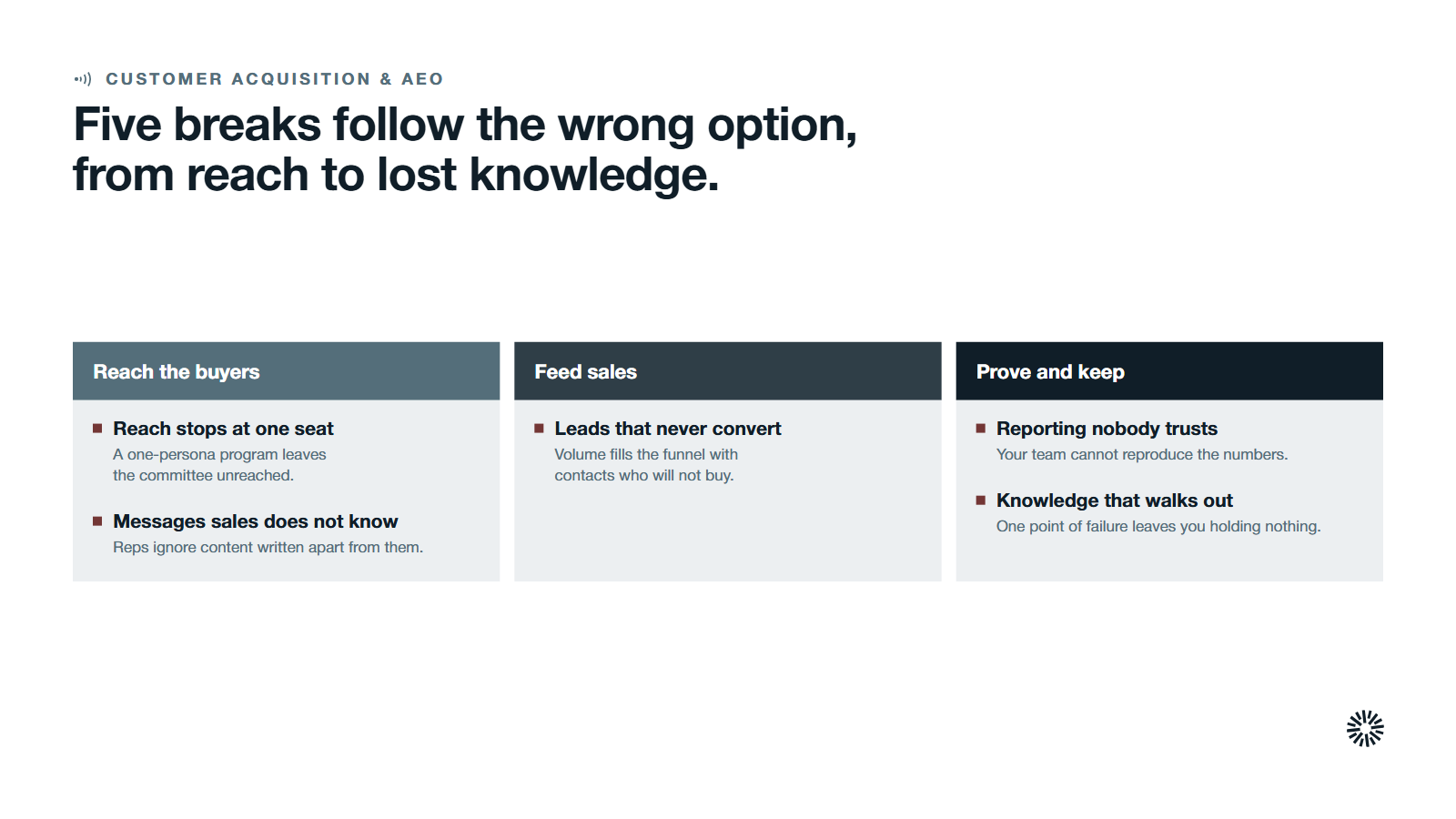
The cost of choosing badly arrives slowly. It shows up as busy dashboards, a sales team that stops trusting marketing and a budget that is hard to defend.
Leads that never become pipeline
Lead volume is easy to buy and easy to report. When the brief rewards volume, programs fill the funnel with contacts who were never going to buy, and sales teams stop working them. Judge any option on lead quality, qualified leads and sales qualified leads, not on form fills or lead generation campaigns that report only volume.
Messages that sales does not recognize
A team working apart from sales writes to a buyer who does not exist. Reps then ignore the content, and prospects meet two different stories. Weekly contact between whoever runs demand and the people in sales conversations is cheaper than any rewrite.
Reach that stops at one seat
When the buying group is large, a program built around one persona reaches one voice. Complex sales cycles involve multiple stakeholders, and each one needs a reason to trust you. The rest of the committee meets your company for the first time in the sales cycle, when it is hardest to change their minds. The same goes for channels: expecting one channel to fix everything is unrealistic, and effective demand generation combines several channels with personalized messaging.
Reporting nobody trusts
If the agency grades its own work with a report your team cannot reproduce, you cannot decide whether to continue. Credit for revenue should be traceable in your own system, with your revenue operations team or whoever owns the data. Our guide to revenue attribution explains how to set that up.
Knowledge that walks out
Whether it is a contractor or a single employee, an arrangement with one point of failure leaves you holding nothing when they go. Insist on documented audiences, messages and campaigns that live in your systems.
Match the option to your company stage
Company stage changes who should run the work. The logic holds at every size, but the first move differs.
Early-stage company with a small team
Build the foundation yourself: a clear target market, a single message and a simple way for sales to follow up. Bring in a specialist for one channel or a short project, and name an internal owner from day one. Hold back a full-service retainer until the offer is proven. Watch whether sales conversations repeat the same questions, because that tells you what content to make.
Growth stage with several teams
Use an agency to add channels and speed, with an in-house marketer who owns strategy, reporting and the link to sales. Hold back any new channel your sales team cannot follow up within the same day. Watch whether the leads you pay for are accepted by sales without argument.
Scale stage with several segments or regions
Build a core team that owns strategy, data and measurement, and treat agencies as specialist capacity for channels, regions or launches. Hold back handing over the strategy itself. Watch whether pipeline quality holds as volume grows. If your option is a single hire rather than an outside team, see GTM agency vs in-house GTM engineer for a comparison.
How to judge the best demand generation agencies
A ranked list of the best demand generation agencies tells you little, because the right firm depends on your stage, your sales cycle and your existing marketing foundation. Judge each candidate on seven tests instead.
- Fit with your buyers. Ask for case studies in a similar market, such as enterprise technology companies or mid market SaaS companies, and for the reasoning behind the work.
- A shared definition of a qualified lead. Ask how they define one before you sign, and make sure it matches how your sales team defines one.
- Full funnel demand generation. Look for a plan that covers awareness, consideration and handoff, not only the bottom of the funnel.
- Pipeline metrics over vanity metrics. Ask what they report each month, such as sales qualified leads, qualified conversations and revenue influenced, and how it ties to revenue growth.
- One connected system. Audience targeting, messaging and reporting should work together as one system, with success measures agreed at the start so expectations stay aligned.
- Senior people doing the work. Ask who writes the campaigns and who reviews them.
- Honest limits. A credible firm tells you what it will not do and when you should not hire it yet.
Four questions to settle before you hire or build
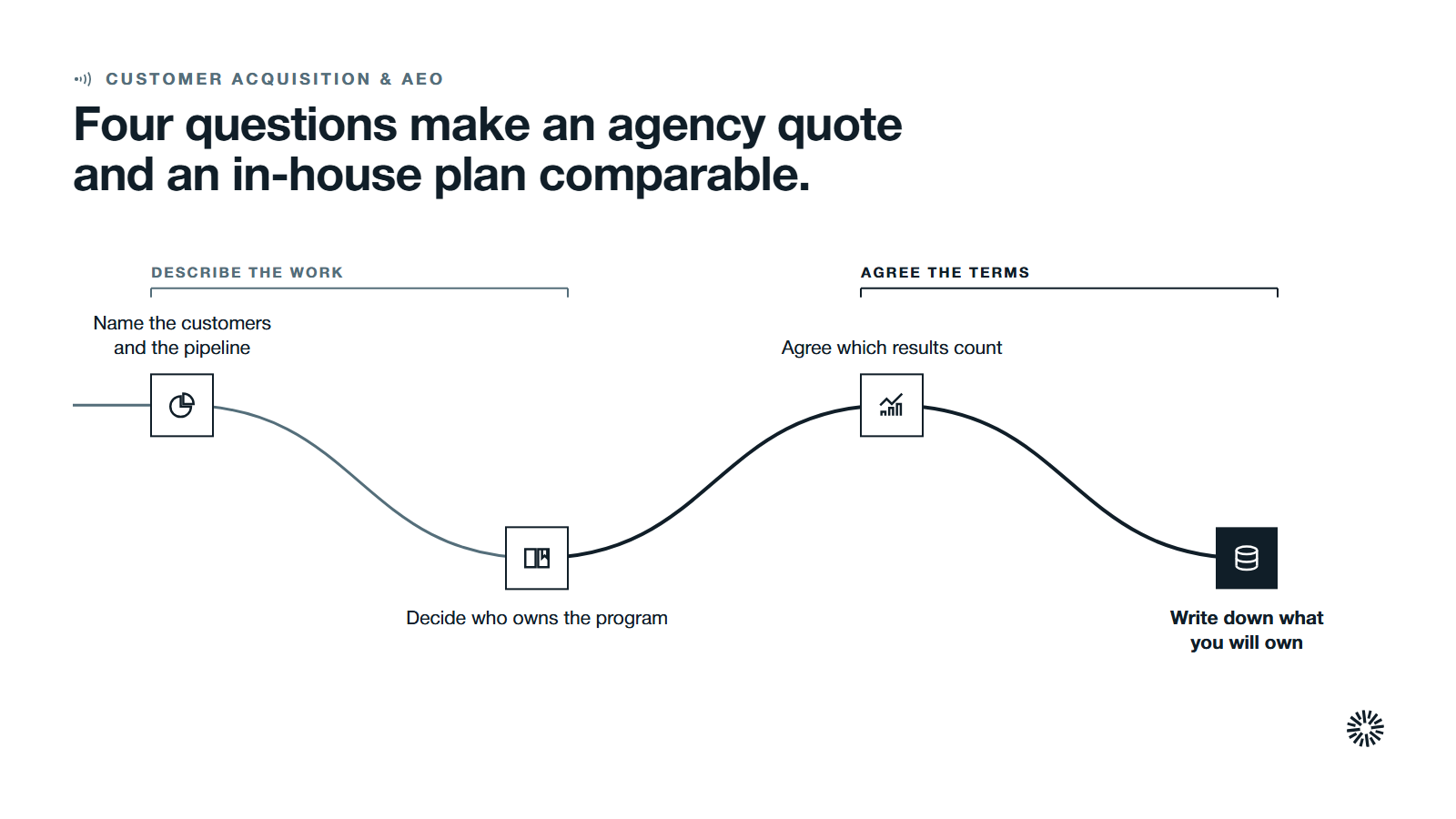
A quote is only as good as the brief behind it. Settle these four questions and proposals from an agency and your own team become comparable.
- Name the customers you want and the pipeline you expect them to create, in your own words.
- Decide who inside owns the program, approves the work and talks to sales every week.
- Agree which results count: qualified pipeline, accepted leads and sales cycle movement, not clicks.
- Put in writing what you will own afterward: audiences, content, data and reports.
Ask each candidate to answer against the same four points. The answers show who has done this before.
What you gain when this is done properly
The right choice, made with a clear brief, pays back across the revenue team and not only in marketing.
Sales spends time on buyers who already know you
Prospects arrive having read your work, so the first call starts with their problem rather than your introduction. Reps spend less time on cold prospecting and more on the accounts that fit.
Marketing can show what its work produced
Agreed definitions and connected systems let marketing tie programs to qualified pipeline instead of to downloads. Marketing spend becomes easier to defend, business outcomes are visible, and the next decision about revenue growth is easier to make. When sales and marketing work around shared goals, campaigns can be tuned from real results rather than opinion.
Customer success inherits better-informed customers
Customers who understood the offer before they bought ask better questions in onboarding. Expectations set in marketing match what customer success delivers, which supports renewals and expansion.
Decide by scope, then name one owner
The honest answer to agency or in-house is that it depends on what you can describe before anyone quotes. Use an agency for speed and breadth, an in-house team for knowledge and continuity, and a hybrid when you need both. Whichever you pick, name one person inside who owns the result.
Propello designs and builds connected go-to-market systems on HubSpot. If you want help deciding before you commit budget, an audit is the place to start. See what the Propello GTM Audit covers and how to prepare. Start with the basics in what demand generation is if you are new to the term.
