If you are a founder, CEO, CRO or revenue leader at a growing B2B company, the question is whether the benefits of RevOps justify the effort of setting it up. They do once marketing, sales and customer success run separate systems, definitions and reports, because that split costs you pipeline, forecast accuracy and time.
This article shows what revenue operations replaces, what it costs to run without it, where the benefits appear first and how to judge when they pay back. You will also see what sales, marketing and customer success each gain, so you can decide whether to start now or wait.
The decision in one paragraph: if your teams argue about whose numbers are right, your forecast changes every week or your tech stack grew without a plan, build a revenue operations function now, starting small. If one team owns the whole cycle and the numbers agree, wait until a second team joins.
|
Revenue Operations Revenue operations is the practice of running sales, marketing and customer success on one set of data, definitions and processes so the whole revenue cycle can be planned, measured and improved. |
What revenue operations replaces in a growing company
Most companies do not start with a revenue operations function. They collect small, sensible fixes: a marketing tool here, a sales tool there, a spreadsheet for renewals. Together they leave you with several versions of the truth.
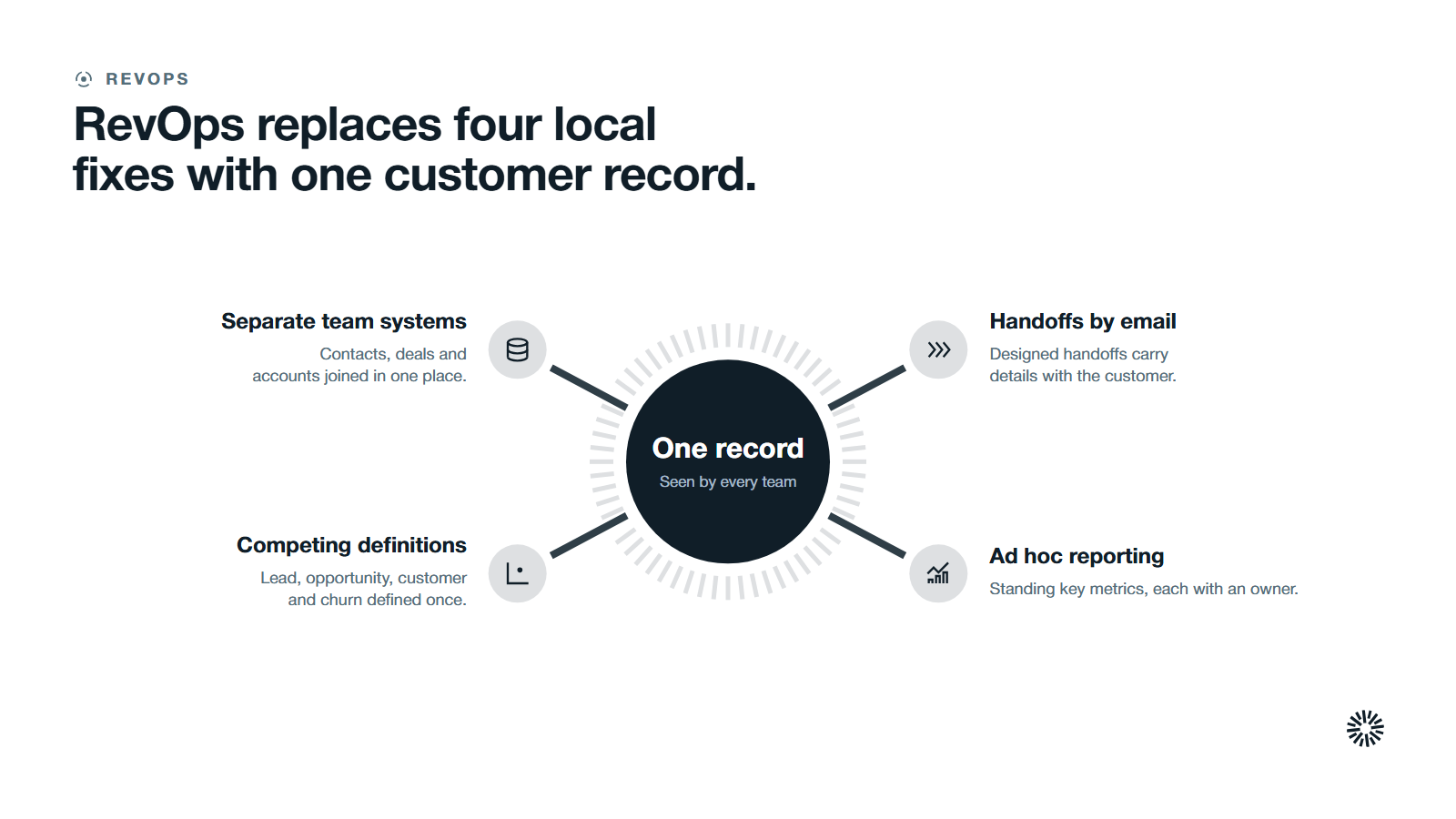
Revenue operations (RevOps) replaces that pile of local fixes with one design for the revenue cycle. Well-run RevOps teams own that design for everyone, and they answer to no single department. For a full definition of the discipline and its parts, read our explainer on what RevOps is.
Separate team systems become one customer record
Marketing keeps contacts in one place, sales keeps deals in another and customer success keeps accounts in a third. Revenue operations consolidates these into one customer record, so every team sees the same history from first visit to renewal.
Revenue data lands in one central place. Integrating sales, marketing and finance systems, such as the CRM and the ERP, prevents data silos and the manual copying between them.
Competing definitions become shared ones
Ask three leaders what counts as a qualified lead and you may get three answers. Revenue operations writes the definitions down once: lead, opportunity, customer, churn. Aligning sales, marketing and customer success on one vocabulary is the cheapest fix in the whole program.
Align incentives too: if marketing is rewarded for volume and sales for closed deals, shared targets point both toward the same outcome. Written RevOps processes keep these rules in place when people change roles.
Handoffs by email become designed handoffs
A lead moves from marketing to sales, and a closed deal moves to customer success teams.
Where nobody designed that handoff, details get lost and customers repeat themselves. Revenue operations maps each handoff across the customer lifecycle and decides what information travels with the customer. Streamlined handoffs lift pipeline velocity, because deals stop waiting for missing details, and they improve the customer experience.
Ad hoc reporting becomes a set of key RevOps metrics
Someone builds a custom report before every board meeting, and nobody can quite reproduce it. Revenue operations turns those one-off reports into standing key metrics and key performance indicators with owners. Our guide to revenue operations metrics covers which ones to track.
What it costs to run revenue without it
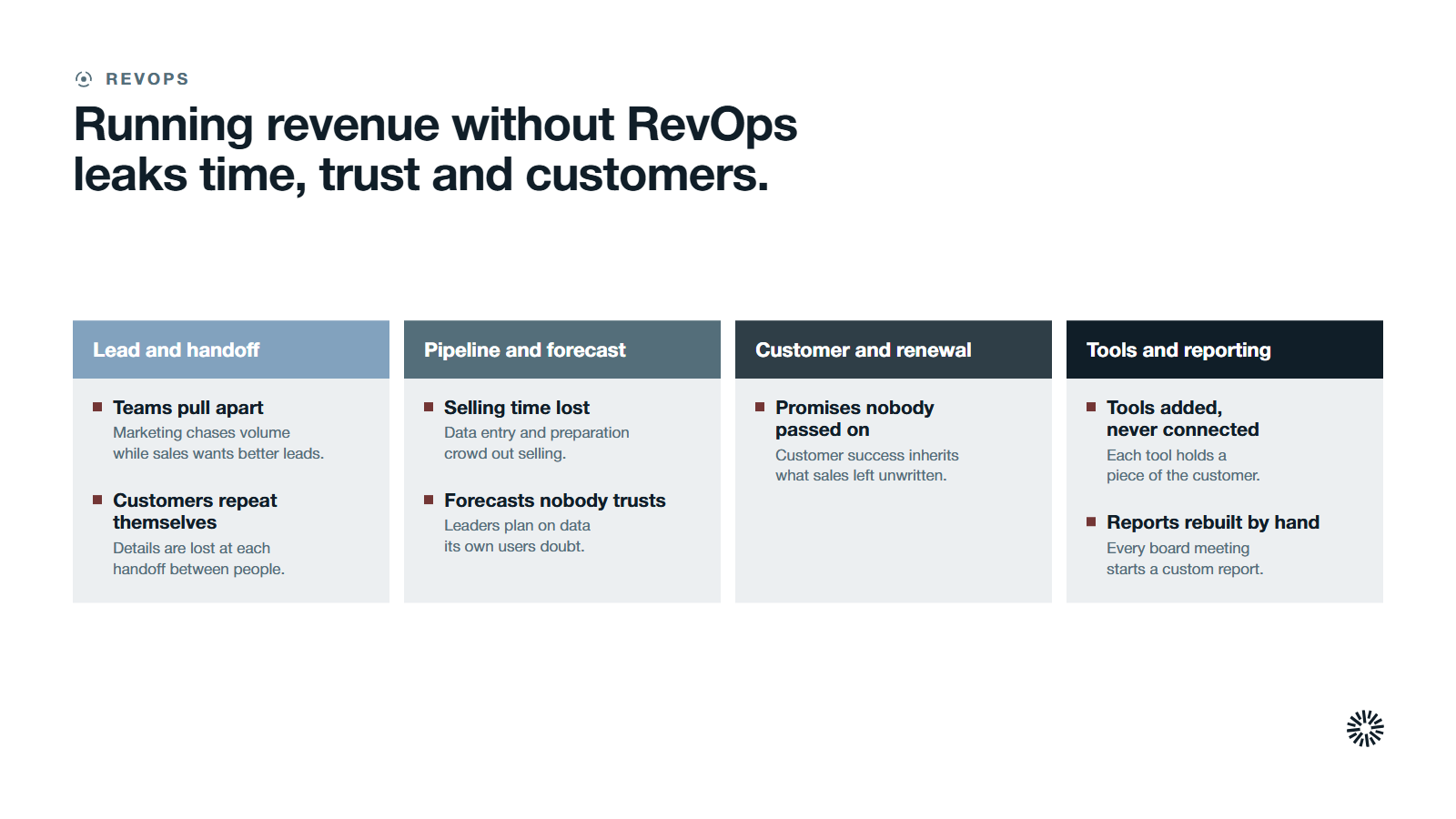
The case for revenue operations rests on the cost of the alternative, which rarely appears on a budget line.
Selling time goes to administration
Salesforce's State of Sales 2026 survey of more than 4,000 sales professionals found that the average seller spends 40% of their time selling. The rest goes to data entry, analyzing data in spreadsheets, internal coordination and preparation.
Sales productivity suffers first, because the sales pipeline is only as good as the time reps can give it.
Leaders cannot trust the numbers they plan with
In Salesforce's State of Sales 2024 research, only 35% of sales professionals said they completely trust the accuracy of their organization's data. A forecast built on data its own users doubt is a guess with a spreadsheet around it.
Fragmented data also makes analyzing data and data driven decision making slow. People check, reconcile and argue before they act.
Teams pull in different directions
HubSpot's 2026 State of Marketing report found that 27.6% of marketers named sales-marketing alignment a top challenge.
Marketing optimizes for lead volume, sales wants fewer and better leads, and customer success inherits promises it did not make. Sales marketing disputes over lead quality are the visible symptom, and the customer experience suffers.
The tech stack grows without a plan
Salesforce's 2025 MuleSoft Connectivity Benchmark, based on over 1,050 IT leaders, found that the average enterprise manages 897 applications and only 29% are integrated. Your tech stack is smaller, but the pattern repeats at every size: tools are added faster than they are connected.
Marketing automation platforms, sales tools and support systems each hold a piece of the customer, and the pieces rarely match. The result is duplicate data entry, paid-for features nobody uses and reports that need manual stitching. For the wider picture, see our guide to revenue operations strategy at scale.
Where revenue operations pays off first
RevOps teams usually sequence the work. The earliest gains come from the groundwork: data, definitions and process. Later gains, such as better forecasting and stronger retention, rest on that groundwork.
Cleaner customer data and one source of truth
When marketing, sales and customer success share one customer relationship management system and agree on its fields, people stop rebuilding reports and start using them. Data quality improves because someone owns it, and cross functional collaboration becomes one record instead of a weekly reconciliation call.
Shared metrics also promote joint problem-solving, because teams read the same numbers and fix problems together instead of defending their own slice.
A shorter, more predictable sales process
Once handoffs are designed and stages have clear entry rules, the sales process becomes easier to see and to improve. You can spot where deals stall, shorten sales cycles that drag on and give reps a clear next step.
Lead management rules decide who follows up and how fast. Process optimization starts with the whole sales funnel, not one team's slice of it.
Revenue operations also identifies bottlenecks in the revenue funnel, so resources go where deals actually stall. The aim is shorter sales cycles and better win rates.
Our guide to sales enablement shows how sales enablement supports this.
Data driven decision making starts with forecasts you can defend
Forecasting revenue is only as good as the pipeline data under it. With shared stage definitions and one record, you can compare commitments with outcomes and see why a forecast missed. Finance and the board can see which assumptions moved, whether you are on track against revenue goals and how business performance is trending.
Standardized sales pipelines and accurate forecasting models are what make revenue growth predictable.
Better use of the tech stack and more operational efficiency
A revenue operations manager or one of the RevOps teams reviews the tools you pay for, removes overlap and connects what remains.
Review the tech stack every quarter, because a good tech stack is small, connected and owned. Standardized workflows and automation of routine tasks free time for strategic work. The aim is operational efficiency: fewer manual steps, fewer places to update and less time spent chasing data between systems, so teams can optimize performance.
A consistent customer journey across the customer lifecycle
When all three teams work from one view of the customer lifecycle, the customer journey feels continuous. Buyers do not repeat their story to each new person, and onboarding starts with what sales learned. That consistency improves the customer experience and supports higher customer satisfaction and renewal.
Feedback loops between sales and customer success also refine the target buyer profile, so marketing aims at the customers who stay.
How revenue operations helps drive revenue growth
Revenue operations does not create demand by itself. It removes the friction in revenue generation that keeps demand from becoming revenue, which is how it helps drive revenue growth. Healthy revenue growth shows up in a handful of key metrics that every revenue leader already watches.
- Customer acquisition cost: the cost of winning a customer. Better targeting and fewer wasted handoffs lower it.
- Customer lifetime value: the revenue a customer brings over the whole relationship. Smoother onboarding and clearer ownership keep customers longer and open expansion.
- Revenue growth rate: the change in revenue between two periods, the headline number the others explain.
- Sales cycle length: the average time from first contact to closed deal. Shared stages and cleaner data remove days from it.
- Conversion rates: how effectively the business closes deals at each stage, which shows where the sales funnel leaks.
- Average revenue: average revenue per customer rises as expansion is planned across the revenue lifecycle, not left to chance.
- Recurring revenue: monthly recurring revenue and annual recurring revenue, which matters most to subscription models, rise when retention improves and expansion is tracked.
Business growth built this way is sustainable growth. Sustained revenue growth comes from a better revenue engine, not from more spending on the same one, and it helps drive business growth without a matching rise in sales costs. Our guide to how to implement a successful RevOps strategy shows the order to build it in.
When revenue operations pays back and when it does not yet
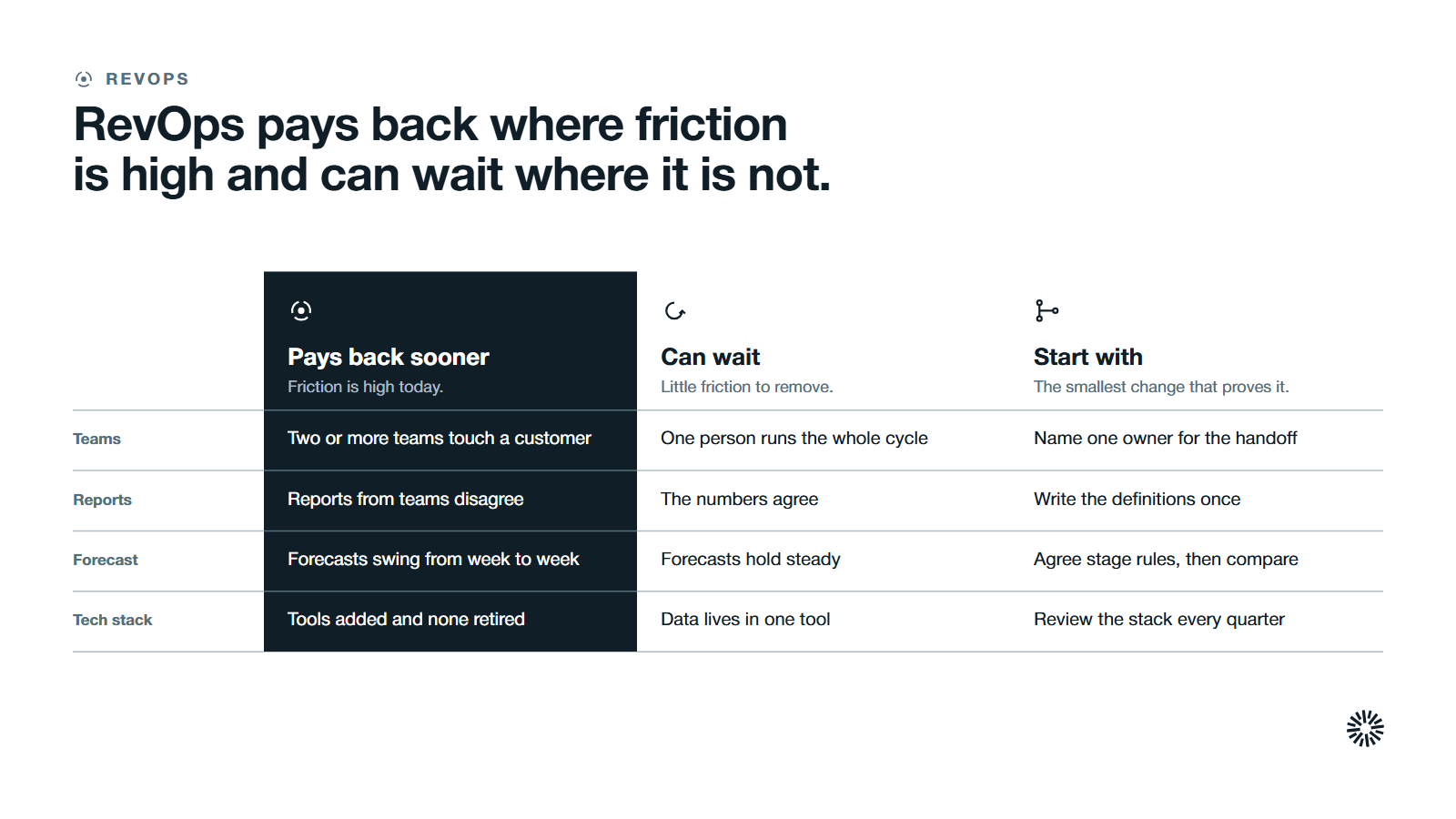
The return on revenue operations depends on how much friction you carry today. A company with a short sales cycle, one buyer per deal and one team running revenue will gain less than a company with three sales teams and a long cycle.
Use arithmetic from your own numbers
This illustrative arithmetic is not data from any company. Suppose a team of ten reps loses five hours a week each to manual data entry and record clean-up. Over 46 working weeks, that is 2,300 hours, close to a year of one full-time person.
If cleaner processes and automation give back even half, you regain more than 1,100 selling hours a year. If you sell subscriptions, watch annual recurring revenue move as the result. Replace each number with your own, add a lower customer acquisition cost if the handoffs improve, and you have a payback test for your situation.
Signs that it pays back sooner
The return arrives sooner when several of these are true:
- Two or more teams touch the same customer.
- Reports from different teams disagree.
- Forecasts move sharply from week to week.
- You have added tools to your tech stack in the last year and not retired any.
Signs that it can wait
If one person runs the full revenue cycle, the data lives in one tool and the numbers agree, a revenue operations function would add cost without much return.
Start with a role or a service
Many companies start with one revenue operations manager or a small RevOps team that reports to the chief revenue officer or CEO and owns the data and tech stack.
If hiring is not yet realistic, RevOps as a service is one way to begin. Our comparison of GTM Engineering and RevOps explains where the two disciplines meet.
What you gain when this is done properly
The RevOps benefits are easiest to judge team by team, because each team feels a different change first.
Sales gets cleaner pipeline and more selling time
Sales teams work from one record, so reps walk into calls knowing what marketing sent and what support has heard, and the customer experience feels joined up. Managers forecast from data they trust, and sales performance becomes easier to coach.
Marketing is judged on revenue, not only leads
Marketing sees which campaigns produce pipeline and customers who stay, not only form fills. Sales enablement content built from marketing's best material helps reps close. It also makes it easier to move budget and to agree with sales on what a good lead is. Better sales marketing alignment settles the lead quality dispute with evidence.
Customer success sees risk early and can show its value
Customer success teams work from the full record: what was promised, what was bought and how the account is using it. That means earlier warnings on at-risk accounts. Customer feedback reaches the right people, and a clear view of sell and upsell opportunities lifts customer lifetime value and customer satisfaction.
Stronger customer retention follows from the work the team does after the sale. Our guide to customer success practices that grow sales covers the practice in detail.
Leaders get one view of the whole revenue cycle
Leadership gets one version of performance across business operations, so planning, hiring and budget decisions rest on the same numbers and shared revenue goals. Our guide to marketing data analytics covers the groundwork.
Start with the smallest change that proves the case
Successful revenue operations starts small.
Pick the most expensive disagreement in your revenue cycle. Aligning sales and customer success on one handoff is a good first target. Fix it with one owner, track two or three key metrics for a quarter and let the result guide the next step.
Propello designs and builds connected go-to-market (GTM) systems on HubSpot, and is a HubSpot partner. If you want to know where your revenue cycle leaks, an audit is the place to start.