
B2B SaaS marketing works differently from marketing a product sold once, because customers pay every month and the real sale happens at renewal. A dependable way to run it is as a loop: each stage teaches the next, and what customers do after buying shapes what you say next.
This article is for CEOs, founders, CROs and marketing leaders at companies that sell business to business software. It explains which strategies belong in B2B SaaS marketing, how to measure them, and how HubSpot's Loop Marketing framework fits a subscription business.
|
B2B SaaS Marketing B2B SaaS marketing is the work of attracting, converting and keeping business customers who pay a recurring subscription for cloud software, so revenue grows through renewal and expansion as well as new sales. |
Why B2B SaaS marketing differs from marketing other products
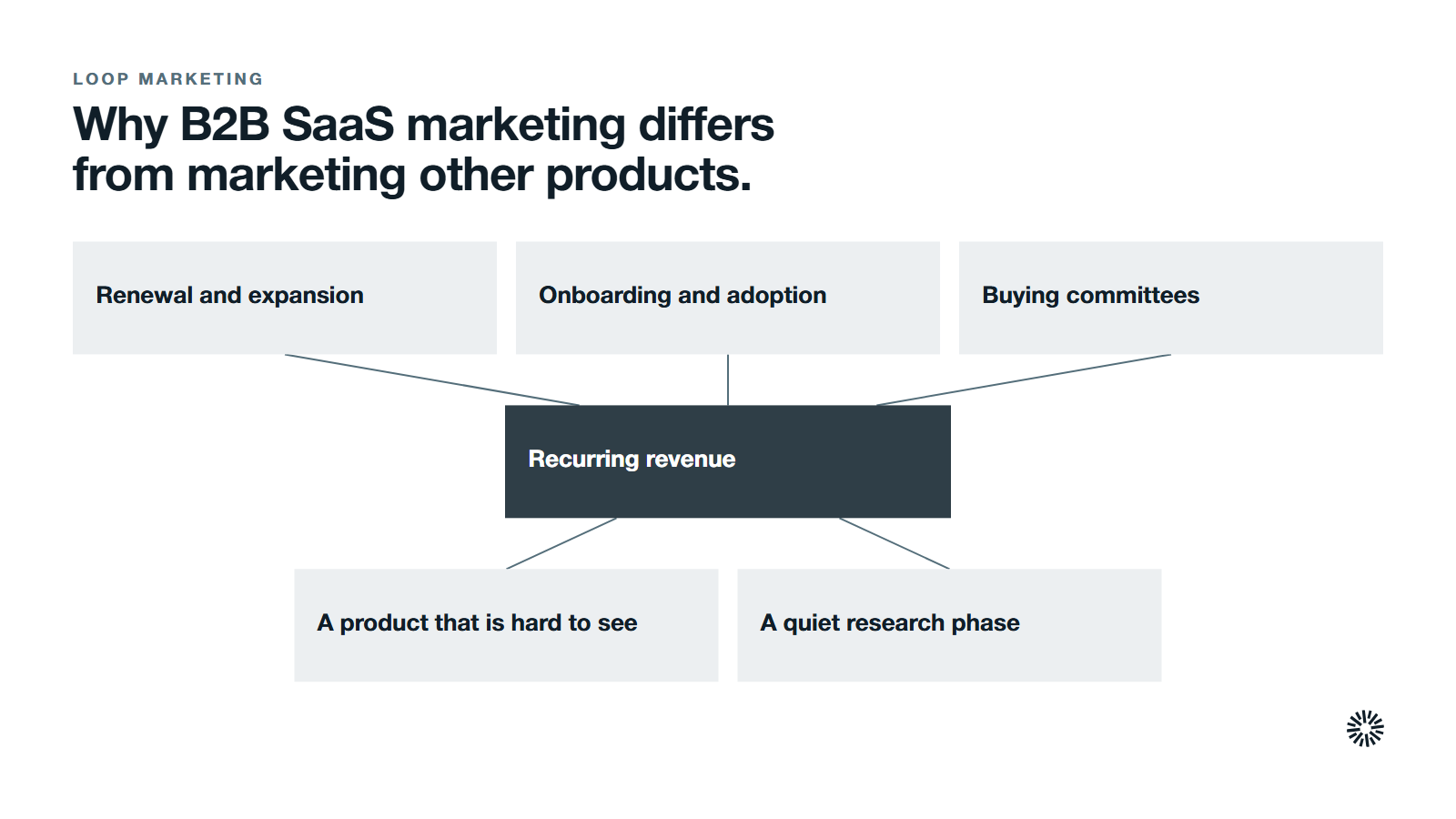
A software subscription changes the economics of every marketing decision. You do not earn the full value of a customer on the day they sign. You earn it over the months and years they keep paying, which means a customer who churns early can cost more to win than they ever return.
That is why recurring revenue sits at the center of a SaaS business model. Acquisition matters, but so do onboarding, adoption, renewal and expansion revenue. Marketing that stops at the signed contract ignores the part of the journey where much of the value is earned.
Three other features shape the work:
- Buying committees. Multiple stakeholders judge a software purchase, each with a different worry, such as cost, security, integration or ease of use.
- A product that is hard to see. Cloud based software solutions cannot be held, so you have to make its value visible through content, demos and customer stories.
- A long, quiet research phase. Buyers form opinions before they ever speak to your sales team.
Pricing and risk matter too. Business software often carries annual contracts and higher prices than consumer apps, so buyers weigh logical return and business impact over personal taste. A tailored go-to-market strategy is what connects your marketing to that revenue.
The quiet research phase has been measured. 6sense's 2025 Buyer Experience Report found that buyers first made contact with sellers when they were 61% of the way through their buying process, and that the vendor a buyer favours before that first contact usually wins the deal.
If you are not known before the first call, you are usually not in the deal.
Where buyers do that research is changing too. G2's 2025 buyer behavior research reported that nearly 8 in 10 respondents say AI search has changed how they conduct research, and 29% start research on platforms like ChatGPT more often than on Google.
AI tools summarize and compare software options and influence buyers before they visit your website, so AI search visibility is now part of any SaaS marketing strategy. Your content has to be structured so that both people and AI tools can trust and cite it.
How the four Loop stages apply to a SaaS business
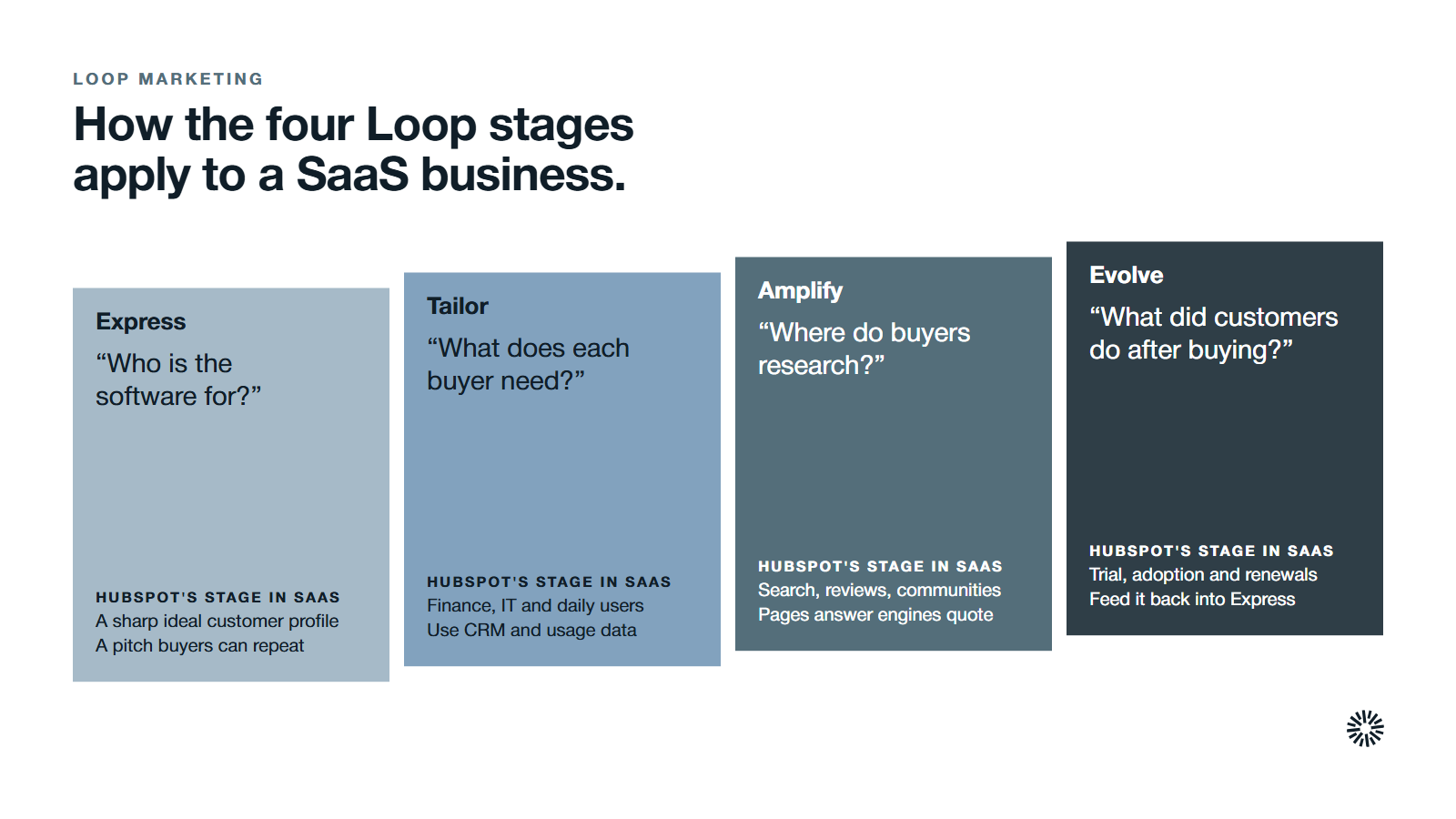
HubSpot describes Loop Marketing as a four-stage framework any marketing team can use to grow in the AI era. The stages are Express, Tailor, Amplify and Evolve. We describe it here as HubSpot does, and Propello applies it as a HubSpot partner.
For a subscription business, the loop is a natural fit, because the product itself produces a steady stream of learning.
Express: say who the software is for and why it matters now
Express is where you define what to say, how to say it and why it matters right now. HubSpot starts it with a Taste Profile, a picture of your customer and your brand that gives AI the context to sound like you rather than everyone else.
For a software company, that means a sharp ideal customer profile and a value proposition a buyer can repeat. Name the problem, the team that feels it and the outcome your product changes. Include industry and company size, because that detail helps you identify high-value target accounts.
Treat the profile as living: continuous research and customer intelligence keep it aligned with market changes and shifts in how buyers talk. Vague positioning leaves a good SaaS product to be compared on price alone.
Tailor: match the message to the account and the buyer in it
Tailor uses AI to turn your strategy into content that connects personally, across every format your audience consumes. In B2B software, that means speaking differently to the finance lead, the IT owner and the team that will use the product daily.
Your CRM already holds what you need: industry, company size, product usage and the pages each person read. Tailoring is the discipline of using that record, so a prospect who read your integration guide sees different content from one who read your pricing page.
Marketing automation then carries the match through email and your website, and buyer intent signals, such as repeat visits to a pricing page, tell your sales team when to reach out. For depth on the data behind this, read about first-party data and a unified customer record.
Amplify: publish where buyers research, including answer engines
Amplify means publishing your content across diversified channels, optimized for humans and answer engines. For software, that covers marketing channels such as search engines, review sites, communities, email and events, plus the AI tools buyers now use to build a shortlist.
Write pages that answer a buyer's question completely: how the product works, who it suits, how it connects to other tools, and what implementation takes. Pages like that serve a person on a search engine and give an answer engine something accurate to quote. AI generated summaries lean on pages that state facts plainly.
Evolve: learn from every pass, including what customers do after they buy
Evolve is where you iterate quickly and effectively; HubSpot says AI helps you make changes in days, not quarters. A SaaS company has an advantage here. Trial behavior, feature adoption, support questions and renewal outcomes all show what your marketing promised against what the product delivered.
Feed that evidence back into Express. When customers keep praising one capability, it belongs in your positioning. When they stall at one setup step, it belongs in your onboarding content. That is how your next SaaS marketing strategy starts from evidence, not opinion. The Loop Marketing playbook walks through each stage in more detail.
The marketing strategies that matter most for SaaS companies
No SaaS marketing strategy works alone. The skill is choosing a few, running them well and letting the loop show which marketing efforts deserve more of the marketing budget. These are the ones B2B software teams rely on most.
Content marketing builds trust before a buyer speaks to sales
SaaS content marketing is the base layer for most SaaS companies, and the software equivalent of inbound marketing. Blog posts, guides, comparison pages and documentation answer the questions buyers ask while they research. A content marketing strategy built around those questions earns attention that paid channels have to keep renting.
Create content for every stage of the sales process, from the first question to the renewal conversation.
Educational content helps buyers understand the category before they compare vendors. Landing pages should show features and use cases for one audience, and comparison pages build trust when they describe product differences honestly. Prospective customers remember the vendor that taught them something.
Search engine optimization makes that content findable
Search engine optimization turns content into a steady source of qualified visits. Target relevant keywords that match how buyers describe their problem, not just the name of your product category. Strong SEO efforts also cover your product pages, which should state plainly what the software does and for whom.
Product-led growth lets the software do some of the selling
Product-led growth uses the product itself, through a trial, a free tier or an interactive demo, to introduce buyers to the value. Freemium models are common here. It suits software that a single user can try without help, and it is a common route into SaaS growth marketing.
Marketing's job is to get the right people into the product and guide them to the moment it clicks.
Sales-led growth works differently: it relies on human conversations and demos, and usually carries a longer sales cycle. Most SaaS companies blend the two, with product-led entry and a sales team that steps in when an account shows signs of wanting to buy for more users.
Account-based marketing focuses effort on the accounts that matter
Account-based marketing treats a named list of target accounts as a market of one each. It fits enterprise deal sizes and committee buying, where you must win several stakeholders inside the same company. Marketing and sales agree on the list, then coordinate content, outreach and events around those accounts.
Paid search and paid advertising fill gaps and test messages
Paid search captures buyers who already know what they want, and paid ads can reach a defined audience quickly. Use them to test messages, support launches and cover topics where organic content is still maturing. Judge them on pipeline and customer acquisition cost, not clicks.
Customer stories turn happy customers into proof
A customer story that explains the problem, the change and the result in the customer's own words gives a buying committee the social proof it needs. Ask for stories at moments of success, such as after a strong adoption milestone or a renewal.
How to measure B2B SaaS marketing
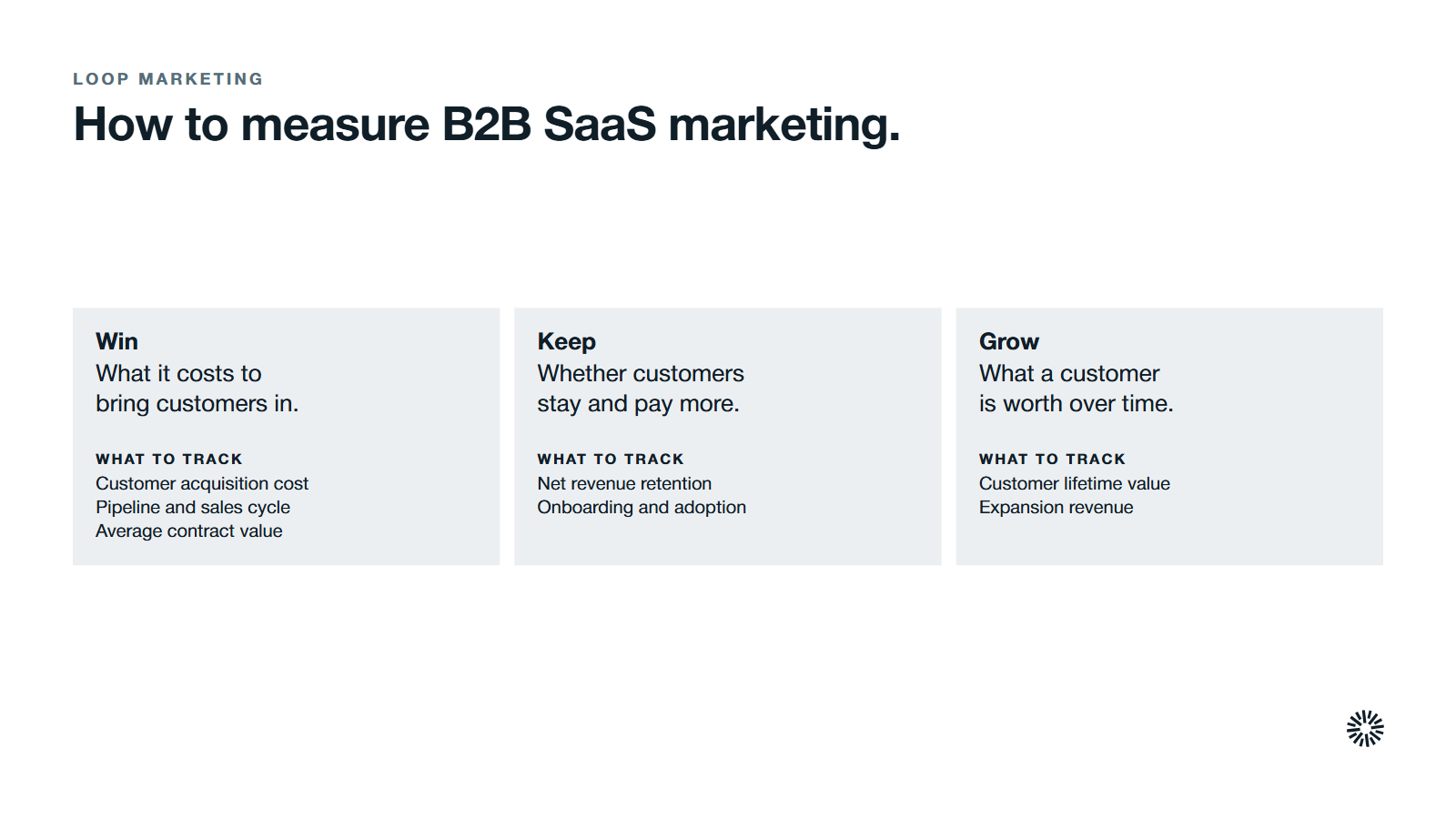
Measurement keeps the loop honest. Because revenue recurs, a SaaS marketing strategy is only as good as the numbers that test it. The numbers worth tracking connect marketing to the full customer lifetime, not just the first sale.
- Customer acquisition cost. What you spend on marketing and sales to win a new customer.
- Net revenue retention. Whether existing customers pay you more or less over time, once upgrades, downgrades and churn are counted.
- Customer lifetime value. What a customer is worth across the whole relationship, set against what it cost to win them.
- Expansion revenue. Revenue added from existing customers through more seats, more usage or more products.
- Pipeline and sales cycle. Qualified opportunities created and the time they take to close.
- Average contract value. What a typical deal is worth, which sets how much acquisition cost you can afford.
Lifecycle marketing is what makes these numbers move. It covers onboarding, adoption, renewal and expansion, which means the funnel for software continues past the purchase, through evaluation and into advocacy. Acquisition cost is only justified when retention and lifetime value outweigh it, and compound growth happens when acquisition, retention, expansion and advocacy reinforce one another.
Read these together. A rising acquisition cost is a warning only if retention and lifetime value are not rising with it. If you are deciding between a straight funnel and a loop model, growth loops compared with funnels lays out the decision rules.
What B2B SaaS marketing is not
A few nearby terms get mixed up with it. Marketing traditional software was a one-time sale, while a subscription model is bought continuously, so paying customers can leave at any renewal. Product marketing shapes positioning and launches, and it is one part of the whole.
Demand generation creates pipeline and ends where the marketing funnel ends.
B2C software marketing sells to individual consumers who decide quickly. Business software sells to a group who decide slowly, with security, integration and cost to weigh.
What you gain when this is done properly
When the loop connects your teams and your customer data, each function works from the same picture of the customer. The gains show up differently for each team.
Sales gets better-prepared buyers and clearer signals
Prospects arrive having read content that matched their situation, so early calls are about fit, not basic education. Shared data shows which accounts are researching and which features they care about. Sales calls become shorter and more useful, and the sales process stays focused on fit.
Your sales team spends more time on accounts that were always likely to buy.
Marketing learns which work earns revenue
With one record from first visit to renewal, marketing can see which content and channels bring customers who stay and grow, not only customers who sign. That lets the marketing team shift effort toward what compounds and stop what only produces leads.
Customer success becomes a source of growth
Adoption, renewals and expansion all start in customer success. When its insight flows back into positioning and content, the team shapes what new buyers hear. Its work on customer relationships becomes part of how the company grows, not only how it retains.
Start with one loop and one metric
Do not try to rebuild every channel at once. Pick the stage where your learning is weakest, run one loop through it and agree on one metric that captures the result. Many SaaS marketers start with Evolve, because connecting renewal and adoption data to marketing reveals what the other three stages should change.
Then widen. Add a stage, a segment or a channel only when the last pass taught you something. The real shift is treating every customer interaction as evidence, so your growth strategy and your go-to-market get sharper with each cycle, and business growth becomes easier to explain.
Propello is a HubSpot partner. We design and build connected go-to-market systems on HubSpot, and you can read more about Propello. If you want a clear view of where your software marketing leaks, an audit is the place to start.
