If you are a founder, CEO or revenue leader with stalled growth who is weighing a fractional CMO, this article is for you. Hire a fractional CMO first when marketing has no senior owner and positioning is unclear. Start with GTM Engineering when leadership exists but your leads, data and handoffs break inside your systems.
You will get a plain explanation of what a fractional CMO is, what fractional CMO services usually include and who they suit. Then a side-by-side comparison with GTM Engineering, a clear view of when each comes first, how they work together, and a short decision check you can run with your leadership team this week.
|
Fractional CMO A fractional CMO is a senior marketing leader who works part time, on a contract basis, owning strategy, positioning, budget and team direction for a company that does not need a full time executive. |
What is a fractional CMO?
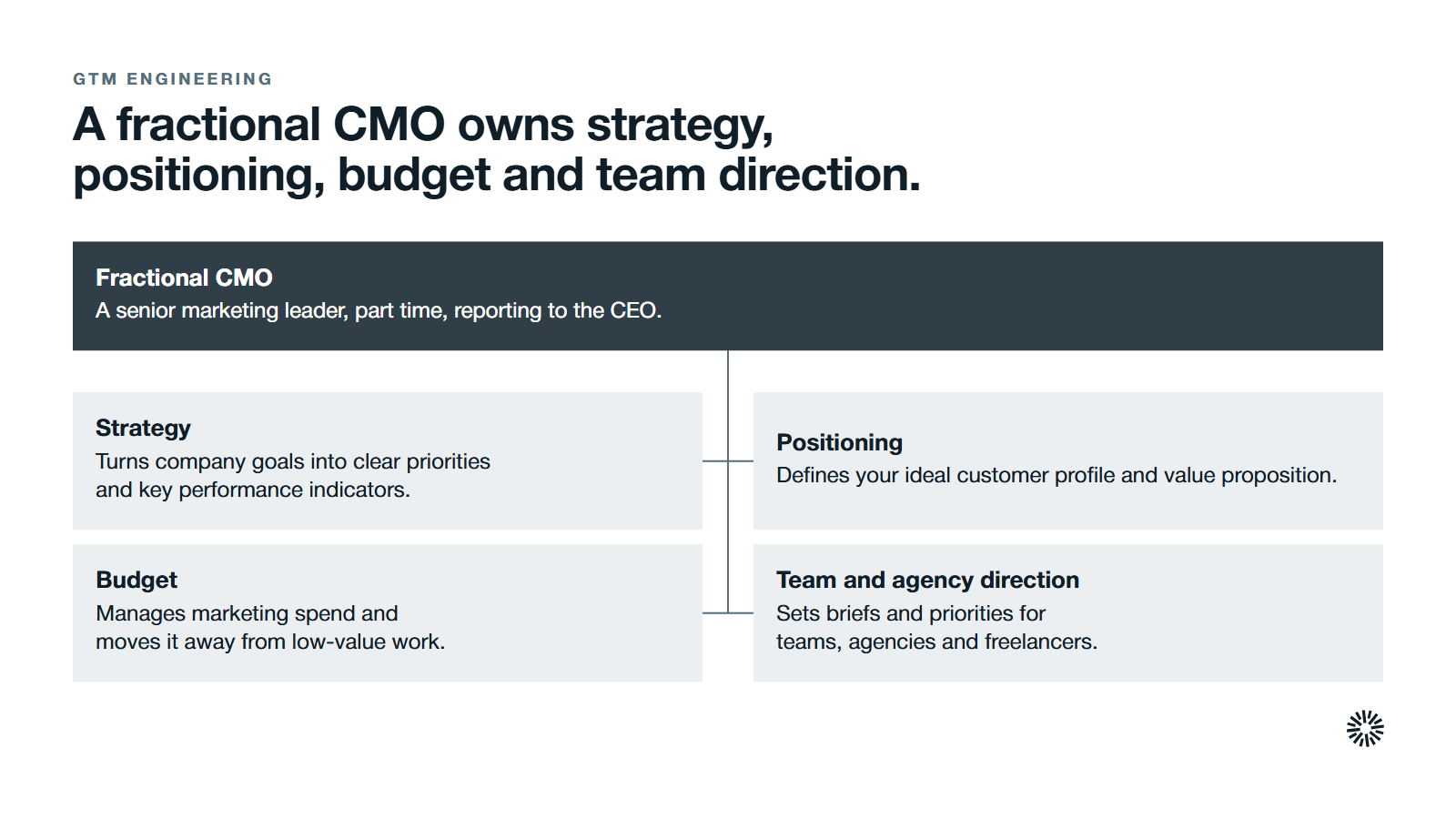
A fractional chief marketing officer is a senior marketing leader who leads the marketing function for your company on a part time basis. The usual pattern is a set number of days each week, often shared across several clients.
They report to the CEO and carry the same strategic remit as a full time CMO.
The word fractional means you buy a fraction of an executive's time, not of their judgment. You agree a defined number of days each week, and you get senior expertise without the full time cost of an executive on your payroll.
The engagement runs for a defined period, long enough to set strategy, build momentum and, when it makes sense, hand over to a full time marketing leader.
What a fractional CMO does week to week
The fractional CMO role is practical, not theoretical. In a typical week, a fractional CMO will:
- Define your ideal customer profile and value proposition using pipeline data, win and loss notes and competitor positioning.
- Turn company goals into a marketing strategy with clear priorities, a channel plan and key performance indicators that create accountability.
- Direct your internal teams, agencies and freelancers by setting briefs and priorities and managing marketing spend.
- Review results with you, move budget away from low-value work and keep marketing efforts tied to business goals.
- Mentor your existing team so its skills grow during the engagement.
The role centers on strategic vision and direction rather than hands-on production. A fractional CMO can oversee external agencies and check that their work lines up with your goals, but the day-to-day execution usually belongs to your team or your partners.
What fractional CMO services usually include
Fractional CMO services vary by company, but the core is strategy and leadership. Duct Tape Marketing's 2024 Fractional CMO Insights survey, which polled over 260 respondents, ranked strategic planning (92.67%), marketing strategy development (88.67%) and content strategy (82.67%) as the top fractional CMO services.
Most engagements also include a marketing roadmap, budget ownership, hiring and coaching support, digital marketing oversight and regular reporting to the CEO. The same survey found that over 70% of fractional CMOs had more than 10 years of marketing experience, which is the point of the model: senior judgment without a full executive package.
Who a fractional CMO suits
A fractional CMO fits growing businesses and medium sized businesses that need direction more than extra hands. Common situations include:
- Founder-led marketing that has hit a ceiling, with many tactics, no coherent story and no senior direction. Often the brand leans heavily on the founder's personal brand.
- A new market or product where positioning, messaging and pricing are still open questions.
- A small team that is busy but uncoordinated, facing marketing challenges that nobody owns.
- A significant shift, such as a new funding round or a departing marketing head, where the company needs steady leadership without losing momentum.
A fractional CMO sits at the C suite table without being a full time employee, and the commitment on both sides stays flexible.
Because fractional CMOs work with several clients at once, they also bring industry knowledge from other sectors and an outside view that is free of internal politics, which helps when you cannot tell what is working.
How a fractional CMO differs from a marketing agency
A marketing agency brings expertise in execution: campaigns, content, advertising, design. A fractional CMO focuses on strategic leadership: what to say, to whom, through which channels and with what budget. Many companies use both, with the fractional CMO setting the plan and directing the agency that carries it out. If you need a one-time market plan instead of ongoing leadership, go-to-market consulting is the closer fit.
What a fractional CMO engagement costs compared with a full time CMO
Fractional CMO cost depends on days per week, scope of work and the executive's market, so quotes vary widely. Some work by the hour or on a project basis, but a monthly retainer is common. The model exists because a full time CMO is a major commitment: salary, bonus, equity and benefits.
A fractional engagement gives you executive-level leadership at a part-time cost and a faster start than a full time executive hire. Agree a defined scope in writing before it begins, and ask what you will own when it ends. That is the fair way to compare offers, and it applies equally to GTM Engineering.
How to hire a fractional CMO well
Start by asking whether the role truly needs a full time executive or whether a fractional leader fits. Then name the outcome you need, such as a clear positioning or a plan the board can trust.
Next, assess experience and fit: ask for examples of work with clients at your stage and speak to some of those clients. Agree the scope and the reporting rhythm before the engagement begins, and check whether a full time hire would really serve you better.
What GTM Engineering is
GTM Engineering is the discipline that designs and builds the systems your marketing, sales and customer success teams run on. Where a fractional CMO decides which motion to run, GTM Engineering makes that motion work inside your tools, using HubSpot as the system of record.
A GTM engineer builds the enrichment, lead scoring, routing, lifecycle stages, automation and dashboards that let every team work from the same data. It is not brand or messaging work. It is system design for revenue, and the technical expertise sits on the execution side of the business.
The problem is common. Salesforce's 2025 MuleSoft Connectivity Benchmark found that the average enterprise manages 897 applications, yet only 29% are integrated. Disconnected tools are exactly where leads stall and reports disagree.
What GTM Engineering delivers
The outputs are concrete and durable:
- A lead lifecycle designed across marketing, sales and customer success and built in HubSpot.
- Clean data structures: lifecycle stages, deal pipelines and account and contact records without duplicates.
- Automation for routing, alerts, service levels and handoffs that matches how you actually sell and serve.
- Dashboards that show pipeline health, conversion and retention, not only channel activity.
- Documentation your teams can run after the project ends.
Fractional CMO vs GTM Engineering: how they compare
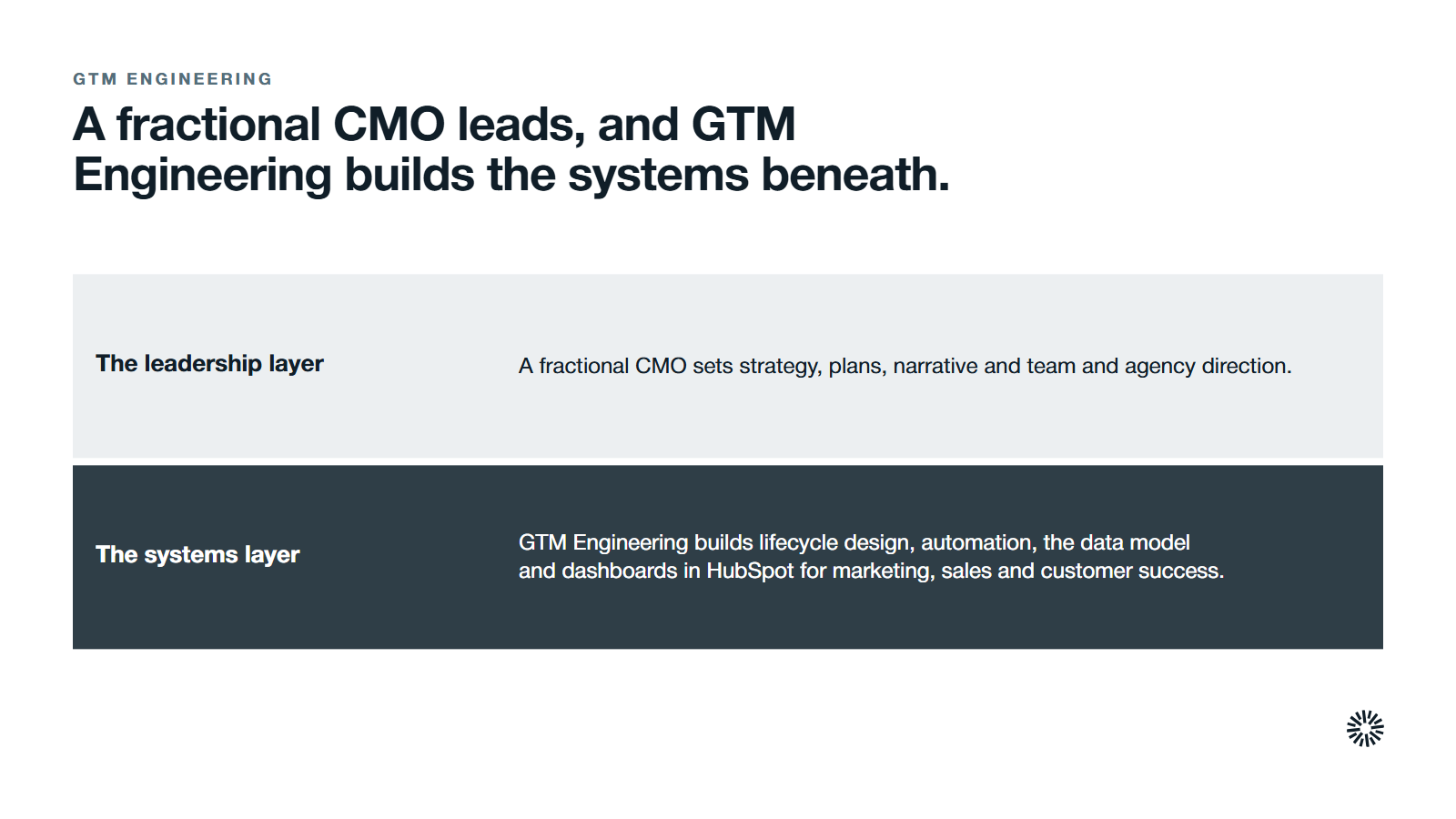
The two solve different problems and produce different outputs. The question is not which one is better. It is which constraint is costing you more right now.
| Criterion | Fractional CMO | GTM Engineering |
|---|---|---|
| Problem it solves | No senior marketing owner; unclear positioning, messaging and channel mix | Broken data, unreliable handoffs and disconnected systems across teams |
| Output | Strategy, plans, narrative, team and agency direction | Lifecycle design, automation, data model and dashboards in HubSpot |
| Scope across teams | Mainly marketing, with alignment to sales | Marketing, sales and customer success together |
| What you own afterwards | A clear positioning, a marketing strategy and a stronger team | A working revenue system and documented processes |
| What it needs from you | Access to leadership decisions and marketing resources | Decisions on lifecycle stages, definitions and who owns each handoff |
| Fits best when | There is no senior marketing leadership in place | Leadership exists but data and execution are inconsistent |
When to hire a fractional CMO first
If your main gaps are leadership, focus and narrative, a fractional CMO is likely your first hire. Look for these signs:
- You cannot say clearly who your best customers are, what they buy first and why they stay.
- Marketing is a list of disconnected tactics run by a small team or a marketing agency with no single owner of strategy.
- Your brand story, messaging and website feel generic or contradict each other across products.
- Sales leaders say leads are weak, but nobody has agreed what a good lead looks like.
- Your senior leadership or board wants a marketing plan and you cannot produce one you trust.
In that situation, systems work built too early can lock in unclear decisions. A fractional CMO can also start within days, which gives you time to decide whether you will later need a full time CMO.
When to choose GTM Engineering first
If you already have a CMO, a head of marketing or a strong fractional CMO, but you still cannot see what happens to a lead after handoff, the constraint is in your systems. Salesforce's 2024 State of Sales research found that only 35% of sales professionals completely trust the accuracy of their organization's data.
- Each team runs its own version of the truth in separate views and spreadsheets.
- Pipeline reviews become debates about whose numbers are right.
- Expansion and renewal are reactive because customer data is scattered.
- Leaders spend their time patching workarounds instead of improving the customer journey.
- You have execution capacity, but no reliable process for it to follow at scale.
How a fractional CMO and GTM Engineering work together
Many businesses at the growth stage need both, in sequence or in parallel. A typical pattern: the fractional CMO clarifies positioning, your ideal customer and the demand generation plan, then GTM Engineering builds those decisions into HubSpot so they can be executed and measured.
The reverse order also works. Sometimes you need clean pipeline visibility first, so a fractional CMO can make decisions from real numbers instead of guesses. If you want outside help designing that visibility, compare revenue operations consulting with GTM engineering.
Alignment matters in either order. HubSpot's 2026 State of Marketing survey found that 27.6% of marketers named sales-marketing alignment among their top challenges.
The two roles should agree together on lifecycle stage definitions, lead scoring criteria and how results are measured. Strategy without systems stalls. Systems without strategy automate confusion. This is why GTM teams need GTM Engineering alongside leadership, not instead of it.
What you gain when this is done properly
When senior marketing leadership and GTM Engineering are both in place, the effect builds across your revenue teams.
Sales gets a pipeline it can predict
Reps see qualified leads move through defined stages. Routing rules and alerts in HubSpot help them prioritize instead of guess. Forecasts become easier to trust because a lifecycle stage means the same thing to everyone in the room.
Marketing sees what actually works
With a fractional CMO owning strategy and GTM Engineering connecting activity to revenue, your marketing team can read campaign performance in HubSpot without rebuilding spreadsheets. It becomes easier to stop low-value work and put effort where it produces more leads and pipeline.
Customer success starts earlier and sees more
Shared data gives customer success a clear view of what was promised before the sale. Health signals, product usage and expansion triggers sit against each account, so your team can plan renewals and upsell using the same blueprint that drives acquisition.
How Propello works
Propello is a HubSpot-powered Go-to-Market Agency that designs and builds GTM systems on HubSpot.
Work starts with a GTM audit that shows where leads, data and handoffs break today, and it is designed to sit alongside your existing marketing leader, whether that is a CMO, a head of marketing or a fractional CMO.
Which one comes first for you
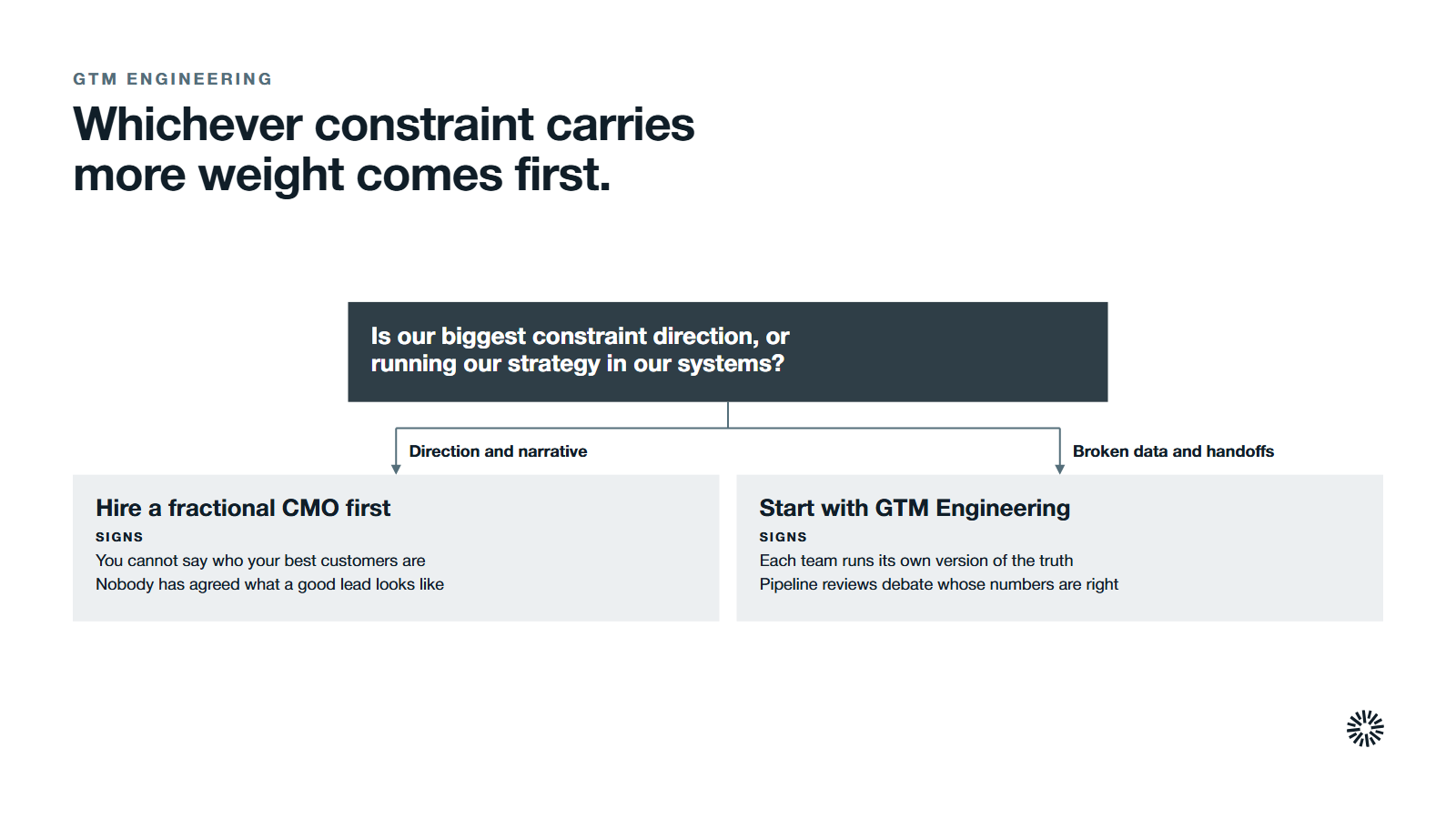
Sit down with your leadership team and ask one question: is our biggest constraint that we do not know what to say or where to focus, or that we cannot run our strategy reliably in our systems?
If the answer leans toward direction and narrative, hire a fractional CMO first. If it leans toward broken data, handoffs and reporting, start with GTM Engineering.
Whichever answer carries more weight comes first, with a plan to address the other soon after. Delay on either side slows your growth.
Propello designs and builds connected GTM systems on HubSpot. If you want to see where your systems are holding growth back, an audit is the place to start.