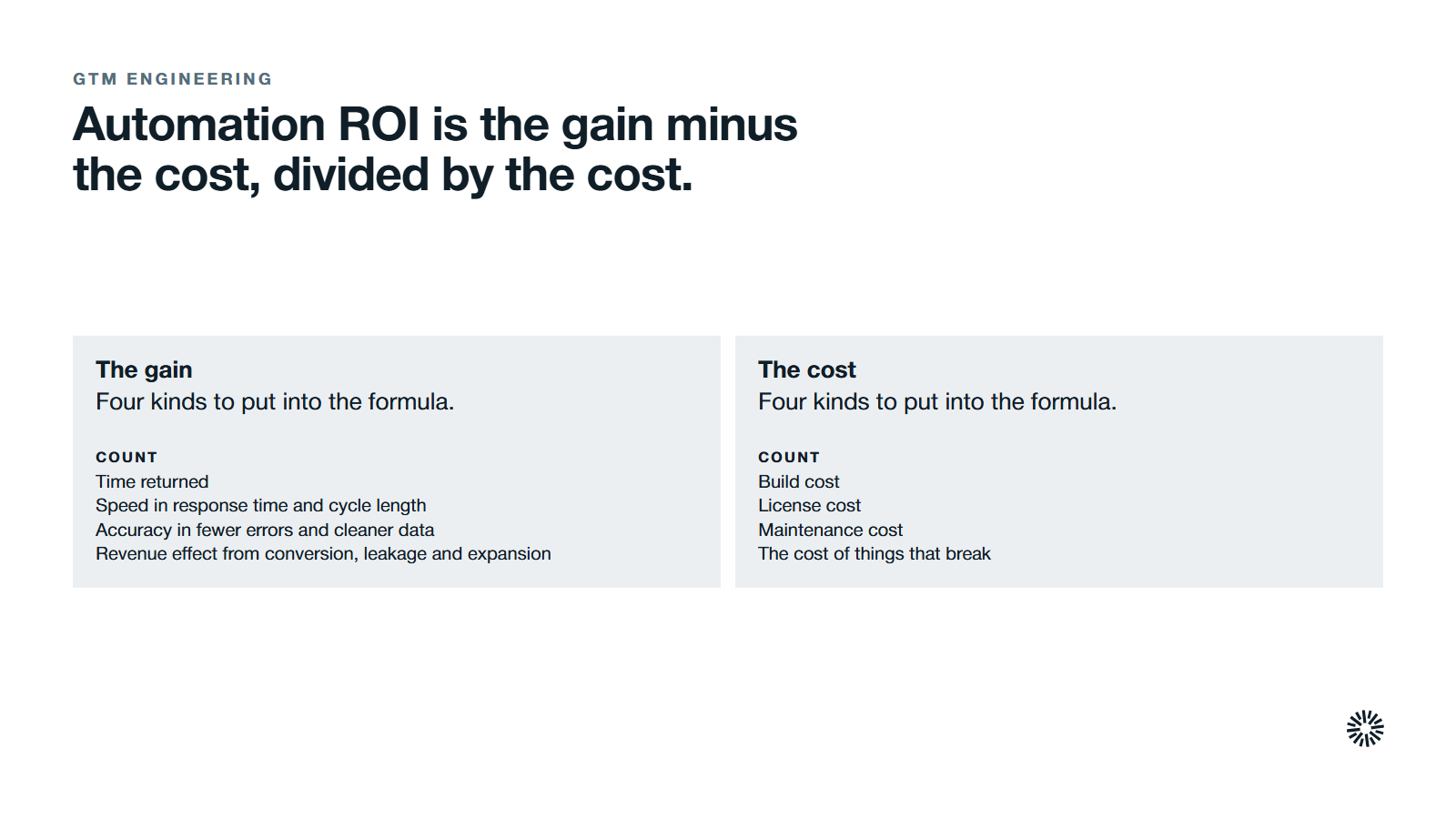
This guide is for CEOs, founders and revenue leaders who must justify automation spend to a board or a finance lead. Automation ROI is the gain from the automation minus its cost, divided by its cost. Go-to-market automation is harder to measure than that formula suggests, because teams, tools and seasons all move at once.
You will get four kinds of gain and four kinds of cost to put into that formula, a six-step method for measuring one workflow at a time, a worked example with illustrative numbers, and a simple register that keeps every automation accountable.
|
Automation ROI Automation ROI is the return on an automation, calculated as its measured gain minus its total cost, divided by that cost, over a stated period. |
How do you calculate ROI for automation?
ROI means return on investment. In words: compare total benefits against total costs by taking the gain, subtracting the cost, dividing by the cost, then multiplying by 100.
As an illustration, a gain of $3,000 against a cost of $2,000 leaves $1,000, a positive return of 50%. Each dollar spent came back with 50 cents on top.
The same ROI calculation works for sales automation ROI and marketing automation ROI. Only the inputs change.
There is no universal good number, so judge a result against the next best use of the money and the risk you took, not against a vendor headline. Check the payback period too: the months the net gain takes to repay the build.
Why automation ROI is harder to measure in go-to-market work
In a factory, one machine does one job and the output is easy to count. In a go-to-market system, several teams touch the same record, and many workflows share one GTM Engineering foundation in HubSpot.
That makes every part of the formula contestable. Finance will ask which automation caused the lift, so measure automation impact workflow by workflow. It will also ask how you split shared license costs and what else changed in the quarter.
Finance is not the only doubter. In HubSpot's 2026 State of Marketing survey, 33% of marketers named measuring the ROI of marketing activities as a top challenge.
Overlapping automations blur cause, a gain at one funnel stage feeds the next, and gains arrive after the build. None of this means you cannot measure. It means you should report an honest range, with the logic written down.
What you gain when this is done properly
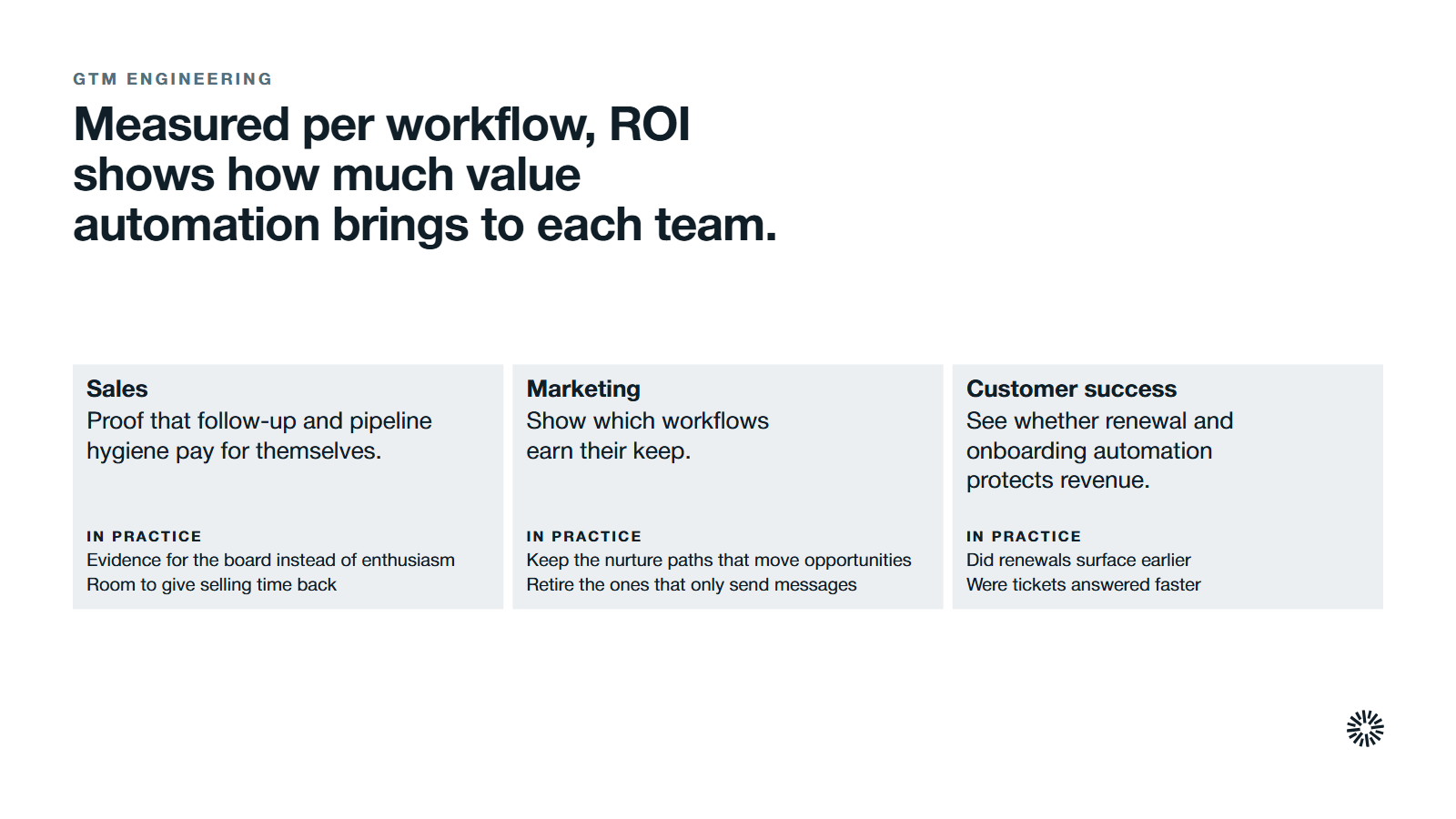
Measured per workflow, ROI shows how much value automation brings to each team and gives the board evidence instead of enthusiasm.
Sales gets proof that follow-up and pipeline hygiene pay for themselves
Salesforce's 2026 State of Sales report found that the average seller spends 40% of their time selling, so there is room to give time back.
Marketing can show which workflows earn their keep
Measured marketing automation lets you keep the nurture paths that move opportunities and retire the ones that only send messages.
Customer success sees whether renewal and onboarding automation protects revenue
Onboarding sequences, health alerts and renewal reminders are easy to defend and hard to prove. A baseline and a fixed window show whether renewals surfaced earlier and tickets were answered faster, which improves the customer experience.
The four kinds of gain to count
Direct benefits, such as salary savings, drive efficiency ROI and are the easiest to count. Indirect benefits, such as improved customer satisfaction, take more care. Give every gain a written rule that turns it into money, so finance has something to test.
Time returned, valued honestly
Pick the repetitive tasks the automation removes, such as manual logging, record routing and task creation. Measure the manual execution time before, using a short sample or HubSpot activity records, then multiply the hours by fully loaded labor costs.
Be strict about what time savings mean. Hours returned are a capacity gain. Automation savings become money only when the time is redeployed into paid work or the cost base shrinks.
Nucleus Research's 2021 review of 16 published ROI case studies found that deploying organizations redeployed 2.5 full-time equivalents on average, which is the kind of evidence to look for in your own team.
Speed in response time and cycle length
Speed is the gap between a signal and the action it should trigger, such as lead response time or sales cycle length, the critical paths of your revenue system. The metric that combines speed with deal value and win rate is sales velocity. Pull baselines from lifecycle, deal stage and ticket timestamps.
A Harvard Business Review audit published in 2011 covered 2,241 U.S. companies and found that only 37% responded to a web lead within an hour. Value speed through its effect on conversion, not as a separate line, or you will count the same gain twice.
Accuracy in fewer errors and cleaner data
Count the rework that disappears, such as mis-routed leads and duplicate records. Time it before the automation, then again after.
Cleaner data has a second value. Forecasts built on correct records need less fixing, an operational efficiency gain, and fewer human errors in consent and retention fields lower compliance risk.
Revenue effect from conversion, leakage and expansion
Revenue is where boards look first, and where claims about business impact are weakest. Credit the automation only with conversion changes you can tie to a specific rule or path, such as a new assignment rule or nurture sequence.
Leakage is revenue lost when follow-up was slow or missing. Expansion capture is revenue that renewal and cross-sell sequences surface, including the chance to upsell existing customers at the right moment. Count gross profit, not revenue, so the number survives a finance review.
The four kinds of automation costs to count
Many business cases count only license fees. Total costs fall into four buckets, and together they give an accurate picture. Software licenses belong in them, and so do staff training expenses, since training costs real time.
Build cost
Build cost covers the initial investment: solution design, technical requirements, GTM engineer time, workshops, configuration in HubSpot, testing and documentation. Internal time has an opportunity cost, so value it instead of treating it as free. Spread these upfront costs over the period you measure, such as twelve months.
License cost for your automation tools
Count software licenses for the automation tools involved: the workflow's share of your platform subscription, plus add-on subscription costs. Spread shared costs across your existing tech stack by seat, volume or usage.
Unused seats also inflate this line. Zylo's 2026 SaaS Management Index reported that license utilization went from 47% in 2024 to 54% in 2025, which suggests many organizations still pay for seats nobody uses.
Maintenance cost
Every workflow needs conditions updated and fields remapped when the data model changes. Keeping that upkeep under control is the topic of CRM governance for GTM workflows. Budget a few hours a month for each complex workflow.
The cost of things that break
Mis-routed leads, stuck deals and wrong emails consume RevOps time and can damage relationships. These hidden costs stay hidden unless you keep a short incident log for each automation.
Calculating automation ROI one workflow at a time
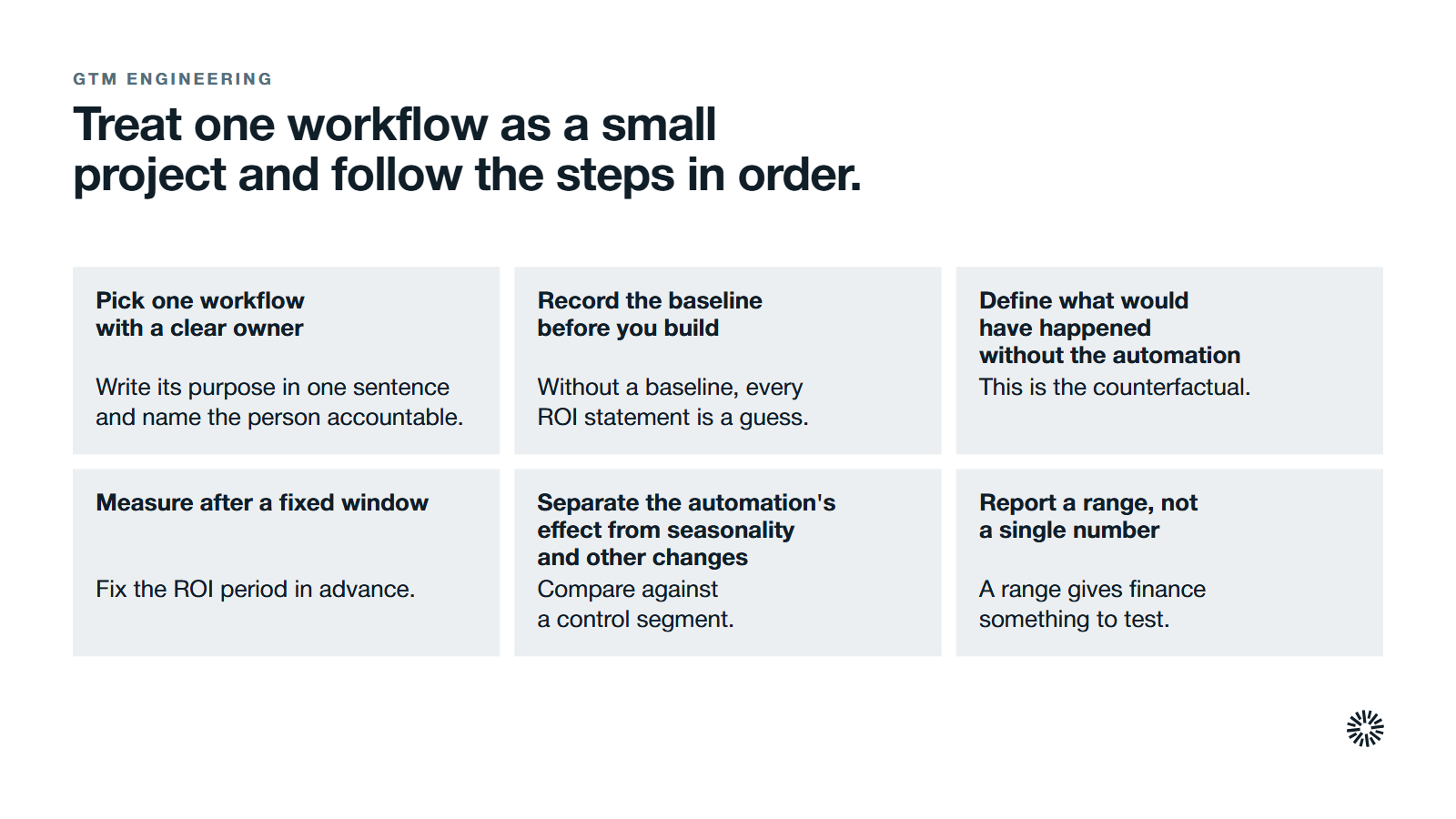
Do not measure automation in general. Treat one workflow as a small project and follow these steps in order.
Pick one workflow with a clear owner
Choose something that runs multiple times a week, so it produces data within a quarter, and is simple enough that everyone agrees where it starts and stops. Lead routing and demo request handling qualify. Write its purpose in one sentence and name the person accountable.
Record the baseline before you build
Capture the key metrics: volumes, time spent by role, cycle times, error rates and conversion at the stage the workflow touches. Without a baseline, every ROI statement is a guess.
Define what would have happened without the automation
This is the counterfactual. Use recent history from your existing systems, or a comparable segment that will not get the automation during the test. Agree these assumptions with finance before you show results.
Measure after a fixed window
Launch, then measure over an ROI period you fixed in advance. A quarter works for many teams, though a long deal cycle needs longer. Track metrics such as processing speed and added capacity, and write down any other process change made during the window.
Separate the automation's effect from seasonality and other changes
Raw before and after numbers mislead when pricing, campaigns or demand also changed. Compare against the control segment, adjust for known seasonal patterns, or normalize by total lead volume.
Report a range, not a single number
Present a low and a high case with every assumption labeled. Use a combined method: add time savings, accuracy gains and revenue effect together instead of relying on any single measure. A range gives finance something to test.
A worked example with one demo request workflow
These numbers are illustrative: an example of the method, not a benchmark, and your own figures will vary significantly.
Suppose you automate how inbound demo requests are routed, logged and followed up in HubSpot. The workflow handles 300 requests a month, and each used to need 10 minutes of manual work. Your loaded labor cost is $50 an hour.
Time returned. Manual work was 50 hours a month. The automation removes 60% of it, which is 30 hours, worth $1,500 a month if the time is redeployed. In the low case you count none of it.
Accuracy. Mis-routed requests fall from 12% to 3%, which is 27 fewer a month. Each cost 15 minutes to fix, so about 7 hours are saved, worth roughly $340 a month.
Revenue effect. Response time falls from hours to minutes, which you price only through conversion. Demo-to-opportunity conversion started at 20% in both segments. The control segment moved to 21%. The automated segment moved to 22% in the low case and 23% in the high case, so the attributable lift is 1 point or 2 points.
That is 3 to 6 extra opportunities a month. With a 25% close rate and $4,000 of gross profit per deal, that is $3,000 to $6,000 a month.
Cost. Build of $12,000 spread over 12 months is $1,000 a month. Add $250 for the license share, $250 for maintenance and $150 for breakage. Total: $1,650 a month.
Result. The low case gains $3,340 a month, which gives an ROI of about 102%. The high case gains $7,840, which gives about 375%. Report it as roughly 100% to 375%.
Now look at the weak point. If the revenue lift were zero, the same workflow would gain about $340 against $1,650 of cost, an ROI near negative 79%. The case rests on the revenue effect, so that is the number finance will test hardest.
Common mistakes that inflate your automation ROI
Overstated savings make the next budget request harder. * Do not treat every freed hour as saved money. Show where the time went.
- Do not credit automation with all revenue growth when pricing, headcount or offers also changed.
- Do not ignore maintenance and failure costs, which tend to grow over time.
- Do not stop early. A short horizon can misstate the true return.
- Do not fold morale or customer satisfaction into the dollar figure. Describe them in words beside it.
Vendor-style numbers deserve the same caution. Nucleus Research's 2021 review reported that marketing automation returned $5.44 in benefits for every dollar spent over three years, with payback under six months.
That is a benefit-to-spend ratio from published case studies, not an ROI in the formula's sense, because it does not subtract the cost.
When automation ROI is negative
Sometimes an automation costs more than it returns. Finding that out early is useful.
Return is usually negative in four situations: the process is rare, so there is little volume to save; the process is broken, so you are making a bad step faster; the workflow is over-built for edge cases; or nobody owns it.
Your options are to switch it off, simplify it, fix the underlying process first, or re-scope it to a part of the funnel where volume justifies it.
Calculate test automation ROI for the changes you ship
Some teams mean something narrower by the phrase: test automation, where automated tests check that a workflow still works before it goes live. The method is the same. Count the manual testing hours the tests replace and the cost of maintaining test scripts and test cases. Strong test coverage lowers the risk of hidden problems and shortens the release cycle, so faster releases follow and release frequency rises.
Keep an automation register finance can trust
A register is one list of every automation running in your GTM systems. Small businesses can keep it in a single spreadsheet. Without it, nobody can say how many workflows are live, who owns them or what they cost.
For each automation, record: * Owner and purpose. A named person and one sentence on what the workflow is for.
- Cost. Build hours, monthly maintenance hours and the license share.
- Measured effect. Which gain types apply, the last measured ROI range and a link to the analysis.
- Review date. When it was last checked and when it is next due.
Review the register every quarter with RevOps and finance. Retire anything with no owner and fix anything with negative ROI. Compare automation efforts across teams on the same terms.
Align your automation strategy with business goals
Measured returns support informed decisions about where to invest next. Maximizing ROI means funding the automation initiatives with a clearly positive range and fixing or retiring the rest. Automation also gives you scalability and flexibility: a proven workflow handles more volume as demand shifts, without more headcount. The next business case then writes itself.
If marketing workflows return well but sales follow-up does not, the process or the data is usually the problem, not the tool. To see how this fits a wider system, read how a sales productivity machine works and what marketing automation is.
Propello designs and builds connected GTM systems on HubSpot. If you need to show a board what your automation is returning, an audit is the place to start.